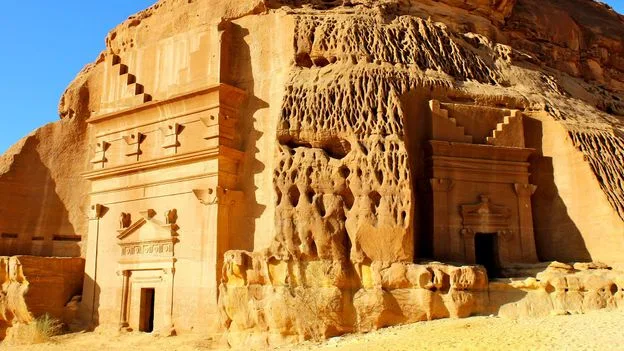
Deep in the Saudi Arabian desert lies Madain Saleh, the second-largest city of the ancient Nabatean empire and a UNESCO World Heritage Site. While Petra in Jordan draws crowds, this silent city remains largely unknown, preserving its monumental rock-hewn tombs in stunning condition.
The Nabateans built their wealth on controlling desert trade routes and water resources. Madain Saleh was a key stop on the spice route, where camel caravans paid taxes for water and rest. However, after the Roman annexation in 106 AD, land routes declined, and the city was gradually abandoned.
Today, the site features over 131 tombs carved into golden sandstone outcrops. Intricate carvings of eagles, sphinxes, and griffins adorn the facades, while Aramaic inscriptions reveal details about Nabatean society. One tomb bears the name of Hany son of Tansy and the sculptor Hoor, dated to April 31 AD.
Unlike Petra, Madain Saleh sees few visitors. Muslims often avoid the site due to beliefs it was cursed, and tourist visas for non-Muslims have been historically difficult to obtain. This lack of foot traffic, combined with the dry desert climate, has left the city remarkably well-preserved.
The silence at Madain Saleh is overwhelming. From the tomb of Qasr al Farid, visitors can see only their own footprints disturbing the sand. The site offers a rare glimpse into a lost kingdom, untouched by modern tourism.