The first book I ever picked up willingly was Bridget Jones’s Diary. I was 19, and until then my loyalties lay with football, Baywatch and a boy called Robin Budd in the year above. Given a choice between a book and a blank wall, I would have gone for the wall.
After my A-levels, I landed a job at a barbecue restaurant in Portsmouth. That’s where Bridget Jones found me, in the staffroom. I read a few pages, then more. It felt like meeting someone, like being in a relationship. I started cancelling evenings out to read in bed. My mother thought I was depressed.
It hardly matters what first lights the fire. Jeanette Winterson had Deuteronomy; David Nicholls had Tales from Moominvalley. For me, it was Bridget Jones. Through my 20s I worked as a carer, reading and scribbling on the side. Seven years ago, I became a published author. It’s no exaggeration to say Bridget Jones changed my life.
So when I learned that 2026 had been declared National Year of Reading in the UK, and that Rabat was to be this year’s Unesco World Book Capital, I threw some books in a bag and flew to Morocco’s capital. I hoped for culture and maybe a tagine in this ancient, scenic city between Casablanca and Tangier.
A capital built by the French
Rabat has been Morocco’s capital since 1912, when the French protectorate began. My first glimpse was the Ville Nouvelle, the New Town laid out in the 1920s in a French style, a world away from the medieval medina nearby.
At the solar-powered Mohammed VI Museum of Modern and Contemporary Art, the permanent show, Shifting Horizon(s), does what it promises. I was struck by Mohamed Melehi’s abstract paintings and a photograph by Lalla Essaydi from her Bullet Revisited series. It depicts a woman covered head to toe in gold bullets – a devastating indictment of violence against women.
Medina and kasbah
Walking north into the medina, I found a maze of narrow streets lined with shops selling mint, slippers, strawberries and sabon beldi, the black olive-based soap. The medina was busy but calm. No one tried to sell me a carpet or tempt me with sardines. In fact, I felt almost invisible – customer service, I thought, could not have been more French.
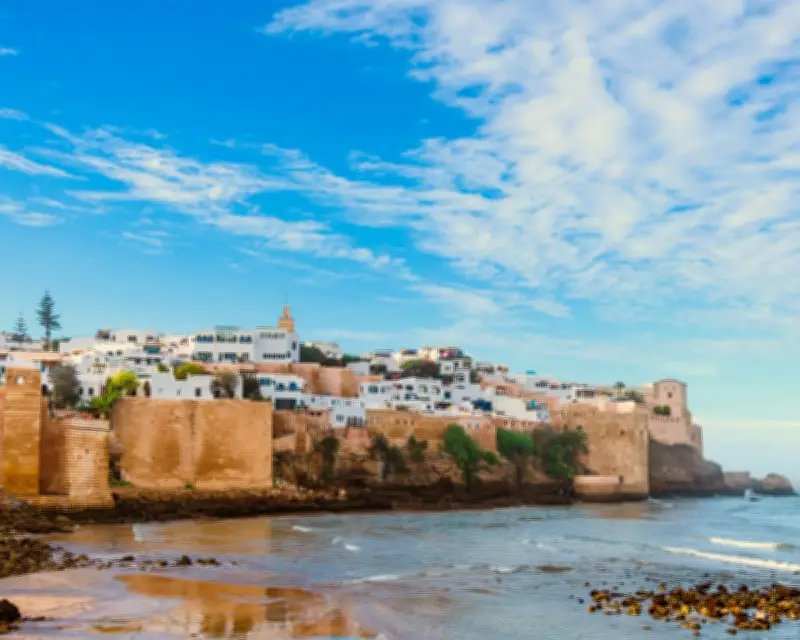
Following my nose took me to the Kasbah of the Oudayas, an enchanting quarter of low whitewashed houses on high ground above the ocean. This former royal citadel was perfectly placed to spot arrivals on the horizon. After checking into a riad on Rue Bazou, I walked down stone steps to a modest curve of beach where people played football and volleyball. I climbed the breakwater and watched a neon sun sink slowly as a lone surfer waited for the perfect wave.
A tagine and a diver
At the Relais Marin restaurant beside the beach, I ordered tagine. The dish had lamb, almonds and prunes in a gravy that had reduced to a bold, pesto-like sauce. I mopped it up with khobz, the Moroccan flatbread, and could easily have had a second.
Next morning, at the Cafe des Oudayas by the Andalusian Gardens, with its orange and pomegranate trees, I drank mint tea and ate biscuits. From the terrace, I watched a boy stand on a rock 30 metres above the Bou Regreg river. Encouraged by his friends, he hesitated for minutes in the sun. When he finally leapt, the dive was a wide, graceful arc – almost unreal. He surfaced to mockery: “La poule a attendu une éternité!” Lads, eh?
Tuk-tuk detour and Chellah
On a whim, I took one of the city’s 60 electric tuk-tuks. I asked the driver to head to the Chellah, a medieval necropolis also containing the remains of the Roman city Sala Colonia. He decided to show off his home town first, passing St Peter’s cathedral and a club called Amnesia, where Morocco’s king is said to have danced when he was a prince.
The Chellah was worth the detour. After exploring the ruins, I climbed to a cafe above the site and ordered couscous. It arrived as a pyramid of seven vegetables, surrounded by a moat of couscous, with a jug of broth and hidden meat. It was unmistakably good.
A pint on the Bou Regreg
If you want a beer in Rabat, Le Dhow is the place – a bar and restaurant on a boat moored below the kasbah. Up on deck, I drank an ice-cold pint and talked to a British undergraduate from the Université Internationale de Rabat. Did she feel at ease in the city? “It’s been fine,” she said. “Some men have said hello. One asked for a photo. To be honest, I’ve experienced a lot worse in Worcester.”
Don’t go for the books
Let me be direct: don’t visit Rabat simply because it is this year’s World Book Capital. Despite my efforts, the exact programme of its 300-plus events remains a mystery to me. Go instead because Rabat is a fine city. C’est simple.
On my final evening, I stumbled upon a small medina bookshop, Bouquiniste El Azizi. Among the hundreds of second-hand books were a dozen or so in English. One was Bridget Jones’s Diary. I picked it up, read a few pages, and put it back – leaving it for someone else to discover and perhaps break their reading duck.
As I left, I noticed a sign: “Les livres prennent soin de nous.” Books take care of us. That strikes me as the right note to end on.
Ben Aitken is the author of Shitty Breaks: A Celebration of Unsung Cities, £9.99. To support the Guardian, order your copy from guardianbookshop.com; delivery charges may apply.