Fresh from a painful break-up, Liz Connor heads to India, Eat, Pray, Love style, to the dazzling birthplace of Sikhism, where a restored Maharaja's palace proves the ideal place to recharge her soul.
Perhaps it’s the Eat, Pray, Love effect, but ever since Julia Roberts kicked off her ballet flats and went in search of a post-divorce glow-up at an ashram in Delhi, solo female travellers have been setting their coordinates to India. Having just turned 37 and emerged from a cataclysmic breakup myself, I was what you’d class as an ideal candidate for some spiritual awakening. Just one conundrum, where to go?
A Fortress of Restoration
Seasoned Indiaphiles who’ve been there and bought the Ganesha trinkets will urge you to stray far away from the well-trodden Golden Triangle of New Delhi, Agra and Jaipur, insisting the further-flung the destination, the richer the cultural experience. So when I heard about a restoration project involving a once-ruined Maharaja’s fort-palace in Patiala, a lesser-known city in Punjab — the region where Sikhism was born — it seemed like the ideal pin drop to sink myself into the country’s riches.
As my car snaked through Patiala’s dense grid of noisy market stalls and rolled into a gated stone fortress sealed away from the sound of honking tuktuks, it was clear I was firmly off the backpacker trail. It was here I caught my first glimpse of Ran Baas The Palace, its traditional Araish plasterwork gleaming as white as coconut lassi. Once the Maharaja’s ladies’ guesthouse, this former royal residence forms part of Qila Mubarak, a sprawling 10-acre fort complex founded by Baba Ala Singh, the first Maharaja of Patiala, in 1763. The palace and its fortifications were passed down a lineage of male rulers over the centuries, before falling into ruin after the reign of the eccentric Maharaja Bhupinder Singh in the 1930s, a friend of Queen Victoria’s who was famed for his extraordinary wealth and love of lavish court culture.
A sense of this old-school grandeur can be felt the moment you step foot in the palace’s scalloped, surkhi-plastered entranceway, flanked by Sikh guards in sherbert-pink sherwanis and traditional Punjabi dhol drummers. Watching my suitcase get whisked away across a preened court, with its intricate stucco-work archways glinting in the midday sun, it’s hard to believe that this stately palace was in ruins just a decade ago. That was, until hotelier Priya Paul and conservation architect Abha Narain Lambah stepped in to pull the building out of disrepair, with a mammoth restoration project helmed under The Park Hotels portfolio.
Opulence and Spiritual Riches
The dazzlingly spacious suites (35 in total) and decadent dining spaces, with their playful contemporary design touches like hand-painted de Gournay wallpaper and dangling glass light fittings from local studio Klove, inspired by Punjabi’s famous Lotan chandelier-style earrings, are a lesson in tasteful opulence. Our afternoon began with high tea on the roof terrace, sipping kulhars of homemade hot chai and watching the sun dip behind the silhouette of the historic Qila Androon palace. As a sitar strummed peacefully beside us, our concierge Sonu regaled tales of the flamboyant Maharaja Bhupinder Singh’s love for excess in the gilded 1920s (apparently, he once commissioned Cartier to create an eye-wateringly expensive Patiala necklace containing almost 3,000 diamonds — part of which YouTuber Emma Chamberlain wore as a choker to the 2022 Met Gala).
Bling really was his thing, and nowhere is that clearer than in the palace’s Rang Mahal, a royal room adorned with thousands of tiny Belgian glass mirrors and delicate frescoes, some dating back over 600 years, which has been transformed by Paul’s team into an immersive dining experience. Over candlelight and traditional Patiala gharana music, we worked our way through a thali of creamy, slow-cooked dal makhani, flaky rotis and spiced seekh kebabs, chased by a stiff Patiala peg — a famously oversized whisky measure, which is served neat in the hotel’s moody, velvet-clad bar.
The next day, our hangovers were firmly shaken off with a bumpy tuktuk ride, battling the stifling Punjab heat to reach Shri Kali Devi Temple; an intricately carved sanctum built by the Maharaja in 1938, its gem-like dome gleaming gold in the sun. Here, families gather with their children, mouthing prayers before shrines and ritually dipping their feet into the temple’s sacred bathing pool. Nobody appeared to mind outsiders stopping to observe worship; one family even called us over to sit cross-legged under the temple’s colonnade and explain where we’re from.
A City of Contrasts and Calm
Back at Qila Mubarak with our spiritual cups filled, we crossed the fort’s forecourt to pore over Maharaja Bhupinder Singh’s personal collection of artefacts, now housed in a new museum inside the fortress walls that has only recently opened to the public. His fascinating hoard includes ceremonial weaponry, a silver gilt horse-drawn carriage and paintings charting his friendship with Queen Victoria, plus remnants of his fleet of vintage Rolls-Royces. He’s said to have bought 22 of them outright, after a dealer slighted him at a London showroom. As revenge, Singh had the cars shipped to India and put them to work as bin trucks, collecting rubbish through the streets of Patiala — a deliciously petty move that reportedly had the carmaker apologising within the year.
Outside the palace gates, the city is a patchwork playground of fragrant spice markets stacked with saffron and cardamom, tailors’ stalls draped in phulkari embroidery and street hawkers cooking up hot pakora and rich curries. For a breather from the colour and chaos, seek out peace at the nearby Baradari Gardens, the Maharaja’s former private retreat, with its lush lawns and shaded avenues offering a place for silent contemplation.
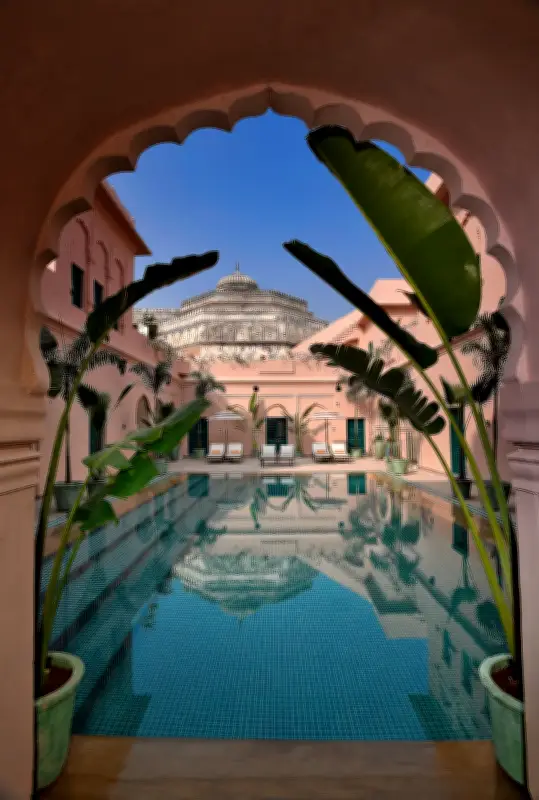
We returned to Ran Baas later that evening, armed with reams of Phulkari fabrics and jewelled juttis (shoes), to settle into the type of massage that unknots months of desk-hunched shoulders, before slipping into an outdoor swim as the light faded over the surrounding fort walls. This, I realise, is the real lure of Patiala — a grown-up way of interrogating India, without the need to drop your bags in a dirt-under-the-nails hostel dorm. Well, if you’re going to have a post-breakup reckoning anywhere, you might as well have it in a palace.