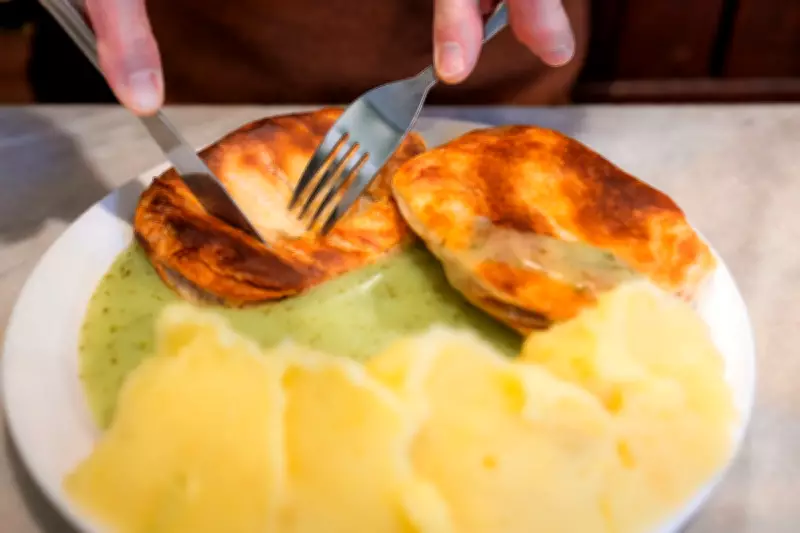
London's Traditional Pie and Mash Faces Social Media Survival Test
In an era where visually stunning dishes dominate social media feeds, London's most traditional meal – pie and mash – presents a stark contrast. This unapologetically beige institution, consisting of a suet-bottomed pie, plain mashed potato, and vivid green parsley liquor, was designed for sustenance rather than aesthetics. Yet its survival in the digital age may depend on the very platforms often accused of eroding culinary authenticity.
A Shrinking Tradition
Recent reports indicate that barely 30 pie and mash shops now remain in London, representing a significant contraction for a dish that once sustained hundreds across the capital. Few foods are as tightly bound to London's identity as this working-class staple, which carries geography, class, and memory in equal measure. Like many culinary traditions associated with the urban poor, its reputation now oscillates between nostalgia and obituary.
James Dimitri, an influencer who has visited every pie and mash shop in London, offers a more optimistic perspective. "Most of the shops that were going to die out have already died out," he explains. "Most of the ones that are left are packed. There are even some newer shops that have opened in the past few years."

Historical Roots and Evolution
The dish's origins trace back to Georgian and early Victorian London, where pies served as portable street food sold by roaming "piemen" to labourers with neither time nor money for proper meals. Early versions commonly featured eels from the Thames before evolving into the now-familiar combination of minced meat pies, mash, and liquor codified by Robert Cooke in 1862.
Traditional pie and mash shops developed distinctive interiors with tiled walls, marble tables, and gilt lettering – aesthetic features that modern restaurants often spend fortunes attempting to replicate. These spaces come with their own quiet rules: eating with fork and spoon only, mandatory salt and white pepper, and the proper technique of flipping the pie upside down to add chilli vinegar.
Social Media as Survival Tool
At Noted Eel & Pie House in Leytonstone, 28-year-old Alfie Hak represents something increasingly rare in the pie and mash world: succession. As the fourth generation of his family to work in the century-old business, Hak recognized early that social media was not optional but essential infrastructure.
"Everyone says you've got to be on TikTok nowadays," Hak explains. His account, That Pie Guy, now boasts more than 126,000 followers, with videos of pie assembly and shop lore routinely attracting vast audiences. "People would come into the shop and say, 'I saw you on TikTok, I wanted to come down.' It's working, basically."
Hak frames digital invisibility as a decisive factor in shop closures. "If you were to look at the last 10 or 15 pie shops that have closed in London, nine out of 10 of them would be ones with zero social media, zero online presence."
Generational Challenges and Changing Demographics
Many remaining pie and mash shops face a quiet generational problem: family-run businesses without willing successors. Older owners often operate in marketplaces they barely understand, lacking knowledge of social media or delivery platforms like Just Eat and Deliveroo.
Social media has transformed customer demographics at surviving shops. While traditional regulars still visit, Hak notes the arrival of "new Londoners": younger customers who actively seek out pie and mash rather than stumble upon it, along with international tourists from Italy, France, America, and China.
Preserving Authenticity in a Digital World
Despite social media's commercial benefits, Hak emphasizes that pie and mash was never built for spectacle. "It was a food for the poor and the working class of London. It's not supposed to be anything special... I don't want people to expect to come in and have their minds blown by how flavoursome it is because it's just comfort food."
Dimitri echoes this sentiment: "It's not supposed to be elevated. Even when it's bad, it's not awful, and when it's good, it's not going to blow you away. Every cuisine around the world has dishes like this."

What emerges is not a simple story of decline or revival, but rather a tradition negotiating relevance in a constantly changing city. Pie and mash has always been aesthetically unbothered. What threatens it is not ugliness, but obscurity. And thanks to the very platforms accused of eroding culinary authenticity, obscurity is, at least for some shops, no longer inevitable.