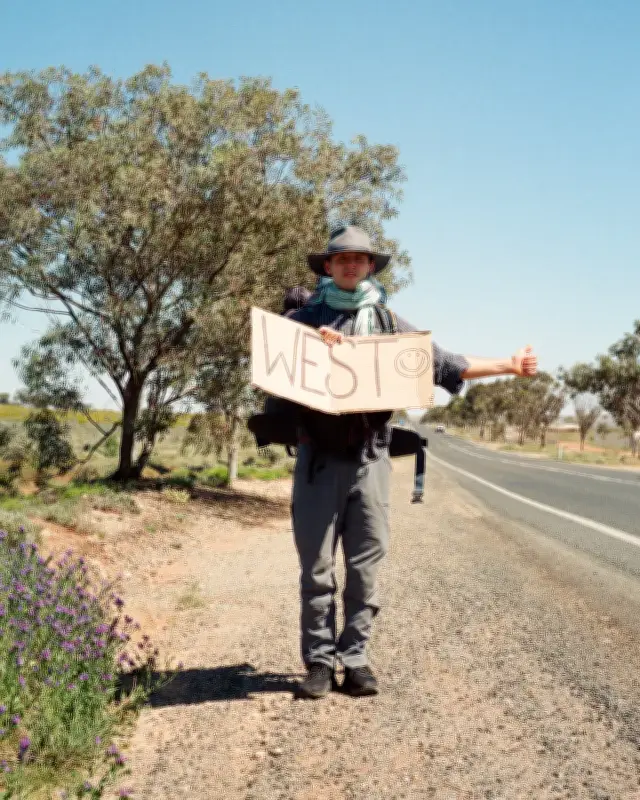
Aston Brown hitchhiked from Sydney to Perth, a journey of 4,360km across the most isolated inhabited continent on Earth, finding comfort in the company of strangers. The trip, which took him through New South Wales, South Australia, and Western Australia, was marked by a series of rides from diverse drivers, each offering a unique perspective on life in Australia.
The Art of Hitchhiking
Brown describes hitchhiking as a subculture, an art, and a way of travel that satisfies wanderlust like no other trip, and it costs nothing. He is drawn to the idea of abandoning control and finding comfort in a stranger's company. Once a popular way to travel in the 70s and 80s, it's now rare to see a hitchhiker on Australian roads, partly due to its association with serial killer Ivan Milat, who murdered several hitchhikers in the early 90s.
Australia is also one of the few countries that make it legally fraught to hitchhike, with laws explicitly naming it as an offence, though legislation differs between states and territories. According to Hitchwiki, most jurisdictions essentially prohibit a pedestrian from standing on or moving on to a road to hitchhike, though the wording varies. However, in the ACT hitchhiking is legal in most circumstances, and Tasmania removed any reference to it from its road rules in 2019.
Signs of a Comeback
Despite safety and legal baggage, there are signs hitching is making a comeback. Online resources such as Hitchwiki and its offshoot Trustroots, which has more than 120,000 members, are steadily growing. According to the University of Western Australia's Dr Fang Liu, who studies adventure tourism, social media accounts sharing extreme ways of travelling are demystifying and normalising hitchhiking.
"Young international travellers are seeing people online and think, 'Oh, I can do that too,' but they may be unprepared and unaware of the risks," she says. "In a lot of places there's no [phone] signal and you might have to wait hours for someone to stop. By then you've probably already dehydrated. Social media doesn't convey that."
Encounters on the Road
Brown's journey began outside Broken Hill in outback New South Wales, where he waited just five minutes before an SUV offered him a ride. Inside was Miranda and her two children, originally from Zimbabwe, who had immigrated to the US a few years ago but left due to gun violence and immigration crackdowns. "I never would have picked up someone there, but here we feel so safe," Miranda said. They now live in the regional Queensland town of Chinchilla, where Miranda says they've been embraced by the community.
Later, Brown rode with Mike, 67, a retired tractor restorer, who said, "You're the first hitchhiker I've seen in decades. Milat probably changed things." Ivan Milat was convicted of the murder of five female and two male backpackers between 1989 and 1992 in NSW, several of whom had been hitchhiking. Brown acknowledges the inherent risks of hitchhiking but notes that as a white male, his risks are not the same as those a woman or female-presenting person might encounter. He follows safety rules, standing well off the road in places with good visibility and enough room for cars to pull over.
The Final Stretch
Brown's last driver was Doug Hilton, the boss of Australia's national science agency, CSIRO, who was driving 500km west to Albany. Doug, 62, was passionate about moths, and on his way to meet with two Menang Indigenous elders who co-authored a paper with him about moths in the region, including three newly discovered species of primitive jaw moths. Brown joined him for bird watching, where they saw one of Australia's rarest birds, the noisy scrubbird, presumed extinct until it was rediscovered in 1961.
After reaching Albany, Brown took the bus for the final six hours to Perth. He reflects that despite the distance, he rarely felt alone. Throughout his journey, he met a 79-year-old widower named Neil, who drove him 1,900km over three days, and shared his motto: "If you never go, you never never know." Brown's experience underscores the unique connections that hitchhiking can foster, even in a country where the practice is rare and fraught with legal and safety concerns.