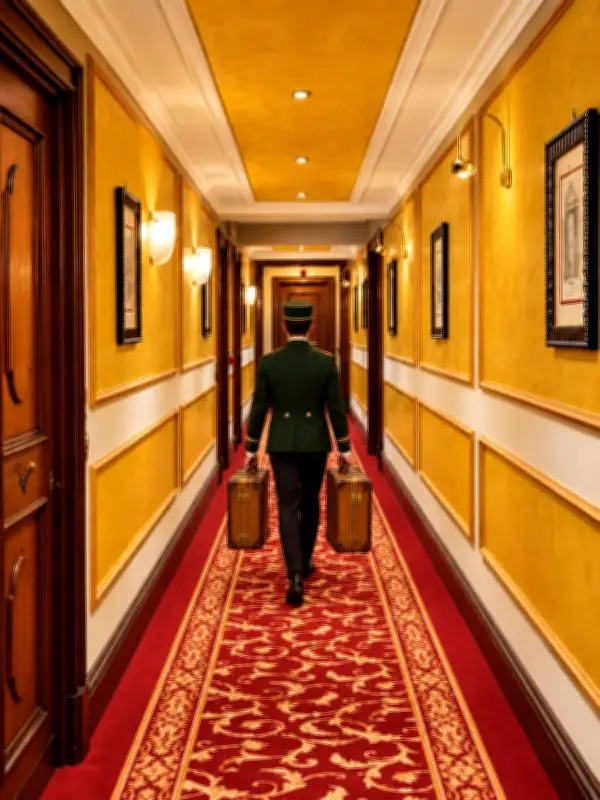
Verona's Due Torri hotel, a member of The Leading Hotels of the World, offers a journey through centuries of history, from medieval masonry to a mid-century circus-themed basement, all while housing a kitchen that impresses with modern Italian cuisine. The hotel, which counts Maria Callas among its former guests, is a palazzo that rewards wandering and reveals its considerable pleasures gradually.
A Suite Fit for a Diva
The experience begins with a room change to the Maria Callas Suite. Giorgia Gazzuola, who oversees sales and marketing and has worked at the hotel for fifteen years, explains that Callas would greet her fans from the suite's balcony. The suite offers more space and character, with antique furniture featuring strange faces and high-collared bathrobes.
One floor down lies the S. Anastasia Presidential Suite, a 100-square-metre residence on its own private floor. Giorgia mentions a couple who booked it for three weeks to celebrate the wife's eightieth birthday.
History and Art Around Every Corner
The hotel occupies the fourteenth-century Palazzo dell'Aquila, an inn since 1674. Thirteen-year-old Mozart stayed with his father in 1769-70. In 1867, Garibaldi addressed the Veronese from its balcony. During the Second World War, three ministries of Mussolini's Republic of Salò occupied the building. Its next great reinvention came on New Year's Eve 1958, when Enrico Wallner reopened the hotel, commissioning much of the exuberant decoration that survives today.
In the extended foyer, ammonites fossilised into the floor tiles reward looking down, while oils on the ceiling belong to a collection of sixteen allegories by the seventeenth-century painter Francesco Barbieri. Below, Pino Casarini's exuberant frescoes transform the basement Arena Casarini into a procession of acrobats, clowns, dancers, and performing animals. The room was part of Wallner's 1958 reinvention, when Casarini, also a set designer for the Verona Arena, was commissioned to turn the basement into a theatre. The murals disappeared behind partition walls for decades before being uncovered and restored in 2015. Today the room serves as a meeting and conference space.
A Culinary Awakening
The greater surprise is dinner at Bistrot al 2, occupying the Sala dell'Aquila, conceived with Gualtiero Marchesi in 1977. The kitchen is now led by Salvatore Garofalo, whose roots are in Calabria and Puglia, with a culinary education in Parma and a stint in Queensland.
Highlights include a carrot tartlet with pumpkin and an onion filling, and a spaghettone with soured butter, Calvisius caviar, and katsuobushi flakes. The soured butter gives the sauce a wonderful citrus lift, with an almost miso-like savouriness. Langoustine follows with foie gras, yuzu, beurre rouge, more caviar, and crisp bread, with yuzu running through the meal as a recurring idea.
Service occasionally loses its rhythm, but maître d' Marie-Claire's warmth and attentiveness give the evening its human dimension. The petits fours include Cuba Libre macarons with a properly assertive pinch of salt, miniature chocolate cakes, and crisp coffee chocolates embossed with the Due Torri logo.
A Sleeping Beauty Awaiting Investment
Due Torri presents its own eccentric accumulation of centuries: medieval masonry, a mid-century circus, operatic glamour, contemporary art, and a chef unafraid of Japanese ingredients. The hotel embodies what makes Italy compelling: history is not merely preserved but continually inhabited, embellished, and occasionally contradicted.
The hotel has something of a sleeping beauty about it, although waking this particular princess will require considerably more than a kiss. It needs sympathetic investment, a coherent vision, and a renewed sense of what five-star hospitality should mean. Yet there is something to be said for visiting now, before a future refurbishment risks ironing out the eccentricities which make it such a beguiling time capsule.