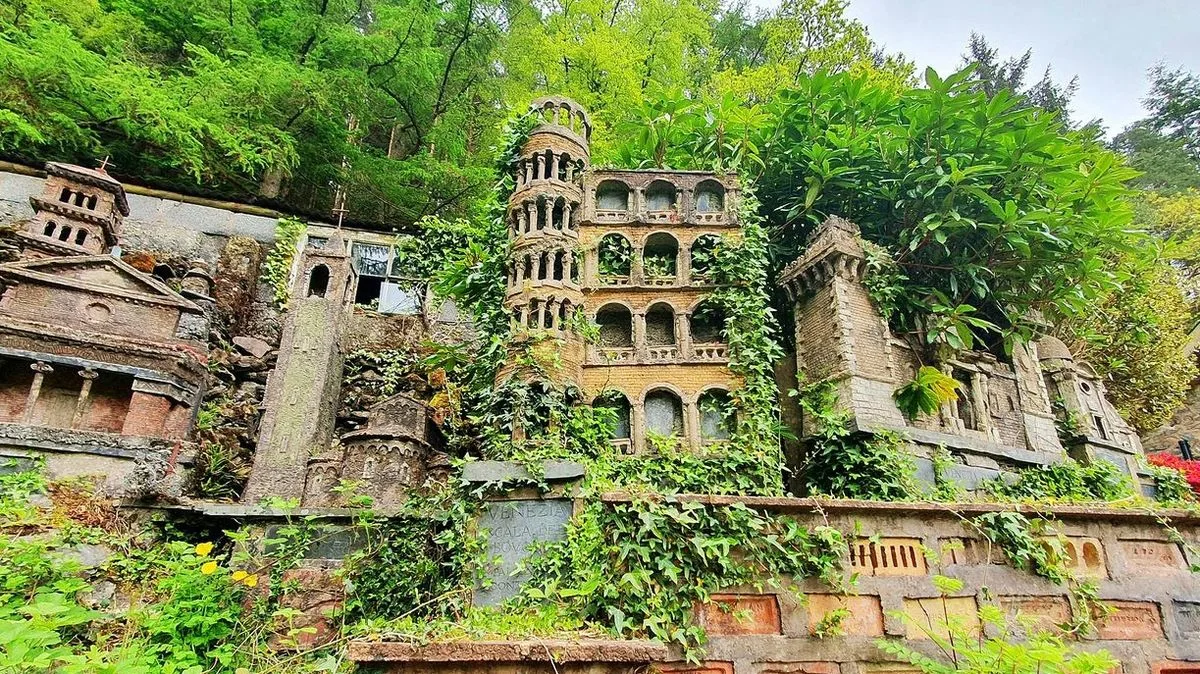
A hidden 'little Italy' featuring around 200 statues, buildings, and artworks has been uncovered in dense woodland near Corris, between Dolgellau and Machynlleth in north Wales. The site, created over 25 years by Mark Bourne and his wife Muriel, includes replicas of iconic Italian landmarks such as Florence's Duomo and Venice's Rialto Bridge, along with a Venetian canal that once may have held running water.
Volunteers were astonished by the scale of the find. Curator Jonathan Fell said: 'Every time I pulled away more ivy, I thought, bloody hell, there's another one.' Before conservation work began a few years ago, only about 30 structures were known; now, around 200 objects have been unearthed, including statues, plaques, and curios.
Mark Bourne, a former caravan site and poultry unit owner, would travel to Italy for weeks, returning with sketchbooks of architectural drawings. Using recycled materials like wash boilers and hub caps, he built the structures with chicken wire and concrete. Over 25 years, he carried thousands of buckets of water and ballast from the Afon Deri river, hauling them up a steep 30- to 45-degree slope with the help of an underpowered Datsun 4x4 and sheer physical effort.
The site, locally known as 'Mark's Folly' because villagers thought him crazy, was placed in a trust before the Covid pandemic. Trustee Richard Withers enlisted Jonathan Fell, a former designer and conservationist at Brighton's Royal Pavilion, to lead the rescue. Fell estimates restoration will take a decade, with work already underway using lime mortar to repair cracks and leave conservation 'fingerprints'.
Fell dismisses comparisons to Portmeirion, the Italianate village in Porthmadog, saying: 'I absolutely love this place... it's such an important site, one of the most important in Wales – far more so than Portmeirion, which had all that money thrown at it.' He notes that the site is now accessible for walking, though many structures still need stabilising.