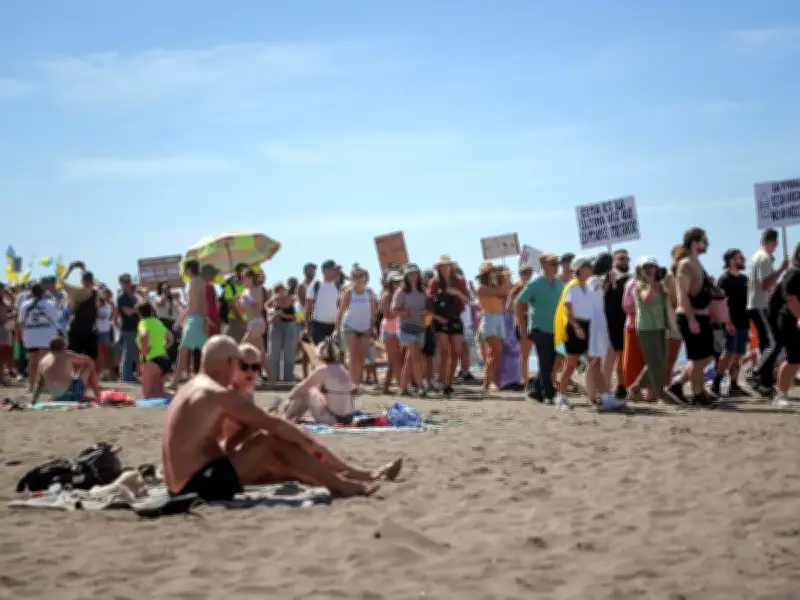
Campaigners in the Canary Islands are warning that mass tourism is pushing the Spanish holiday hotspot toward collapse, with record visitor numbers straining water supplies, waste systems, and housing while locals take to the streets in protest.
Slogans such as "Tourist, go home!" and "Your paradise, our suffering" have featured at recent demonstrations against overtourism on the island chain, which is grappling with the consequences of its immense popularity.
High-Volume, Low-Value Cycle
Ava Hughes, a development journalist, said Tenerife is "currently trapped in a high-volume, low-value cycle that is alienating its most loyal visitors while simultaneously radicalising the local population against the very industry that provides 35% of their GDP." She described "viral images of high-rise construction looming over crowded beaches" as "symptoms of a systemic failure in the island's infrastructure."
Hughes added that returning travellers often feel "sardined" into a "concrete jungle," noting that when a visitor pays thousands of pounds for a sea view but instead "spends their week staring at the rusted cranes of a half-finished luxury resort or the back of another tourist's parasol, the value proposition evaporates." She called this "a rational response to a product that no longer matches its price tag."
Record Visitor Numbers
According to the National Institute of Statistics, 15.1 million people visited the Canary Islands seven years ago, before the coronavirus pandemic halted travel. Last year, the number reached a record 18.4 million, an increase of 3.3 million visitors on an archipelago home to 2.2 million permanent residents. In 2009, just 10 million tourists visited.
Hotel numbers have grown accordingly, with one count finding 593 active hotels providing approximately 265,000 tourist beds.
Daniasa Curbelo, a young campaigner from a poor family in a rural Tenerife village, said her local beach was once free of tourists and the water clean. Today, she said, the beach is crowded for much of the year. "Because of social media, no place has remained a secret from tourists," she told IS.
Curbelo said many young Canarians cannot afford rent because tourist euros and hotel expansion have pushed up prices. She also highlighted infrastructure strain: "There is not enough water for everyone, and waste management is struggling to handle the load. Sewer pipes are breaking into the sea and beaches are being closed. Our islands are on the verge of collapse."
On Tenerife alone, Playa de El Médano, Playa del Socorro, Playa Jardín, Playa de Leocadio Machado, La Jaquita and Tabaiba Area Beach have been closed this year due to sewage spilling into the sea. By one estimate, tourists use six times as much water as locals, putting heavy strain on farms.
Zero Growth Policy and Luxury Shift
John Dale Beckley, founder of the sustainability platform CanaryGreen.org, told Fodors: "Tenerife has been under an official water emergency, but honestly, on the ground, we’re not feeling a ‘water emergency’ at all. People are still showering, watering gardens, filling swimming pools, everything as normal."
The tourism sector directly accounts for 35 to 40% of the islands' GDP. Local resident Jorge told Sage: "The bad part is that everything is tourism," adding, "The neighborhoods—as we see—are being destroyed."
In response, Canarian authorities have introduced a "Zero Growth" Hotel Policy limiting new hotel construction licences, effectively capping tourist arrivals. This year, the annual visitor count is projected to be similar to 2025's, ending years of growth.
The policy is driving a shift toward higher-end holidays. €1.039 billion was invested in Canarian hotel developments last year, the most of any Spanish region, much of it converting old two- and three-star hotels into luxury offerings. By 2028, 44 new hotels and luxury expansions are slated to open, adding 6,395 new rooms, according to EY Parthenon reports. This includes a €700 million masterplan in Gran Canaria aiming to deliver five new premium hotels.
Cheap stays are becoming scarcer. According to the Hotel Price Index, hotel room prices rose 65% in the five years leading up to 2023. The average price per hotel room in the Canary Islands rose 4.3% from 2025 to 2026, with an overnight stay costing 131.94 euros. Jet kerosene costs average roughly €84.60 per passenger each way on typical routes from London airports to Gran Canaria, partly due to recent price spikes caused by the US and Israeli invasion of Iran.
Fodor's has placed the Canary Islands on its 'No List', advising travellers to avoid the area. Campaign group Asociación Tinerfeña de Amigos de la Naturaleza said: "The continuous arrival of new residents–mainly Europeans–worsens overpopulation, environmental degradation, and land occupation, given the islands’ very limited space. Essential resources like water are also being pushed to their limits."
The group added: "We are losing our identity, culture, and, ultimately, our right to exist as a community. Tourism has become unlimited, mass-oriented, and largely low-cost party tourism that doesn’t come to truly discover the islands, but to consume a fake backdrop." The Canary Islands tourist board has been contacted for comment.