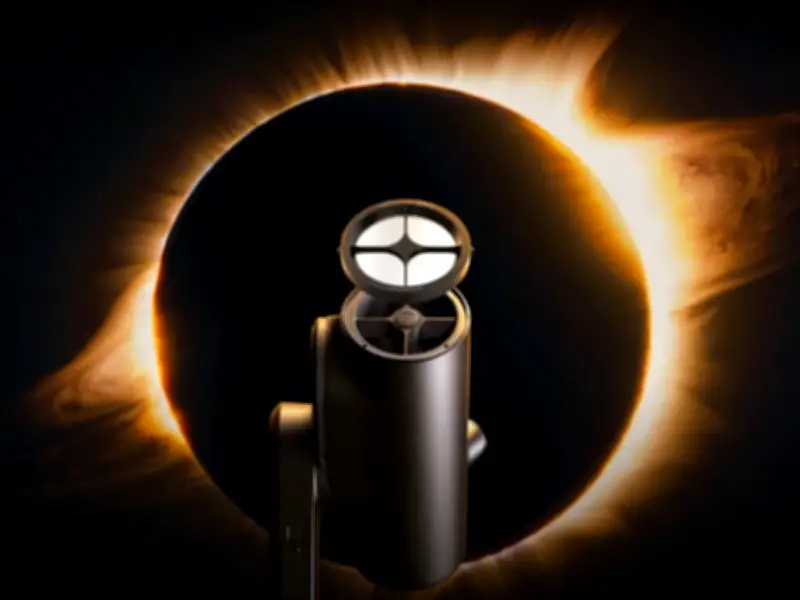
The £3,699 Unistellar Odyssey Pro is a smart telescope that automates most of the hard work of astronomy, and its Nikon-developed electronic eyepiece turned a recent partial solar eclipse into a communal street experience.
Set up the telescope, open the app, choose an object and the technology does the rest. The Odyssey Pro combines an 85mm mirror, motorised alt-azimuth mount, automated focusing and alignment, onboard image processing and the Nikon-developed electronic eyepiece.
Simple setup and approachable design
The biggest selling point is the sheer simplicity of getting started. Unistellar's software handles alignment and navigation, while the accompanying iOS and Android app provides access to a catalogue of thousands of objects.
Rather than spending the first part of an evening trying to identify stars and align the telescope, you can concentrate on actually observing. Select a galaxy, nebula, cluster or planet in the app, and the telescope automatically slews into position.
That makes a particularly compelling difference when sharing the experience with friends or family. And when it came to the recent solar eclipse, it really helped turn the event into a true community experience.
Portability and build quality
While not exactly tiny, the Odyssey Pro is considerably more portable than you'd imagine. This is very useful; to get the best out of it, you want to find dark skies away from light pollution. Although the Pro is packed with computational imaging to overcome much of that limitation, producing surprisingly detailed views of galaxies, nebulae and star clusters even if you live in a city.
Build quality is excellent, too. The telescope feels like a premium piece of equipment, and the tripod is solid and very easy to set up. Bar one thing: the telescope attaches to the tripod with screws that you tighten as much as possible, but they get loose during a viewing session, risking the very expensive scope falling off. It's a flaw that you have to be constantly on your guard against.
Dual viewing and the solar eclipse
The Odyssey Pro's real party trick is the dual way it captures what it sees. You can view some spectacular shots on a phone or tablet, or use the digital eyepiece to see a galaxy or whatever with your own eyes.
The eyepiece is a worthwhile reason to choose the Pro over the standard Odyssey. It gives you a physical experience you just don't get from looking at your phone. The system's live image processing is particularly impressive on deep-sky objects. Rather than simply showing what a relatively small mirror can see in a single exposure, the Odyssey Pro progressively builds its image, revealing considerably more detail and colour.
It is also not limited to deep-sky photography. Unistellar positions the Odyssey range as suitable for planets and the Moon. And, if you invest in the Smart Solar Filter, the Sun as well.
During the partial solar eclipse, the reviewer set the scope up in a front garden. A few taps of the phone later, and with clear skies, the Odyssey was tracking the Sun as the Moon approached. The eyepiece really came into its own: watching on a phone was all well and good, but seeing it firsthand was pretty spectacular. A bunch of neighbours - most with colanders in hand - came out and were all able to share the experience together.
Limitations and verdict
The price is the obvious obstacle. At £3,699, the Odyssey Pro is a serious investment, particularly for somebody taking their first steps into astronomy. Its five-hour battery life is another limitation. That's enough for several good observing sessions, but serious users may want to consider how and where they will recharge it, particularly when travelling.
The Unistellar Odyssey Pro is one of the most accessible ways to get genuinely impressive views of the night sky without having to become an amateur astronomer first. Its automated setup, compact design, excellent image processing, and tremendous Nikon digital eyepiece make for a potent mix. The Unistellar Odyssey Pro is available for £3,699 from the Unistellar website.