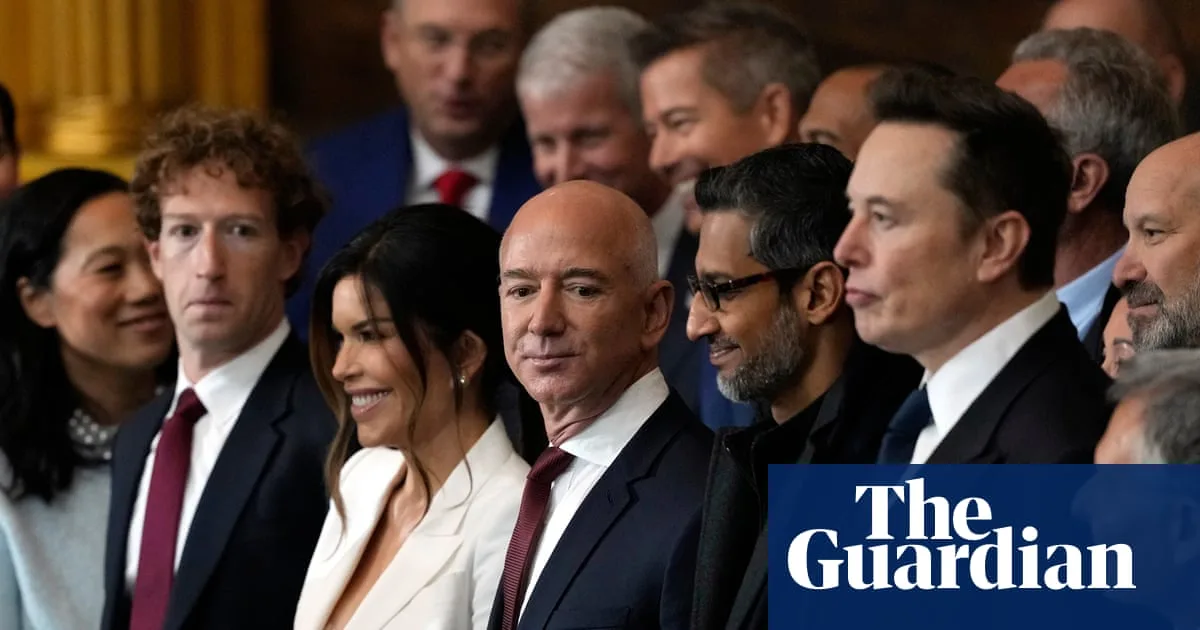
Tech Titans Reap Rewards One Year After Trump Inauguration Attendance
One year ago today, on 20 January 2025, Donald Trump was inaugurated as President of the United States in Washington DC. Standing prominently alongside him were the leaders of the technology industry's most powerful companies: Mark Zuckerberg of Meta, Jeff Bezos of Amazon, Sundar Pichai of Google, and Elon Musk of various ventures including xAI. Their presence represented an unprecedented alignment between Silicon Valley and the Trump administration, following significant campaign donations.
In the twelve months since that historic day, these technology titans and their corporations have harvested enormous benefits from their political alliance. The Trump administration has sponsored the sector with billions in government funding and has featured chief executives as key negotiators in major international trade agreements. This symbiotic relationship was further cemented last month when President Trump signed an executive order prohibiting individual states from passing laws regulating artificial intelligence, a move widely seen as favourable to big tech's expansion ambitions.
Datacenter Dilemma: Trump's Energy Anxiety
As year two of Trump's second term commences, the administration is grappling with the infrastructure demands of the very technology boom it has championed. President Trump has expressed particular concern about datacenters and their impact on America's already expensive electricity market. He worries that rising energy costs could undermine both his deregulation agenda for AI and his party's prospects in the upcoming November congressional elections.
This anxiety manifested in two significant actions last week. On 13 January, Trump and Microsoft's president jointly announced that the technology giant would pay full property taxes and accept no electricity rate discounts in towns hosting its datacenters. "We are the 'HOTTEST' Country in the World, and Number One in AI. Data Centers are key to that boom, but the big Technology Companies who build them must 'pay their own way,'" Trump declared on his Truth Social platform.
Then on Friday, Trump coordinated with north-eastern state governors to direct the nation's largest power grid operator to hold an emergency reliability auction by September. This measure could compel technology corporations to bid on future electricity reliability, potentially forcing them to finance new power plant construction.
These moves represent Trump tugging at the edges of a complex problem: while promising to halve Americans' electricity bills, his administration is simultaneously blocking renewable energy projects he labels a "scam," instead promoting expanded gas and oil drilling. Administration directives to reverse closures of ageing coal plants and restart liquefied natural gas exports may paradoxically increase domestic energy costs further.
European Contrasts and UK Concerns
Across the Atlantic, European governments are confronting similar limitations on datacenter expansion. Germany, which hosts the highest number of datacenters in Europe, faces growth constraints from high energy prices. Chancellor Friedrich Merz's government has taken an opposite approach to Trump's, agreeing to subsidise heavy industrial electricity use until 2028 while reducing grid fees for all consumers. Notably, German datacenters must source half their electricity from renewables, though public scepticism about compliance persists.
In the United Kingdom, home to Europe's second-largest datacenter concentration, construction continues despite already having among the world's highest electricity rates. The Department for Science, Innovation and Technology proposed in November to offer electricity discounts to datacenters in designated "AI growth zones," aiming to stimulate investment despite the nation's ongoing cost of living crisis.
Ireland's experience serves as a cautionary tale: datacenter electricity consumption surpassed that of all urban homes in 2024, leading to significantly higher costs for citizens. The Irish government imposed a ban on new datacenter connections to Dublin's power grid in 2021, a measure that only ended this past December.
Regulatory Spotlight on Musk and AI
Elon Musk finds himself under regulatory scrutiny as part of this broader energy narrative. Last Thursday, the US Environmental Protection Agency ruled that Musk's company xAI has been illegally operating methane-powered generators at its Memphis facility. This establishes an important precedent: technology companies cannot simply deploy backup generators like homeowners during power outages when they exceed grid capacity. Instead, they must pursue nuclear power plant purchases, as Meta, Microsoft, Google and Amazon have done.
Australia's Social Media Ban: A Global Template?
Meanwhile, lawmakers worldwide are examining Australia's social media ban for under-16s as a potential model. Since implementation on 10 December, platforms have deactivated, removed or restricted over 4.7 million accounts belonging to Australians judged to be minors. Despite these substantial numbers, opposition politicians question the ban's effectiveness, noting that new accounts are easily created and age-verification tools prove "laughably easy to bypass with some makeup and good lighting," according to shadow communications minister Melissa McIntosh.
As the datacenter boom extends to the Middle East and India, and social media regulation evolves globally, the technology industry's relationship with political power continues to shape both economic opportunity and everyday life. The alliance forged one year ago at Trump's inauguration appears set to deepen, with Silicon Valley poised for further enrichment through presidential support, even as the infrastructure and social consequences of technological expansion generate increasing political tension.