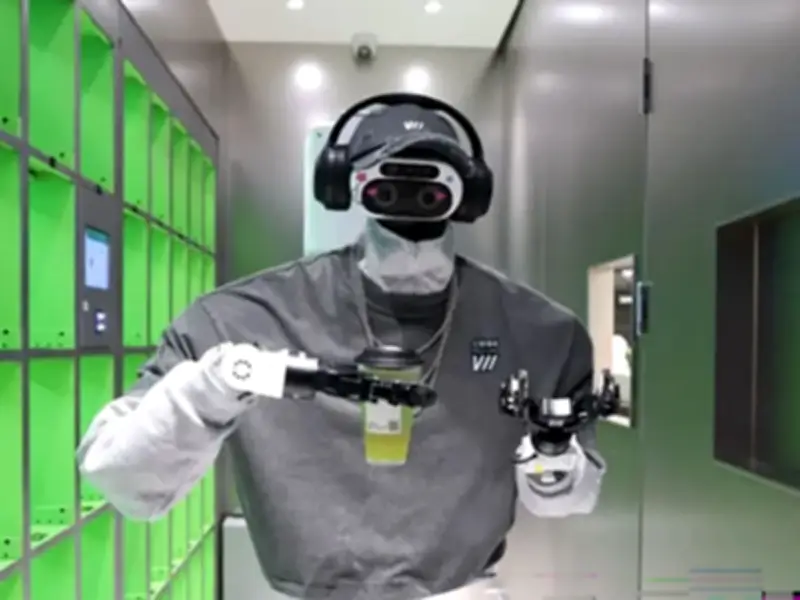
A 24-hour coffee shop in Beijing, China, staffed entirely by robots, has set a Guinness World Record after serving 202 cups of coffee in one hour on its opening day. The robot barista, dressed in a grey and white jumper, grey cap, headphones, and silver chains, prepared and served the drinks with an average wait time of less than 30 seconds per cup.
Record-breaking service
Customers place their orders through a self-service system, allowing them to tailor the sweetness and intensity of their coffee. Videos from Sunday showed the robot placing cups in pigeon holes for customers to collect. One customer said her coffee was “pretty well-balanced,” while her partner marvelled at how quickly he got his drink despite a large crowd. “When I first saw the place, I thought it would take a while to get a cup. But I walked in and got it almost right away,” he said.
Impact on jobs
Dr Leonora Risse, an economist from the Queensland University of Technology in Australia, said the lack of human connection could be a sticking point. She noted that humanoid bots and AI are well-suited for routine and repetitive tasks, offering productivity gains, but things tend to fall apart if variety is needed. “This shows how the essence of hospitality jobs is about human interactions,” she said.
Dr Risse highlighted that clerical and administrative jobs are at highest risk of being replaced by AI, as these involve routine processes. “Telemarketers and call centre workers are top on the list, but clerks, bookkeepers, secretaries, receptionists and personal assistants are also in this mix. This places women more at risk of losing their job to AI, given that most of these are mostly female-concentrated occupations,” she added.
According to a recent article by Dr Risse and Elise Stephenson of the Australian National University, clerical and administrative jobs make up more than 70 per cent of women and provide almost one in five jobs for all women in the Australian workforce.
Future outlook
Dr Risse said workers need to be ready to transfer their skills to other roles. “I expect that AI will make the ‘human’ side of our jobs even more important and valuable. These skills that make us human – like empathy, care and emotional intelligence – are the skills we don’t want to outsource to robots and automation. Critical Judgement is also a skill that we’ll need to focus on more strongly. AI can perform the mechanics of a task. But how will it navigate complex decision-making processes where there is not a clear answer? This is where human ethics, morals and experience matter.”
In the US, Morgan Stanley predicted 62.7 million American jobs could be replaced with humanoid robots by 2050, though the bank stressed this was not a forecast of mass joblessness. In the UK, analysis from the Office for National Statistics indicates that about 1.5 million jobs in England face a high risk of having specific tasks automated, while the Institute for Public Policy Research estimates that a worst-case “full displacement” scenario could eliminate up to 7.9 million UK jobs.
The robot-run coffee shop is located in the Chaoyang District at Galaxy SOHO, a futuristic office, retail, and entertainment complex in Beijing.