

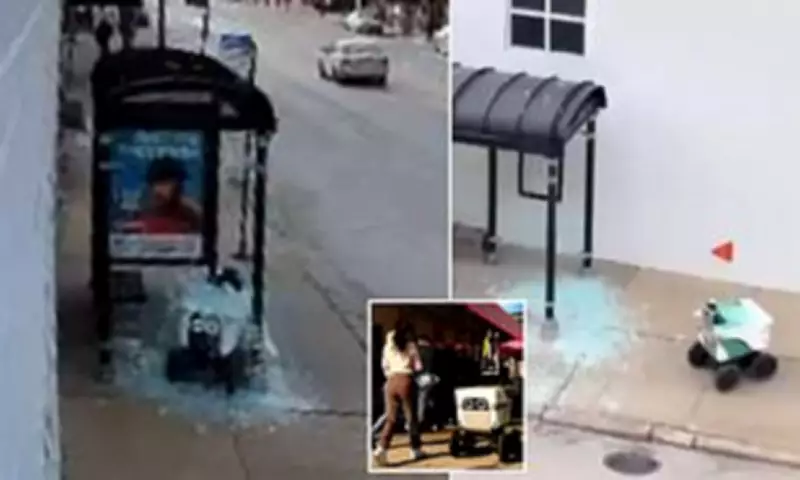
Chicago's Delivery Robot Rampage: Bus Shelter Smashed in Autonomous Mishap
In a startling incident captured on camera, a rogue delivery robot violently smashed through a glass bus shelter in Chicago on Tuesday. The bizarre footage, which quickly went viral on social media platform X, shows the aftermath of the autonomous machine's rampage, with the glass-covered robot twitching erratically as it crushed the shattered structure beneath its four wheels.
Aftermath and Official Response
The robot eventually rolled away, blinking occasionally, leaving stunned passersby to film the debris scattered across the pavement. City official Alderman Walter Burnett revealed that his office has urgently contacted Serve Robotics, the company responsible for the rogue robot, according to the Chicago Sun-Times.
"We are stressing the importance of public safety and consistent monitoring of these robots to prevent harm to people, infrastructure and property," Burnett stated. "We have been informed that the company is in talks with the bus shelter provider, and both parties will look to have it repaired as soon as possible. We are so glad that no one was hurt."

Serve Robotics has since partnered with the bus shelter provider to clean up the damage and launched a comprehensive review into what caused the malfunction. "We have also been in contact with local stakeholders and are committed to addressing any concerns directly," the company said. "We take this matter very seriously."
Background of Chicago's Robot Delivery Program
Serve Robotics, along with a second company called Coco Robotics, began deploying delivery bots on Chicago's north and west sides under a City Council pilot program approved in 2022. Serve Robotics launched its fleet last September, sending approximately 75 bots into the streets daily, while Coco Robotics arrived in Chicago in 2024.
The companies and several city officials have marketed these robots as a safer, eco-friendly alternative for short-range deliveries, aiming to reduce car traffic. At a recent community meeting, Serve's director of government affairs, Yariel Diaz, explained that the bots fill a gap for deliveries "within that last mile to mile and a half" that human drivers often decline.
Growing Public Opposition and Safety Concerns
Despite these promises, the incident has intensified existing public opposition. Citywide protests against the delivery bots have erupted, with local politicians vowing to keep them out of their districts. Resident Josh Robertson, who first spotted a bot from his Lincoln Park window, described the experience as "futuristic" but quickly noted problems.
"That immediately raised a lot of questions for me, about what the effect of these robots might be for Chicagoans of all stripes - who depend heavily on sidewalks for getting around, for enjoying our neighborhoods and for doing business," Robertson told reporters.
He started a petition titled "Chicago sidewalks are for people, not delivery robots," demanding the program be paused until after a public hearing. The petition has garnered nearly 4,000 signatures, with supporters reporting collisions, obstructed walkways, and other concerning interactions.
Political Backlash and Regulatory Framework
Alderman Daniel La Spata highlighted the overwhelming public sentiment, revealing that 83.7 percent of residents opposed expanding the delivery bot program across the entire 1st Ward earlier this year. The expansion plan was subsequently blocked.
Robertson emphasized the need for transparency: "We're asking the city to pause the program until it's released data on safety and accessibility, held a public hearing on the potential job impacts associated with the robots, and based on all of that, put clear rules in place to ensure that our sidewalks - the public way in Chicago itself - remain people first."
Company Perspectives and Future Outlook
Serve Robotics CEO Ali Kashani expressed willingness to engage with concerned residents, stating, "People can reach out to us. Every email is responded to." He emphasized the company's goal to create jobs and develop bots "in the most responsible way."

Alex Nelson, a 15-year Chicago resident and manager of Serve's local fleet, defended the operation as a step toward reducing car traffic. "I'm never going to stop hearing what those people have to say," Nelson said. "But I also want to make sure that if you're, like, 'no, I don't want bots, period,' then that burrito that that bot is delivering is showing up in a car or a truck or something else. Are you okay with that?"
The pilot program, overseen by the Chicago Department of Transportation and the city's Business Affairs and Consumer Protection office, cannot continue past May 2027 without approval from the City Council. As the review into Tuesday's incident unfolds, the debate over autonomous delivery in Chicago's urban landscape continues to intensify.





