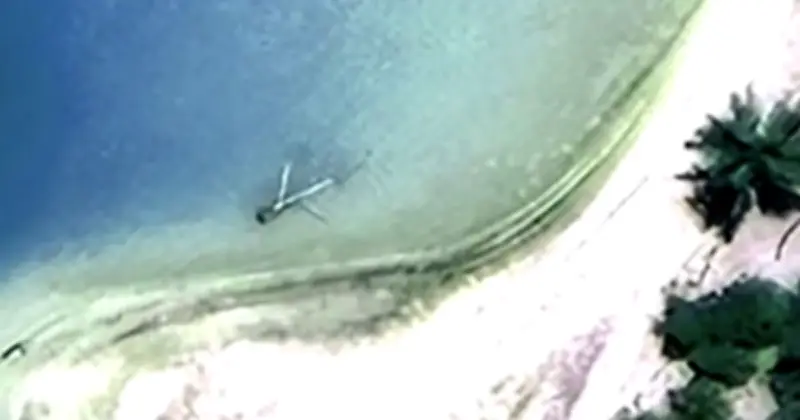
Archaeologists are “very confident” they may have located the wreck of Amelia Earhart’s Lockheed Electra, nearly 89 years after the pioneering aviator and her navigator vanished over the Pacific. A 16-strong team from the Archaeological Legacy Institute and Purdue University will travel to the remote coral atoll of Nikumaroro in early October to examine a plane-shaped anomaly known as the Taraia Object.
Satellite imagery matches aircraft dimensions
Buried in sediment in the island’s shallow lagoon, the feature was first highlighted in satellite imagery and matches the dimensions of Ms Earhart’s aircraft. Lead archaeologist Richard Pettigrew said: “I am feeling very confident about this. I’m pumped.” He stressed, however, that the claim remains a hypothesis: “We won’t know until we go down there and identify it. Something is there, and it’s either the Electra or it’s not.”
Disappearance and alternative theory
Earhart, then 39, and navigator Fred Noonan disappeared on 2 July 1937 while attempting to fly around the world. They left Lae in Papua New Guinea bound for the tiny Howland Island, a refuelling stop roughly halfway between Australia and Hawaii. Radio messages indicated the aircraft was running low on fuel as it searched for the island. The official conclusion at the time was that the plane ditched in the open ocean and sank.
An alternative theory, long promoted by researchers, holds that the pair overshot Howland and made an emergency landing on the flat reef at Nikumaroro, about 350 miles to the south-east. They are thought to have survived for a short period as castaways before the aircraft was washed into the lagoon.
Supporting evidence and planned excavation
Supporting evidence cited by the expedition includes radio bearings that converge on the island, 1930s-era artefacts such as a woman’s shoe and a jar of freckle cream, human bones discovered in 1940 whose measurements match a woman of Earhart’s build, and a photographic anomaly on the reef recorded months after the disappearance that some interpret as landing gear.
The team will spend several days on the uninhabited island, clearing jungle to reach the lagoon and using a hydraulic dredge to remove sediment carefully. They will search for major components such as the fuselage and wings, and for distinctive rivets that could confirm the aircraft’s identity. If aluminium wreckage is found, remote cameras will be installed to deter scavengers and a full excavation planned for the following year.
Talks with Kiribati and cautious experts
Purdue University is in talks with the government of Kiribati, which administers Nikumaroro, over the possible transfer of any remains for permanent display. The expedition was delayed by a year because of severe weather and the time required to obtain official clearance.
Experts remain cautious. Dorothy Cochrane, a retired curator at the Smithsonian National Air and Space Museum, noted that records place the flight close to Howland Island, while author Rachel Hartigan observed that previous promising leads have failed to deliver. Details of the planned dig and Pettigrew’s comments were first reported by USA Today.
If successful, the mission would resolve one of the most enduring mysteries of the 20th century and fulfil a long-held ambition of the university where Earhart once served as a career counsellor and aeronautics adviser.