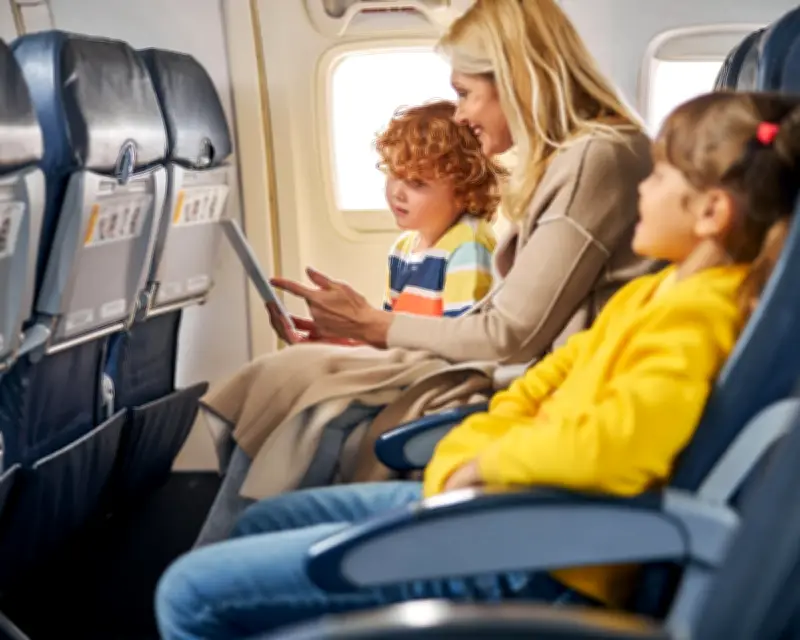
Ryanair recently stopped making parents pay to sit next to their children, but depending on the airline, the hidden extra costs involved in flying with children can be substantial. In some cases, you can even end up spending more for the baby on your lap than you paid for your own flight.
Lap infants can cost more than adult tickets
Your baby might not need a seat, but you are still likely to pay fees for them to travel. Some airlines offer discounts for children over two, while others whack families with the cost of a full-grown adult. In one example found by Guardian Money, there were nine separate charges for taking a baby on board, as fees added to adult fares were also applied to those too young to need their own seat.
“Trying to work out the final cost has become incredibly complicated and frustrating,” says Rory Boland, the editor of Which? Travel. “It’s not until you’re a good bit into the booking journey that the amounts become clear.”
Under-twos: flat fees vs. percentage charges
In some cases, headline prices for tickets are lower than the cost of taking an infant with you. For example, Wizz Air sells one-way adult fares from as little as £14.99, but under-twos travelling on their parents’ laps are subject to a flat charge that is higher. The airline applies a €32 (£28) fee for each flight for an infant to sit on an adult’s lap, regardless of the price of the adult ticket.
Individual seats can be booked for infants on some airlines, but this requires them to be strapped into car seats not exceeding the width of the passenger seat.
“The idea that in-lap infants are charged more than a full adult because of some fixed fee they’ve arrived at, is clearly unfair,” Boland says. “There’s absolutely no sensible argument for why a very small child, or baby, will be charged more than an adult. That simply doesn’t make sense. Some airlines will probably be making a handy profit off the amount they’re charging for lap infants.”
Wizz Air says: “We don’t agree with that assertion … the small fee we charge for infants who sit on their parents’ laps is similar to that charged by many other airlines and reflects standard practice across the industry.”
Basic fees for a lap infant work differently at each airline. For Wizz, easyJet and Ryanair, for instance, there is a flat fee regardless of destination, while British Airways and Virgin Atlantic charge about 10% of the adult ticket price. On top of the seat charges are the many other fees typically applied to child travellers, whatever their age.
Older children: own seat required, variable costs
Those over the age of two must have their own seat, and the cost of their fare varies widely depending on the airline. On Wizz, Ryanair and easyJet, tickets for over-twos cost the same as those for adults; on British Airways, fares are reduced until a child turns 12. Again, there are other fees on top of the basic price.
Lisa Francesca Nand, who hosts the Big Travel Podcast, has paid £136.50 to sit next to her sons, aged 11 and 13, on their return trip to Málaga on Wizz Air this summer – more than a third of the cost of their actual tickets. Wizz Air guarantees at least one seat next to a child under 14 for free for adults on the same booking. But she says of the second child’s seat “it’s never clear how that’s going to work.” At the point of checking out online, “they make it almost foreboding, in a way, that you might not be seated together … I just personally don’t want to take the risk.”
Wizz Air says: “When passengers are travelling with children up to 14 years old, our booking system automatically assigns seats together for the child and one adult passenger. We cannot guarantee that the whole family will be seated together if they do not book seats together – this is clearly stated on the Wizz Air website.”
Ryanair reluctantly changed its policy of charging parents who wanted to be sure they could sit next to their children, after the Competition and Markets Authority launched an investigation. Prior to the change, it required parents travelling with children aged between two and 11, to pay to reserve what it referred to as a “mandatory family seat”.
Breakdown of fees: more than just the fare
Take a look at what goes into the headline cost of a flight and you will see a series of fees on top of the basic air fare. On British Airways, a return flight, departing from London to New York on 17 July, comes with 11 extra charges for an adult ticket, compared with nine for an infant, and 10 for a child (aged 2-11). These fees make up more than £500 of the £858.59 price for an adult, while an infant fare of £30 becomes £162.19.
British Airways says: “All charges are set out clearly at the booking stage, with pricing for children and young adults lower than the full adult fare.”
Some fees are imposed by the countries you are flying into and out of. Some countries charge air passenger duty (a government-imposed tax) for all flyers, based on the distance flown and class of travel. This is not true on economy flights from the UK for children, but may affect your return journey.
The list of fees may also include passenger service charges, which UK airports charge airlines per landing and the number of passengers that pass through. Airlines pay these fees then choose how best to recover them.
Other fees can include what may be called a “carrier imposed charge” – a surcharge from the airline. And there are different immigration and entry charges based on the destination – and stops – which can also raise costs. These may be called things such as “security tax”.
The wide range of charges means that layover destinations make a difference to how much you will pay. On an Air New Zealand flight from London to Auckland via Los Angeles the total cost of an infant’s flight comes to 15% of the adult ticket; returning via Vancouver with the same airline comes out at 9.6%.