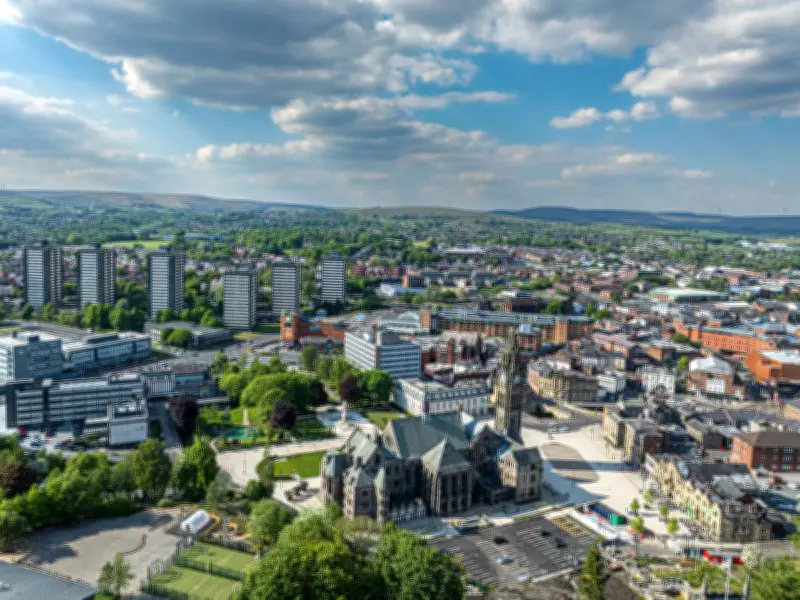
Rochdale's Local Plan, which will shape the borough's future until 2039, is set to be signed off. The plan includes building just under 11,000 new homes and making railway stations the centre of dramatic changes.
Council bosses will discuss the Local Plan at a town hall meeting on July 28 and are expected to push it through to the next phase before formal adoption, following an extensive consultation period.
Housing and Transport Hubs
Housing forms a substantial part of the plan, with land for new homes already mapped out under the Places for Everyone (PfE) plan. PfE is a giant housing strategy adopted by nine out of ten Greater Manchester councils, aiming to build around 175,000 homes across the city region over two decades. It is expected to bring forward investment and major redevelopment in Rochdale and across the city-region.
The Rochdale borough is already anticipating a major boost through the Atom Valley scheme, which plans to build 7,000 new homes, create 20,000 'high-quality' jobs, and carve out 17 million sq ft of employment land. Construction has already started on the Sustainable Materials and Manufacturing Centre (SMMC) in Kingsway.
The Rochdale Rail Corridor Strategy is at the heart of the Local Plan. It would reconfigure land around transport hubs along the Manchester to Leeds railway line into places for people to live, work and play. These hubs focus on stations in Rochdale, Castleton, Mills Hill, Smithy Bridge, Littleborough, and a new Slattocks station. Combined with walking and cycling routes, park and rides, new public realms, and community spaces, these hubs aim to attract more people and boost the local economy.
Key Areas of Focus
The strategic plan covers climate and energy, economic growth and town centres, housing, natural environment, design and place-making, healthy communities, and sustainable transport. Each town and local centre has been prioritised in order of importance: Rochdale is the principal town centre, followed by Middleton, Heywood, and Littleborough, then district centres Milnrow, Castleton, Newhey, and local centres.
Rochdale
The town centre is a principal focus for regeneration. Several schemes have been completed, such as Riverside retail and leisure development, Upper Banks hotel and residential development, and the £20m redevelopment of the Grade-I listed Rochdale Town Hall (completed 2024), which will be a key tourist attraction. Residential development is a priority, with sites like Station Gateway near Rochdale Railway Station expected to deliver more homes up to 2039. Castleton station is also a focus for residential development and the Rail Corridor strategy. Improving bus links to Heywood, Bury, Oldham, and Ashton is a priority, and a cycle lane between Rochdale and Castleton is en route.
Heywood
Regeneration is the first key marker for Heywood, through new residential developments, public space improvements, and protecting key assets. Heywood Civic and Peine Square have recently been revamped. There is potential for transport improvements, including extending the East Lancashire Railway (ELR) into Heywood and connecting the town to Rochdale and Bury with new tram-train technology. South Heywood attracts high-quality distribution businesses at Heywood Distribution Park, and a significant development near Junction 19 of the M62 is delivering new homes and employment.
Middleton
Middleton is subject to significant regeneration ambitions in the town centre and as part of Atom Valley. The Middleton Mayoral Development Corporation (MDC) is being established to drive regeneration, focusing on accelerating housing and commercial growth around planned transport infrastructure. A masterplan adopted in 2023 includes opportunities for residential development and public realm improvements, with significant consented sites such as Warwick Mill, where a £75m redevelopment into flats was approved in 2024 but has seen little progress. Plans to extend Metrolink from the city centre to Middleton are progressing, along with improved bus services and 'Rapid Transit' links to Atom Valley.
Pennines (Littleborough, Milnrow, Newhey)
There is significant demand for housing in Pennines, with thousands of new homes planned through several large sites. Water resources like Hollingworth Lake, reservoirs, the River Roch, and the Rochdale Canal are popular for visitors, but some areas are at higher risk of flooding from the River Roch. The Environment Agency is constructing flood defences in the Roch Valley to reduce future risk. Enhancing businesses in Littleborough town centre and the hubs of Milnrow and Newhey is an ambition to protect local jobs and tourism. Both areas are well served by train stations and tram stops. The Littleborough station masterplan, brought forward in 2023, includes a transport gateway, new housing types, and improved public spaces, along with enhanced walking and cycling links to public transport.