Fears of insider trading have escalated dramatically following revelations that a single individual profited by approximately $1 million through dozens of remarkably precise wagers on the Iran war since 2024. This development coincides with a sudden and unexplained surge in stock and oil futures trading, occurring just minutes before former President Donald Trump announced prospects for a diplomatic resolution to the US-Israel conflict with Tehran, which subsequently calmed financial markets.
Unprecedented Betting Success Raises Alarm
The anonymous trader achieved a staggering 93 percent success rate on their five-figure bets concerning the Islamic Republic, despite predicting unannounced military operations. Their prescient sequence included wagers placed hours before Israeli strikes in October 2024 during the tit-for-tat conflict with Tehran, hours before US airstrikes against Iranian nuclear infrastructure in June 2025, and hours before the joint US-Israeli surprise bombardment on February 28, which ignited the current hostilities.
Bubblemaps, an analytics firm specializing in blockchain transaction tracking, uncovered this pattern amid growing concerns about potential insider trading on prediction markets. These platforms allow users to bet on diverse outcomes ranging from elections and major sports events to warfare.

Analysts Point to Suspicious Indicators
Nick Vaiman, CEO of Bubblemaps, told CNN that multiple factors strongly suggest insider activity. "All of this is strong signaling of insider activity, based on the amount they made, the markets they bet on, the timing of their trades, the success rates of these trades, and the fact that they are connected on-chain," Vaiman stated. "This is pretty suspicious in my book."
At 7:05 AM New York time on Monday morning, Trump posted on Truth Social that the United States had engaged in "very good and productive" talks with Tehran and that he was halting planned strikes on Iranian power plants and energy infrastructure for five days.
Market Movements Before Announcement
Todd Phillips, a finance professor at Georgia State University and former CFTC advisory board member, identified red flags in the Tehran trades analyzed by Bubblemaps. While most high-frequency traders typically maintain win rates slightly above 50 percent, the Iran trader demonstrated an overall win rate of 83 percent, soaring to 93 percent for trades exceeding $10,000. These gambles netted nearly $967,000.
"It sure seems like this person either has incredible luck, or was insider trading," Phillips remarked to CNN. "Having win rates in the 80 percent to 90 percent range is just too good to be true. I look at this, and I think something fishy is going on."
Although many profitable bets preceded US or Israeli strikes by hours, others were placed days or weeks in advance, which Phillips noted is less indicative of insider trading. By Monday evening, some accounts linked to the user maintained active positions on Polymarket.
Coordinated Futures Trading Activity
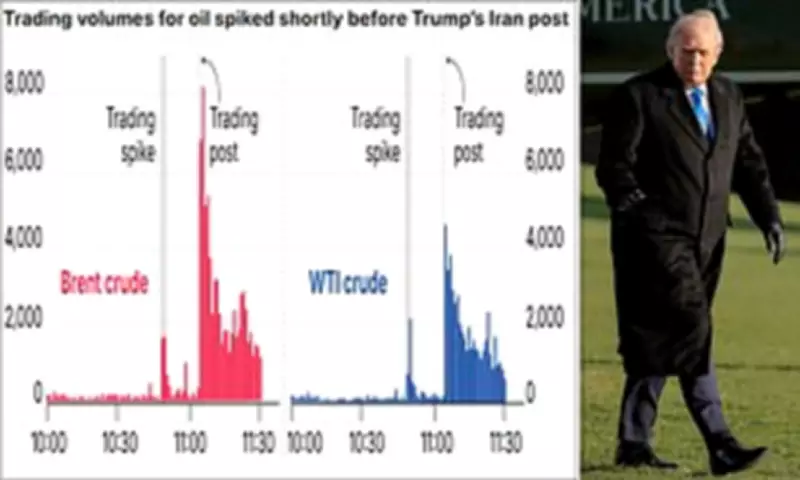
Approximately at 6:50 AM New York time on Monday, S&P 500 e-mini futures experienced a sharp and unusual volume spike, diverging from a typically quiet premarket session. Nearly simultaneously, West Texas Intermediate crude oil futures witnessed a similar surge in trading activity.
Then, at 7:05 AM, roughly fifteen minutes later, Trump published his announcement. S&P 500 futures surged more than 2.5 percent before the opening bell, while oil prices plummeted, with West Texas Intermediate futures dropping nearly 6 percent immediately afterward.
The coordinated movements across equities and crude meant that anyone who had purchased stock futures and sold or shorted oil contracts just minutes earlier would have secured substantial gains. This precise timing, coupled with the absence of any obvious public announcement before Trump's post, has unsettled traders and attracted scrutiny.

Prediction Market Intrigue Deepens
The X account Unusual Whales, which specializes in tracking unusual trading activity, spotted these trades. "Just five minutes before Trump's announcement to halt the attacks on Iran, massive trades reportedly hit the market. In one move, $1.5 billion in S&P 500 (ES) futures was bought while $192 million in oil (CL) futures was sold," the account reported. "These orders were 4–6x larger than anything else at the time. The trader seemingly made huge gains. Unusual."
Early-morning futures markets are generally thinly traded, making large orders more conspicuous than during regular hours. However, the size and coordination across two major asset classes appeared particularly striking. The US Securities and Exchange Commission and CME Group have not commented on this activity.
Patterns Suggest Advance Knowledge
Some analysts warned that algorithmic or macro-driven trading strategies can generate sudden flows without a clear headline trigger. Nevertheless, the pattern of aggressive positioning immediately followed by a major geopolitical announcement has intensified speculation that certain traders may have received information before the news became public.
This suspicion is now amplified by parallel activity in the rapidly expanding world of prediction markets, where bets on geopolitical events are increasingly drawing attention. On the crypto-based platform Polymarket, a cluster of eight newly created accounts, all reportedly established around March 21, collectively staked nearly $70,000 on a ceasefire occurring before March 31. If successful, these bets could yield close to $820,000.
Ben Yorke, a former CoinTelegraph researcher now working on an AI trading platform, told The Guardian that this activity exhibits characteristics associated with insider knowledge. The wallets "definitely [look like] someone with some degree of inside info," Yorke said, highlighting the betting pattern and apparent splitting of positions across multiple accounts.
Anonymity and Regulatory Challenges
Yorke explained that such "wallet-splitting" can indicate attempts to conceal the size or identity of a single investor. "Typically, when you see wallet-splitting and deliberate attempts to obfuscate identity, it's one of two scenarios: either a very large investor trying to shield their position from market impact, or insider trading," he noted.
Polymarket accounts are anonymous, making it extremely difficult to trace specific trades. Adding to the intrigue, a separate account that previously bet on US strikes against Iran and won had also been created shortly before that event and has reportedly placed no other wagers.
Meanwhile, the platform's own implied probability of a ceasefire jumped from just 6 percent on March 21 to 24 percent by Monday, with over $21 million now riding on the outcome. Prediction markets like Polymarket and Kalshi have quickly become a new frontier in geopolitical speculation, enabling users to wager on everything from military actions to diplomatic agreements.
Policing Difficulties in Digital Markets
The features of speed, anonymity, and global access that make these platforms attractive also render them challenging to police. Recent reporting has emphasized concerns that such platforms could be exploited to profit from non-public information related to sensitive events, including military operations and diplomatic negotiations.
However, insiders caution that possessing advance knowledge may not guarantee success in this particular market. The Polymarket contract requires formal confirmation from both the US and Iranian governments that a ceasefire has been reached—a high threshold that introduces uncertainty even for well-informed traders.
The US President's reversal followed his earlier threats over the weekend that America would "obliterate" Iran’s power plants unless the Strait of Hormuz fully reopened within 48 hours. But in a surprise move on Monday, he took to Truth Social to announce that Washington and Tehran had held talks on the "complete and total resolution of hostilities" in the Middle East, later suggesting the war could end within a week if upcoming negotiations proceed favorably.