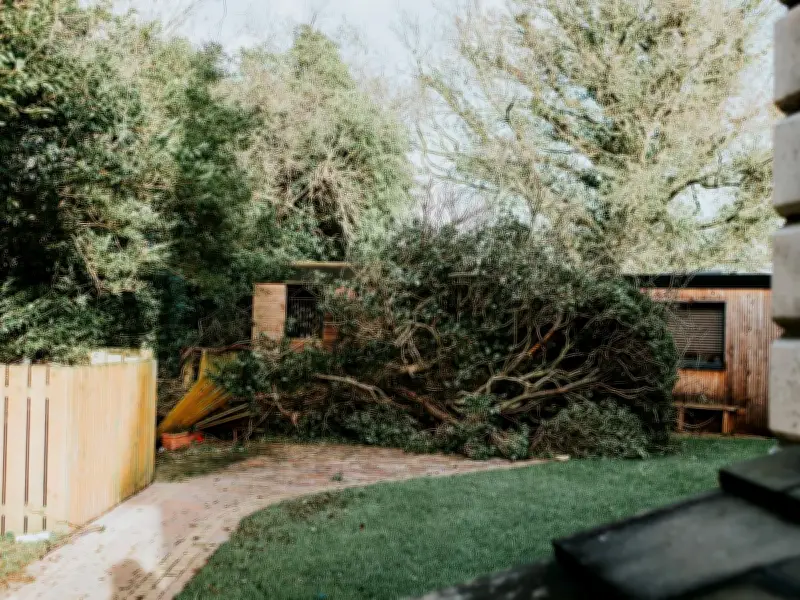
Homeowners whose garden fences have been damaged by powerful storms could face unexpected repair bills, with a lawyer explaining who is legally responsible for the damage and what their rights are.
Powerful storms battering parts of the UK have brought forceful winds posing a threat to garden fences and boundary walls. As conditions deteriorate, residents may be left grappling with shattered panels, toppled posts and disagreements over who must foot the repair costs.
While many assume responsibility for garden boundaries is clear-cut, the legal position isn't always as straightforward as you might think.
Who is responsible for repairing a garden fence?
Daniel Barnett, a London barrister and presenter of LBC's Legal Hour, explained that the first step is to determine who actually owns the fence, reports Wales Online.
Speaking on his YouTube page, he said: "If your fence with your neighbour needs repairing, the first question is, who owns it? If the deeds don't tell you, and they rarely will, the law presumes it's owned by the person on the side of the fence with the rails and posts."
If the fence is yours, you're free to arrange its repair. However, Barnett clarified that homeowners typically cannot force their neighbours to fix a fence belonging to them, even when it has deteriorated significantly.
This doesn't automatically mean the owner bears no responsibility, especially if the damaged structure causes harm or triggers additional issues. Barnett provided examples, including a panel collapsing into a greenhouse or a pet escaping through a broken fence and wreaking havoc in a neighbour's garden.
The widespread boundary misconception
Katy Owen, an associate of the Chartered Institute of Legal Executives, cautioned homeowners against making assumptions about which side of their property they are responsible for maintaining.
"It is a commonly held assumption that a property owner is always responsible for the boundary on the right-hand side and your neighbour is responsible for the boundary on the left. However, this is actually incorrect, as the ownership and responsibility of boundaries depend on the individual circumstances of each property," she said.
Rather than relying on hearsay, homeowners should scrutinise their property's title deeds to determine whether they contain details regarding boundary ownership and maintenance responsibilities.
Owen pointed out that more than 85% of land in England and Wales is registered, meaning the relevant title information can be obtained from the Land Registry. Copies of the title register, transfer deeds and plans cost £3 each through the GOV.UK Land and Property Information service.
Certain documents also feature T marks on boundary plans, which can assist in establishing responsibility. An inward-facing T generally indicates that the property owner bears responsibility for maintaining that particular boundary.
What if the deeds do not say who owns the fence?
Property documents don't always offer a clear-cut answer. In certain instances, transfer deeds contain specific wording requiring an owner to maintain fences or other enclosures along designated sides of a property.
Where responsibility remains uncertain, Owen advised that the most sensible course of action is to come to an agreement with your neighbour before arranging any repairs.
She noted that boundaries not allocated to either property within the deeds may be regarded as party boundaries, meaning the owners who share them could be jointly liable for upkeep. The exact position will depend on the individual circumstances and any relevant legal obligations.
Neighbours frequently choose to divide the cost of replacing or repairing a damaged fence between themselves, even where the legal situation is not entirely straightforward. Homeowners are also advised to check whether their insurance policy covers the damage before funding any work out of their own pocket.
Storm warnings issued as powerful winds approach
The guidance comes as weather forecasters caution that Storm Boelo could bring fierce winds to northern parts of the UK, with the potential to cause damage to fences, trees and other structures.
The Met Office has warned of gusts reaching 60 to 70mph across many areas, with exposed coastal locations potentially experiencing winds of up to 80mph.
An amber warning has been put in place for mainland Scotland and islands off its western coast, with the strongest winds initially expected to strike western Scotland and the far north of Northern Ireland on Saturday evening, before pushing eastwards overnight and into Sunday.
Rail services across western and northern Scotland are also anticipated to face disruption, while ferries and trains could be affected more broadly.
With conditions anticipated to worsen, homeowners dealing with storm damage may wish to examine their property documents and insurance coverage before determining who should organise and fund fence repairs.