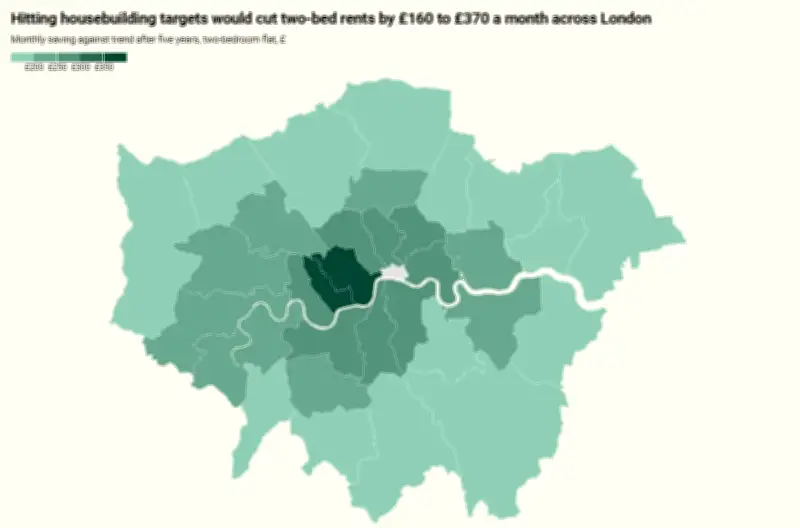
London renters could save £251 a month if the Government succeeds in hitting its housebuilding targets, according to new research by the Centre for British Progress (CBP).
The report argues that building enough homes to meet national targets would significantly reduce housing costs across the capital, where residents currently spend more than 40 per cent of their pre-tax income on rent.
Government targets and current building rates
Labour has pledged to build 1.5 million homes across England between July 2024 and the next general election, including 88,000 homes a year in London. However, ministers have already admitted there is only a “slim chance” of reaching the target.
Sir Sadiq Khan's London Plan also suggests that, even under favourable conditions, only around 55,800 homes can be built annually in the capital over the next decade.
How supply would lower rents
The CBP report argues that increasing supply would help drive down rents through so-called "moving chains", in which people move into new-build properties, freeing up older homes for others lower down the housing ladder.
According to the analysis, meeting national building targets would increase London's housing stock by 2.3 per cent annually. Over five years, that would lead to rents being 9.7 per cent lower than they would otherwise have been.
For tenants renting a typical two-bedroom flat in inner London, that would amount to a saving of £251 a month by the fifth year, the report claims.
Population growth and affordability
The think tank points to a longstanding mismatch between population growth and housebuilding as a major driver of rising costs. Between 2000 and 2019, London's population grew by 1.65 million people, while enough housing was built for only 1.39 million.
Rob Blackie, who co-authored the report and is seeking the Liberal Democrat nomination for the 2028 London mayoral election, said housing shortages had pushed rents to unaffordable levels.
He said: “London’s rents are far too high, because our Mayors have failed to build enough homes for the last 25 years.
“The good news is that we can bring down rents by hundreds of pounds a month if we increase housebuilding.
“If elected, cutting rents will be my top priority.”
By year five, even in the cheapest parts of London, renting a two-bedroom flat would cost £150 a month less. Savings by borough include Bexley at £163, Havering at £165, Sutton at £166, Croydon at £168, Hillingdon at £170, Bromley at £176, Redbridge at £180, Harrow at £183, Barking and Dagenham at £184, Waltham Forest at £184, Kingston upon Thames at £188, Enfield at £189, Lewisham at £191, Barnet at £199, Greenwich at £207, Brent at £207, Hounslow at £208, Newham at £213, Merton at £217, Ealing at £217, Haringey at £218, Richmond upon Thames at £238, Southwark at £251, Lambeth at £251, Tower Hamlets at £259, Wandsworth at £263, Hackney at £266, Hammersmith and Fulham at £280, Camden at £280, Islington at £288, Westminster at £354, and Kensington and Chelsea at £367.
Broader economic impact
The report also suggests that boosting supply would improve living standards. Authors found that, on current building trends, a typical Londoner's income after rent would effectively shrink by 0.37 per cent each year. If housing targets were achieved, that figure would instead rise by 1.15 per cent annually.
Co-author David Lawrence said the impact would be greater than many traditional cost-of-living measures.
“The Government is right to look for ways to give families breathing space,” he said. “The biggest one is hiding in plain sight.
“We find that hitting the Government’s building targets would reduce rents in London by £251 a month for ordinary households.”
The report also claims more housebuilding could ease pressure on councils struggling to accommodate homeless families. Even if only 10 per cent of new homes were delivered as social housing, researchers estimate the number of London households living in temporary accommodation could fall by as much as 59 per cent, saving local authorities around £435 million a year.