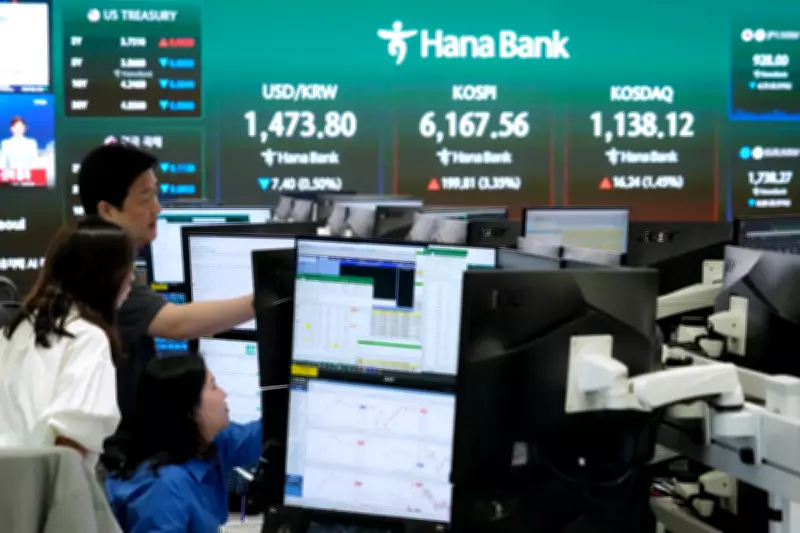
Asian shares experienced a broad uptick in early Wednesday trading, closely following a robust rally on Wall Street. This positive momentum was largely fueled by a decline in oil prices, spurred by renewed optimism that the United States and Iran may resume negotiations to end their ongoing conflict.
Market Performance Across Asia
In Japan, the Nikkei 225 index climbed 0.5% to reach 58,162.84. Australia's S&P/ASX 200 remained relatively stable, inching up less than 0.1% to 8,977.90. South Korea's Kospi saw a significant surge, jumping 3.0% to 6,145.18. Meanwhile, Hong Kong's Hang Seng edged up 0.7% to 26,045.80, and the Shanghai Composite gained 0.2% to 4,033.88.
Wall Street's Influence
The rally in Asian markets echoed strong performances on Wall Street. The S&P 500 added 1.2%, bringing it to 6,967.38, just 0.2% below its record high set in January. The Dow Jones Industrial Average rose 317 points, or 0.7%, to 48,535.99, and the Nasdaq composite climbed 2% to 23,639.08.

Oil Price Dynamics
Benchmark U.S. crude oil inched up by a mere 1 cent to $91.29 per barrel, while Brent crude added 48 cents to $95.27, representing less than a 1% increase after a 4.6% drop the previous day. Although these prices remain above the pre-war level of approximately $70 per barrel, they are well below the peak of $119.
Lower oil prices are beneficial for reducing operational costs across various industries. However, some analysts caution that the ongoing war means this optimism might be premature. Tim Waterer, chief market analyst at KCM Trade, noted, "The counterintuitive decline in crude appears driven by growing hopes that a second round of peace talks between Washington and Tehran could soon materialize. Traders are clearly choosing to price in the possibility of de-escalation rather than the immediate reality of restricted flows."
Global Economic Context
The International Monetary Fund has revised its forecasts, indicating that global inflation is expected to accelerate to 4.4% this year, up from 4.1% in 2025, contrary to earlier predictions of a slowdown to 3.8%. Additionally, the IMF downgraded its global economic growth forecast to 3.1% for the year, from 3.3% projected in January.
Broader Financial Markets
In the bond market, Treasury yields eased as falling oil prices alleviated some inflationary pressures. The yield on the 10-year Treasury fell to 4.25% from 4.30% late Monday. In currency trading, the U.S. dollar edged up to 159.03 Japanese yen from 158.79 yen, while the euro decreased to $1.1780 from $1.1797.
Asian economies heavily depend on access to the Strait of Hormuz, a critical waterway for crude oil exports from the Persian Gulf. Any disruptions in this region can restrict global oil supply, driving up prices and impacting inflation rates worldwide.