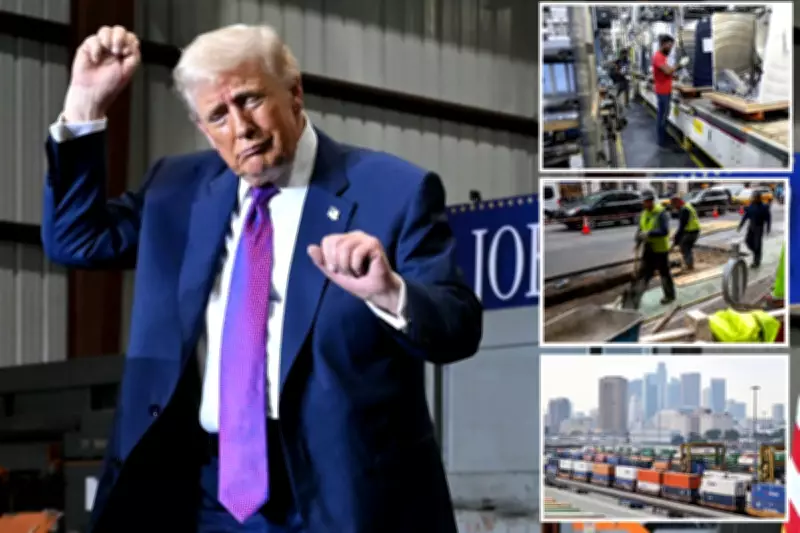
Trump's 'Made in America' Manufacturing Boom Exposed as Fantasy by Experts
President Donald Trump's vision of a "Made in America" renaissance, promising a golden age for manufacturing, is being dismissed as a fantasy by economists and lawmakers. Despite his claims of a manufacturing boom, evidence points to a significant bust, with job losses, investment uncertainty, and failed policies undermining his agenda.
Manufacturing Jobs in Decline
Trump pledged to usher in a manufacturing revival, tapping into nostalgia for midcentury American factories. However, the reality is starkly different. In the nine months following his declaration of "Liberation Day" with sweeping tariffs, tens of thousands of factory jobs have vanished. According to the Bureau of Labor Statistics, while 5,000 manufacturing jobs were added in January 2026, this still represents a net loss of 83,000 jobs compared to the previous year.
A congressional analysis by Democratic members revises this figure even higher, indicating that the U.S. lost over 100,000 manufacturing jobs in Trump's first year back in office. Senator Maggie Hassan, top Democrat on the Senate Joint Economic Committee, stated, "While President Trump promised us a manufacturing boom, the reality of his first year has been a bust." She attributed this to reckless tariffs burdening manufacturers.

Manufacturing employment peaked in 1979 with 19.5 million workers, nearly a quarter of the workforce, but has been declining since. Jobs increased during Trump's first term, plunged during the pandemic, saw a brief recovery under Biden's subsidies, only to evaporate by late 2024 as Trump gutted those efforts.
Tariff Agenda Backfires
Trump's tariff strategy, intended to rebalance global trade and revive American manufacturing, has faced significant setbacks. The Supreme Court recently struck down the bulk of his tariffs, ruling he lacked authority to impose them under federal law. This leaves billions in levies tied up in litigation, with experts warning of long-term damage to the U.S. economy.
Trump falsely claims tariffs are paid by foreign countries, but in reality, they raise costs for American importers and consumers. Dean Baker, senior fellow at the Center for Economic and Policy Research, explains, "When you put tariffs on intermediate goods, which most of our imports actually are, then you make manufacturing more expensive here." This has led to higher domestic manufacturing costs and consumer prices, flattening sales growth and risking job losses.
For example, steel tariffs boosted U.S. production but spiked prices for consumers. While protected firms like Coosa Steel in Georgia benefit, downstream users face increased costs. Domestic steel production has remained relatively flat, dropping from 97 million tons in 2019 to 90 million tons in 2025, despite reduced imports.
Clean Energy Projects Cancelled
While Trump heralds a manufacturing boom, his administration has pulled funding for dozens of clean energy projects, resulting in thousands of job losses. Over 350 clean energy projects or companies have canceled investments, delayed plans, or laid off workers since Trump's election, leading to nearly 173,000 jobs lost or delayed, according to Climate Power.
This contrasts sharply with the gains under Biden's Inflation Reduction Act, which spurred 385,000 new jobs in clean energy. Trump's cuts are projected to cause a $980 billion loss in cumulative GDP by 2030 and cost 760,000 jobs, rising to 900,000 by 2032, per Energy Innovation. Instead, Trump promotes oil and gas production, echoing his "drill, baby, drill" mantra.
Tech and AI Hopes Fade
Trump has centered semiconductor and tech manufacturing as key to economic and national security, touting billions in investments from chip makers. However, many subsidies stem from Biden's 2022 CHIPS and Science Act, and job growth remains unrealized. Semiconductor manufacturers have shed over 13,000 jobs since April due to rising material costs.

Additionally, the AI data center bubble is likely to pop, with states grappling with tax incentives and environmental concerns. Trump proposes legislation to protect energy ratepayers but won't block expansion. Baker notes these centers employ few people and rely on overseas materials, saying, "Even in the most optimistic scenario, you're not gonna talk about major manufacturing employment there."
In his State of the Union address, Trump omitted the word "manufacturing" entirely, despite earlier promises of factories and investment pouring into America. Experts conclude his renaissance is more fantasy than reality, with job losses and policy failures painting a grim picture for American manufacturing.