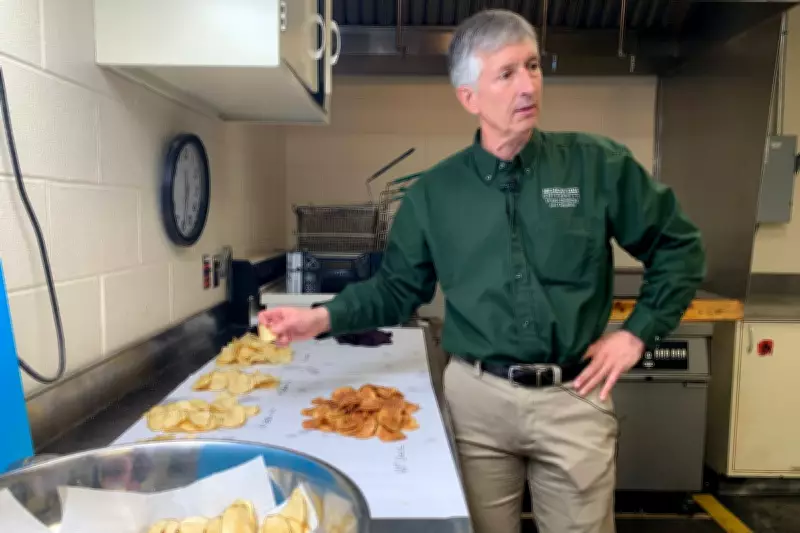
Researchers have spent decades breeding better potatoes for chips, and their work is far from over. There is a surprising amount of science in a bag of potato chips, involving complex genetics and constant adaptation to market trends.
The Science Behind the Crunch
Scientists have developed potatoes for chip makers that can grow in diverse climates, resist diseases and pests, and remain in storage for months while still delivering a satisfying crunch. Consumer trends also influence breeding; for instance, the shift to snack-size portions has increased demand for smaller chipping potatoes.
David Douches, a Michigan State University professor who leads the school’s Potato Breeding and Genetics Program, explained the dynamic nature of the industry. “The needs change, the costs, the pressures that they have, and the markets change. So we have to adapt to that with our varieties,” he said.

Douches has developed five new potato varieties for chips in the last 15 years. His latest breakthrough is a bioengineered potato that maintains a proper sugar balance when stored at colder temperatures, helping prevent rot. He is currently growing seeds for commercial testing, though the potato is not yet on the market.
Global Impact and Local Benefits
Douches’ work also addresses world hunger; he has developed disease-resistant varieties for farmers in Nigeria, Kenya, Rwanda, and Bangladesh. At the same time, his research supports U.S. chip makers and Michigan’s $2.5 billion potato industry. While Idaho leads the U.S. in potato production, Michigan is the top producer of potatoes for chips.
According to the National Chip Program, a cooperative involving Michigan State, 11 other university breeding programs, growers, chip companies, and the U.S. Department of Agriculture, there are around 50 unique potato varieties grown for chips in the U.S. today. Efforts to improve these varieties are constant. The program evaluates about 225 new potato varieties each year and selects 100 for further trials, said Tim Rendall, director of production research at Potatoes USA, the trade group overseeing the chip program.
Unusual Collaboration
The close partnership between researchers, farmers, and potato chip companies is unusual in the food industry, according to Phil Gusmano, vice president of purchasing at Better Made Snack Foods, which has produced potato chips in Detroit since 1930. Better Made worked closely with Douches when he was developing two of the varieties the company now uses. “We were able to talk about size profile and different needs that make a really good chip,” Gusmano said. “And the great thing is, they’re willing to listen to what we have to say, because if they put together a potato that doesn’t really meet the needs for the end processor, it doesn’t do them any good.”
Genetic Challenges
Breeding a new type of potato can take up to 15 years. The simple potato has a surprisingly complicated genetic structure, with four chromosomes in each cell compared to two in most species, including humans. This makes it harder to predict which traits cross-bred plants will inherit. “We’re never able to fix a trait and carry that over to the next generation, so it’s very difficult to find a potato that has all the traits that we want,” Douches said.
Douches became fascinated with potato breeding and genetics in graduate school. At Michigan State, he focuses on chipping potatoes because Michigan is a leading producer. Around 70% of the state’s potato crop is destined for chip processing, according to the Michigan Ag Council. The trade group estimates that one of every four bags of potato chips produced in the U.S. contains Michigan potatoes.
Storage Breakthroughs
Breeding potatoes that can sit in storage for nearly a year has been one of the biggest challenges in Douches’ 40-year career. Historically, farmers harvested potatoes and stored them in huge piles at around 50 degrees Fahrenheit (10 degrees Celsius). Colder temperatures cause sugar levels to rise, leading to darker chips, while warmer conditions can cause rot. “You think they’re just these inanimate objects, but they actually are respiring and breathing,” Douches said. “When you do that to them, you’ve got, like, a two- to three-day window where they’re happy.”

His Manistee variety, released in 2013, can be safely stored until July at 45 F (7.2 C). His new bioengineered potato can be stored at 40 F (4.4 C). Gusmano said Better Made used to source potatoes from outside Michigan for half the year because its fall-harvested Michigan potatoes could only be stored until February. The company now uses newer varieties, like Douches’ Mackinaw potato, which can be stored until July and is resistant to several common diseases. “We’re not shipping potatoes from all over the country to be fried here in Michigan,” Gusmano said. “Instead, they’re being shipped from an hour and a half away all year long.”