
Oil prices fell below $95 a barrel on Thursday morning, while Asian stocks climbed, as optimism grew over a potential deal to end the war with Iran. Brent crude opened 0.4 per cent lower at $94.55, before rising to $95.23 later as a refinery fire in Australia raised supply concerns. US West Texas Intermediate futures were down 70 cents at $90.59.
The moves came after reports that Iran could consider allowing ships to sail freely through the Omani side of the Strait of Hormuz as part of proposals in negotiations with the United States. However, Toshitaka Tazawa of Fujitomi Securities cautioned that many investors remain sceptical, noting that talks have repeatedly broken down even after apparent progress. He expected WTI to fluctuate between $80 and $100 until a peace deal is reached and navigation restored.
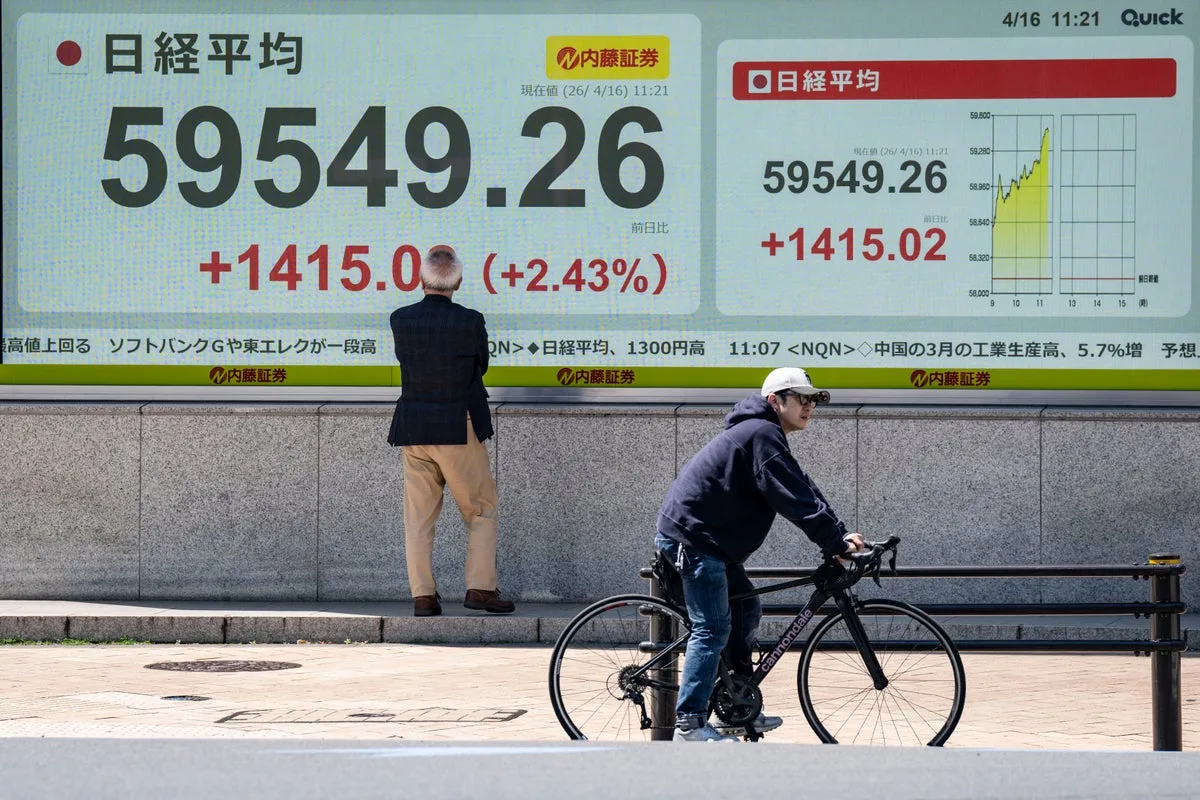
Asian equities extended their gains, with Japan's Nikkei hitting a fresh record, up 2.2 per cent. MSCI's broadest index of Asia-Pacific shares outside Japan gained 0.9 per cent, heading for a third consecutive session of advances, while S&P 500 futures also rose. The rally followed a strong Wall Street session in which the S&P 500 rose 0.8 per cent and the Nasdaq 1.6 per cent, buoyed by better-than-expected results from Bank of America and Morgan Stanley. Of the roughly 6 per cent of companies that have reported so far, 84 per cent have beaten analyst expectations.
Chinese shares rose 0.7 per cent after data showed the economy expanded by 5 per cent in the first quarter, beating forecasts. Elsewhere, the US dollar index was flat as geopolitical worries eased, the euro edged closer to its highest level since the war began at $1.1809, and gold slipped 0.6 per cent to $4,819.55. Taiwan Semiconductor Manufacturing Company, a key player in the AI sector, is due to report quarterly earnings later on Thursday, with a 50 per cent surge in net profit expected on strong demand for advanced chips.
Markets also absorbed news that Donald Trump threatened to remove Federal Reserve chair Jerome Powell from his board seat if he does not leave his post when his term as governor ends on 15 May, renewing concerns about the central bank's independence.
The conflict has caused the largest-ever disruption to global oil and gas flows, with Iran's closure of the Strait of Hormuz cutting off a waterway that normally carries about 20 per cent of the world's oil and liquefied natural gas. Analysts at ING estimated that roughly 13 million barrels per day have been disrupted, and warned that the physical market is becoming tighter every day without a restart of flows.




