Nissan has agreed to explore building cars in northern England for Chinese manufacturer Chery, a move that would secure jobs at the UK's largest car factory and mark the first mass-market Chinese car production in Britain.
The Japanese carmaker announced on Wednesday that it had signed a non-binding agreement, with discussions ongoing about contract manufacturing for Chery, which is partially owned by the Chinese state. If finalised, Nissan aims to start producing vehicles for Chery International UK at Sunderland's production line 1 in the 2027 financial year.
Chery has been aggressively expanding in the UK under its Chery, Omoda, and Jaecoo brands. The Jaecoo 7, a plug-in hybrid electric vehicle built in China, became the UK's top-selling model in March.

Massimiliano Messina, Nissan's chair for several regions including Europe, stated: "This is an important step forward for our operations. We are looking forward to working with Chery International UK in the coming months to finalise a position that is optimal for both companies."
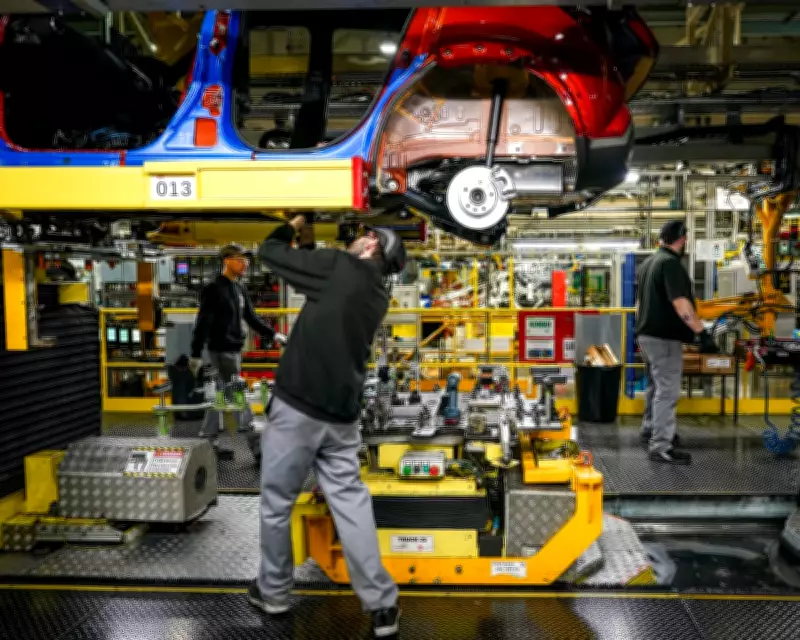
The Nissan Sunderland factory, widely regarded as one of Europe's most efficient plants, produces the Qashqai SUV, Juke crossover, and electric Leaf. However, it has faced challenges due to turmoil at its Japanese parent company and sluggish European car sales recovery post-pandemic. Nissan is undergoing a painful global restructuring, including plant closures in Japan.
Last month, Nissan consolidated production at Sunderland into one of its two lines, a move that did not result in job losses but opened the door for a Chinese entrant to use the other line. Simultaneously, the company cut 900 jobs across Europe, including a small number of office roles in the UK.
A deal with Chery would provide job security for approximately 6,000 workers. The site is operating well below its maximum capacity of 600,000 cars annually; in 2025, Sunderland produced 273,000 cars, down 3% from the prior year.
Steve Bush, national officer at Unite, the union representing Nissan workers, commented: "This is very good news for Nissan's Sunderland workers and the UK's automotive industry in general at a time of uncertainty for the sector. Chinese vehicles are increasingly visible on British roads, so it makes sense for UK workers to build them here as well."
Nissan's chief executive, Ivan Espinosa, had previously indicated that the company was considering manufacturing cars with Dongfeng, another Chinese carmaker.
The rise of Chinese manufacturers as a major force in the automotive industry has placed immense pressure on traditional European rivals. Chinese carmakers can undercut European counterparts, particularly on electrified vehicles, due to substantial state subsidies, lower labour costs, and China's dominance in battery production.
David Bailey, a professor of business economics at the University of Birmingham, described the potential deal as "historic." He said: "Twenty years ago Chinese brands were trying to break into Europe. Now they're going to build cars in Britain's biggest car factory. China isn't just competing with western carmakers anymore; it's becoming part of the industrial base."
Nissan has previously sold two other plants to Chery. The Chinese carmaker began production in April at a plant in Ebro, near Barcelona, and acquired another plant outside Pretoria, South Africa, in January.
Other European carmakers are also collaborating with Chinese manufacturers rather than defending market share. Stellantis, owner of Peugeot, Fiat, and Vauxhall, said last month it would produce cars for China's Leapmotor in Spain, while Ford has reportedly agreed to sell part of its Valencia, Spain, plant to Geely.
Volkswagen has expressed openness to working with Chinese partners, although Xiaopeng, a potential partner, recently described German factories as "a little bit old."
Gary Lan, UK chief executive of Omoda and Jaecoo, stated last month that Chery aims to be a "top three" manufacturer by sales in Britain and indicated that producing vehicles in the UK was on its agenda within the next few months. Chery has also opened a research and development headquarters for commercial vehicles in Liverpool, underscoring its commitment.
The companies did not disclose whether Nissan would produce hybrid or electric cars for Chery in the UK.

The British government had previously suggested Jaguar Land Rover might build cars for Chery, but a senior executive at the UK's largest automotive employer said that was not under serious consideration.