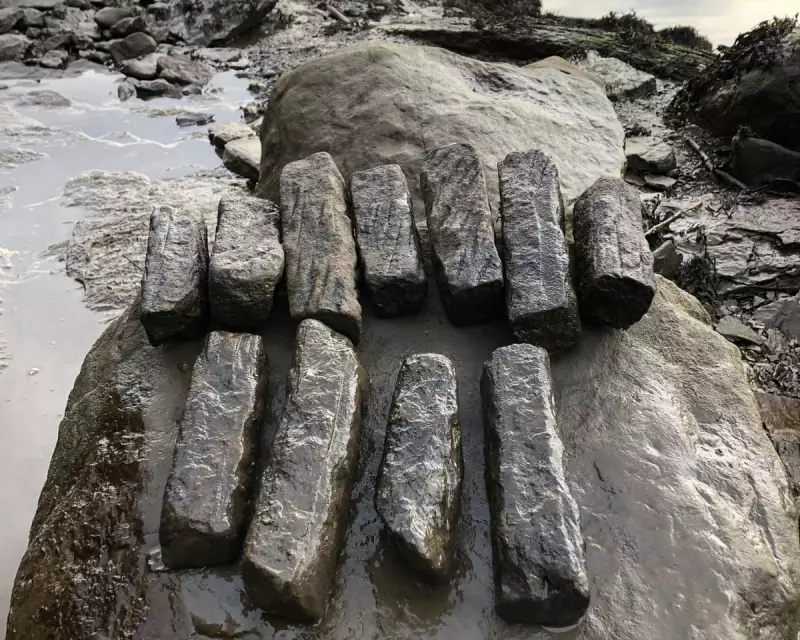
Archaeologists have made a landmark discovery in the north of England, unearthing evidence of a vast and previously unknown Roman industrial complex on the banks of the River Wear in Sunderland.
A Staggering Find of Roman Tools
The team, led by Durham University's honorary fellow Gary Bankhead, was astonished to recover more than 800 whetstones from the site at Offerton, with clear indications that hundreds, if not thousands, more remain buried. Whetstones were essential stone bars used for sharpening bladed tools and weapons and were commonplace across the Roman Empire, with every soldier requiring one.
"This is staggering," said Bankhead, highlighting the scale of the find. He noted that only about 250 whetstones had previously been recorded across the entire British Isles. This makes the Sunderland site the largest known whetstone discovery in north-west Europe, firmly placing north-east England within Rome's advanced manufacturing and trade networks.

The Birthplace of an Ancient Industry
The theory is that Offerton functioned as a dedicated production hub. Sandstone was likely quarried on the river's north bank and transported to the flatter southern bank at Offerton to be crafted into finished whetstone bars. Its riverside location made it an ideal trading post, where goods could be loaded onto vessels for distribution across Britain and the near continent.
Supporting this idea is the discovery of 11 stone anchors at the same site—the largest number found at any river location in northern Europe. All the whetstones recovered were damaged or off-cuts, which experts say makes perfect sense. "The second it fractures, it's useless," Bankhead explained, "which is why they remain there. The perfect ones would have been shipped out."
Putting Sunderland on the Roman Map
One of the most significant outcomes of the excavation is that it puts Sunderland on the Roman map for the first time. Despite being just 10 miles south of Hadrian's Wall, there had been virtually no archaeological evidence of Roman activity in the area until now.
The site is believed to be the first in Britain where stone was deliberately quarried specifically for whetstone production. The find was made possible by volunteer enthusiasts from the Vedra Hylton community association, assisted by researchers and students from Durham University.
Eleri Cousins, an assistant professor in Roman archaeology at Durham University, said the discovery has the potential "to make a significant addition to our understanding of manufacturing and industry in Roman Britain, particularly in the militarised north of the province."
Sunderland City Council leader, Michael Mordey, connected the ancient find to the city's enduring industrial spirit, noting that generations have made "ships, coal, pottery, glass and cars" on the Wear. "This work has revealed yet another generation of makers," he said.
The discovery will feature in an upcoming episode of BBC Two's Digging for Britain, available on iPlayer from 7 January. Bankhead concluded, "This has to be one of the most significant Roman archaeological discoveries in the north of England in the last hundred years."