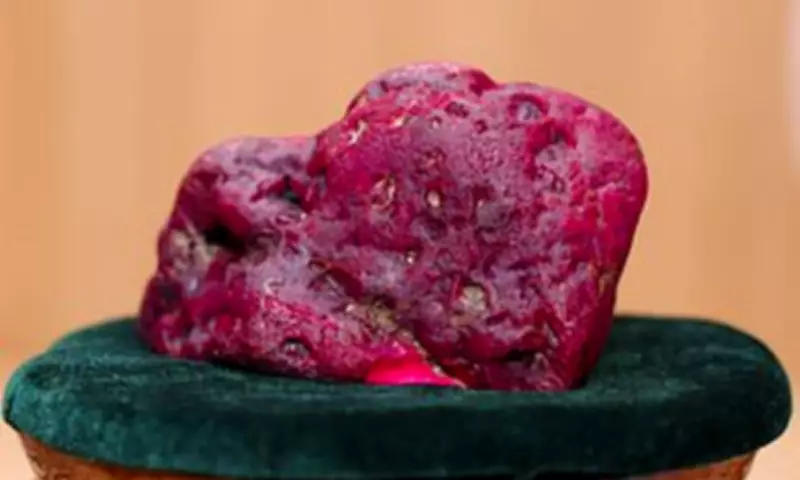
A colossal 11,000-carat ruby has been unearthed in Myanmar's conflict-ridden Mogok valley. The enormous gem weighs 2.2 kg (4.8 lbs), comparable to the weight of a small dog. This discovery ranks among the largest gems ever found in the country, renowned globally for its ruby production.
Possessing a rare 'pigeon blood' colouration and exceptional quality, Myanmar's military-backed government asserts that this ruby could be the most valuable ever discovered. Although it is half the size of the record-breaking 21,450-carat ruby found in the same area in 1996, this newly found stone is considered more valuable due to its superior colour and clarity.
The stone has yet to be formally valued, but high-quality rubies can command prices of up to $1,000,000 per carat, according to the International Gem Society. The government described the ruby as 'exceptionally large, rare, and difficult to find,' noting its purplish-red colour with yellowish undertones and high-quality colour grade.

The Nature of Rubies
Rubies are naturally forming crystals of red corundum, with their value derived largely from size, colour, and clarity. Most rubies are around one or two carats, making gems weighing three carats or more exceptionally rare. This scarcity means larger gems are worth far more than their quality alone would suggest.
According to gemstone traders Gemdaia, the most desirable rubies possess an intense, deeply saturated red colour. The purer and more intense the colour, the higher the value. The most valuable rubies are known as 'pigeon blood' stones, which exhibit a vibrant, almost fluorescent red hue. The vast majority of these prized stones originate from Myanmar, which produces approximately 90 per cent of the world's rubies.
These stones are typically found in the valleys of Mogok and Mong Hsu, which have been mined for precious gems for over 800 years. Myanmar also has a long history of producing some of the world's largest rubies, including the 2,789-carat 'NaSaKa Ruby' found in 2022, a 21,450-carat gemstone unearthed in 1996, and the 496-carat 'State Law and Order Restoration Committee Ruby' found in 1990.
Historically, gemstones of this size and quality can fetch tens of millions at auction. For instance, the Oppenheimer Blue, a blue diamond weighing 14.62 carats, sold for $57.5 million (£42.8 million) in 2016. Similarly, the Williamson Pink Star (11.15 carats) sold for $57.7 million (£43 million) in 2022.
The Myanmar government added, 'Although the ruby discovered in 1996 was the largest in terms of weight, the recently discovered ruby is considered more valuable because its colour and quality are superior in comparison.'
Conflict and Gemstone Trade
All of these enormous gems were found in the Mogok region, which has recently experienced violent clashes between government forces and ethnic minority militias. The region was seized in 2024 by the Ta'ang National Liberation Army (TNLA), a guerrilla force representing the Palaung ethnic minority. While the TNLA had been operating the mines, control was returned to the army last year under a China-brokered treaty.
The security of Myanmar's mining areas has been particularly fraught in recent years as warlords battle for control over lucrative gemstone regions. These gems are either sold legitimately or smuggled out of the country to fund the conflict. Human rights organisations, such as the Britain-based group Global Witness, have called on jewellers to stop purchasing rubies from Myanmar, as they serve as a vital revenue stream for the oppressive military government.
Lab-Grown Diamonds: An Alternative
While natural rubies and diamonds command high prices due to their rarity and the conditions required for their formation, scientists are now growing diamonds in laboratories. A small 'seed' diamond acts as a scaffold; scientists place it in a vacuum chamber to remove impurities, then funnel hydrogen and methane gas heated to 3,000°C (5,400°F) to create plasma. The gases release carbon atoms that collect on the seed, naturally copying the crystal structure of organic diamond. Each artificial stone grows at a rate of around 0.0002 inches (0.006 mm) per hour.