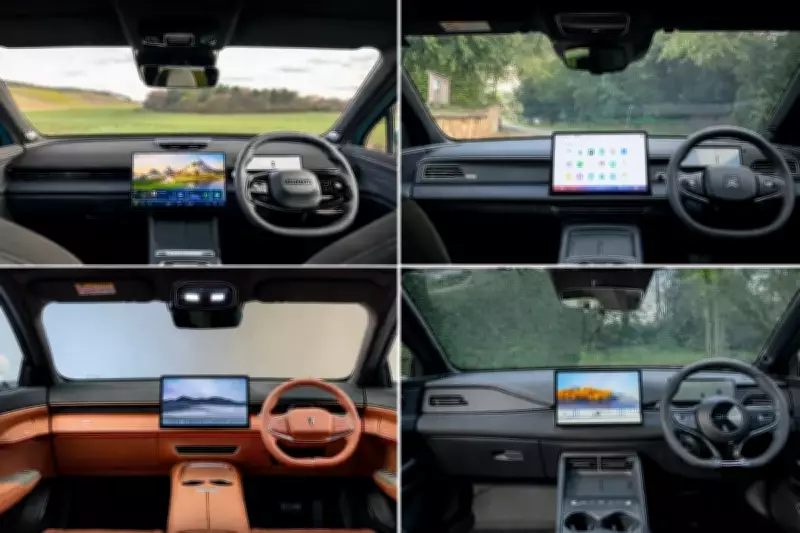
In the rapidly evolving automotive landscape, a striking trend has emerged among Chinese car manufacturers: a pervasive uniformity in interior design. This phenomenon, often described as cookie-cutter, sees brands such as Chery, Omoda, BYD, Xpeng, Changan, Geely, and MG adopting remarkably similar layouts, raising questions about originality and consumer choice.
The Blueprint for Uniformity
Imagine sketching a basic car interior: two horizontal lines, vertical lines descending, a central touchscreen infotainment system, a squared-off steering wheel, and a driver display screen. Add wireless phone chargers, cup holders, and a lidded storage compartment, and you have replicated the interior of nearly any new Chinese-designed vehicle. This design template is so ubiquitous that it spans multiple models, from the Omoda 7 to the BYD Seal 6, creating a sense of anonymity across brands.
External Similarities and Industry Contrasts
The lack of differentiation extends beyond interiors to exteriors, where variations are often limited to badges or lighting signatures. In contrast, brands like Cupra demonstrate that innovation is possible within shared technological platforms, as seen with the Cupra Terramar. This raises a critical question: if Cupra can achieve distinctiveness, why do many Chinese carmakers struggle to break free from this homogenised approach?

Insights from Design Leadership
Steve Fowler engaged with MG's design chief, Jozef Kaban, at the launch of the MG4 Urban, a model that adheres to these conventional interior lines. Kaban, with a prestigious background at Volkswagen Group, BMW, and others, acknowledged the industry's reliance on data and risk aversion in China. He explained, "The world is trying to be perfect and therefore using lots of tools which are there to help. Everybody runs with similar data, and in the end, everybody is prepared for risk, but only limited risk."
Despite this, Kaban expressed optimism for MG's future, highlighting the brand's heritage as a potential source of uniqueness. He emphasised, "The future belongs to those who are able to stand out and have a point of difference. I think we will see MG keeping a recognisable character." This suggests a gradual shift towards more original designs, though retro-inspired models are not imminent.
Consumer Expectations and Market Dynamics
Kaban noted that customers often do not know what they want until they see it, underscoring the importance of bold design initiatives. While Chinese cars offer appealing features, particularly in pricing, the industry's current conformity may hinder long-term brand differentiation. As more models flood global markets, the need for distinctive design becomes paramount to capture consumer interest and compete with established automotive names.
Looking Ahead: A Call for Innovation
The DriveSmart analysis concludes with a hopeful outlook, urging carmakers to embrace creativity. As Chinese brands continue to expand, the potential for groundbreaking designs that wow consumers and set new standards in the automotive world remains vast. The journey towards true originality may be slow, but with leaders like Kaban advocating for change, the future promises more diverse and exciting car interiors.