China's Robotics Revolution: The Race to Automate the Global Factory Floor
In a world where science fiction often blurs with reality, China is aggressively pushing the boundaries of robotics, aiming to transform global manufacturing. The journey to understand this technological surge led me to visit 11 robotics companies across five Chinese cities, uncovering a landscape where ambition meets rapid innovation.
The Visionaries Behind the Machines
Chen Liang, the founder of Guchi Robotics, embodies the drive behind China's automation push. A tall, heavy-set man in his mid-40s with square-rimmed glasses, Chen's calm demeanor belies his passion for robotics. Based in Shanghai, Guchi Robotics specializes in creating machines that install wheels, dashboards, and windows for top Chinese car brands like BYD and Nio. The company's name, derived from the Chinese word "guzhi" meaning "steadfast intelligence," reflects Chen's engineering-focused approach to solving what he sees as a liberation of workers from tedious factory tasks.
For nearly two decades, Chen has dedicated himself to automating the "final assembly" stage of car production—the complex process where all composite pieces come together. While his robots can currently mount wheels, dashboards, and windows without human intervention, he estimates that 80% of final assembly remains unautomated. This is the challenge he has set his sights on, driven by a belief that technology can eliminate the drudgery of factory work.

The Technological Backbone: AI and Deep Learning
Across China, artificial intelligence has become ubiquitous, but it is the fusion of AI with robotics that excites politicians and industrialists. The current robotics boom is powered by deep learning, the same mathematical engine behind large language models like ChatGPT. This technology allows machines to learn by discerning patterns from vast datasets, potentially enabling them to navigate the physical world with human-like dexterity.
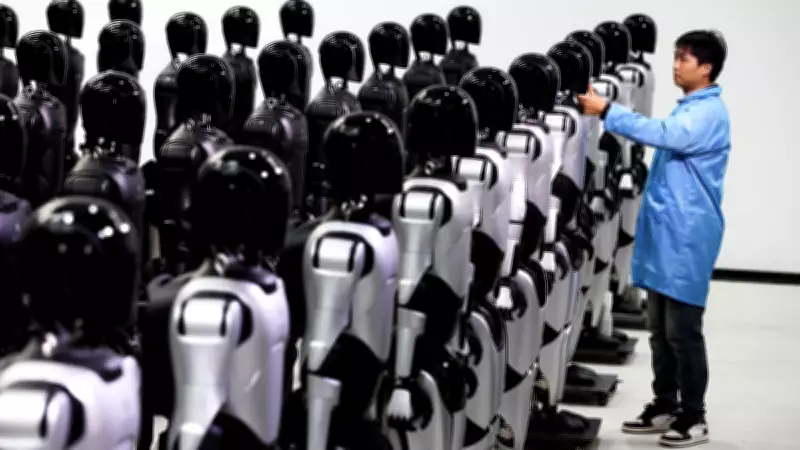
The goal for many technologists is the development of humanoid robots capable of performing factory labor, a sector that employs hundreds of millions globally. To achieve this, China has committed staggering resources, including a £100 billion fund announced in 2025 for strategic technologies like robotics, quantum computing, and clean energy. Major cities have also invested heavily, resulting in roughly 140 Chinese firms now vying to build humanoids.
Showcasing Progress: From Cheerleading to Cartwheels
The speed of advancement in Chinese robotics is startling. At the lunar new year festival gala in February, a state-choreographed spectacle comparable to the Super Bowl in scale, robots performed comedy sketches and martial arts routines for hundreds of millions of viewers. Just a year earlier, they were limited to synchronized cheerleading; now, they execute cartwheels and parkour. This display sends a clear message: China is positioning itself as the global leader in robotics production.
Global Implications and Western Buyers
Despite the sci-fi allure, a world filled with AI-powered humanoid robots remains in development. During my visits, I encountered entrepreneurs operating in an environment deeply integrated with municipal governments, blurring the lines between private and public sectors. Many of these companies already have eager Western buyers. For instance, at Guchi Robotics, a team from General Motors was testing wheel-installation machines for shipment to Canada. Jack, an American engineer from GM's "manufacturing optimization" division, explained that his job involves eliminating factory workers to meet annual reduction targets. The purchase of Guchi machines alone would remove 12 assembly operators from a single factory line.
Chen highlights a key advantage for Chinese robotics: cost and speed. He believes Chinese and American engineers are equally skilled, but China's ability to deploy large teams—1,000 workers versus 100 in the U.S.—accelerates problem-solving. This efficiency is crucial as industries worldwide seek automation solutions.

The Humanoid Race: From Acrobats to Practical Tasks
Companies like Galbot are taking a more pragmatic approach to robotics. Founded in 2023, Galbot focuses on building robots that perform mundane tasks, such as picking up items and setting them down safely. Unlike their acrobatic counterparts, which rely on pre-programmed instructions, Galbot's robots use vision-language-action models (VLAs) to operate in fluid environments. While they cannot yet handle complex tasks like washing dishes, founder Wang He aims to deploy 10,000 robots for basic retail and factory work within three years.
Chen's collaboration with Galbot exemplifies the synergy driving innovation. He visited their Beijing headquarters to explore deploying robots in electric vehicle factories, offering his decades of manufacturing expertise to define tasks and data needs. Their target: enabling a Galbot humanoid to fasten a screw in under eight seconds, a microcosm of the challenges in automating intricate factory work.
Hardware Advancements and Global Competition
Unitree, another key player, has shipped over 5,500 humanoid robots, more than any company worldwide. Their robots, showcased in viral videos like a concert backup dance for pop star Wang Leehom, have impressed even Elon Musk. Unitree's hardware is highly advanced and remarkably affordable, with robots starting at $1,600 compared to tens of thousands for American equivalents. This cost advantage stems from China's dense hardware supplier networks in regions like the Yangtze River Delta and Pearl River Delta, allowing rapid prototyping and iteration.
The robotics industry in the U.S. and China can be seen as a spectrum. American companies, insulated by deep venture capital, often aim for general-purpose humanoids capable of multiple tasks. In contrast, Chinese firms, driven by commercial pressure and government support, focus on specialized robots that excel at specific functions. This dynamic suggests a future where the U.S. leads in generalized robotics, while China supplies cheap, reliable robots for targeted applications.
Training the Robots: The Role of Teleoperators
Behind the scenes, teleoperators play a crucial role in training robots. At Leju Robotics' facility in Beijing, roughly 100 workers guide robots through tasks like wiping tables or sorting boxes, collecting data to train VLAs. These teleoperators, often young adults from vocational programs, perform repetitive actions to build datasets, a process that can be dehumanizing but offers stable employment. Ulrik Hansen, co-founder of Silicon Valley-based Encord, predicts a "huge boom" in teleoperations, framing it as the "new manufacturing job" that could outnumber roles lost to automation.
Government Coordination and Societal Impact
China's rapid technological normalization is partly due to coordinated government efforts. Since President Xi Jinping took power, there has been a shift from "market-driven" innovation to party-led "unified leadership" in setting tech priorities. Local governments compete to attract robotics startups, offering resources like factory space and funding. This support has fueled intense competition among cities, each backing its own champions, such as Hangzhou with Unitree and Beijing with Galbot.
However, this boom raises social questions. With 120 million factory workers in China, many with vocational training, automation threatens their livelihoods. Chen acknowledges this, suggesting higher-skilled workers could transition to training robots, but offers no solution for lower-skilled individuals. The broader economic context, including youth unemployment and subsidy-driven price wars, adds complexity to China's robotics narrative.
Looking Ahead: Automation's Inevitable March
Chen remains optimistic, predicting near-full automation of factory assembly by the mid-2030s. His pragmatism is tempered by recognition of deep learning's limitations, but he views technological displacement as an unstoppable force. As he prepares to expand business with American companies like Tesla and GM, Chen highlights the mutual dependency between the U.S. and China. Despite political decoupling rhetoric, practical collaborations continue, driven by shared interests in efficiency and innovation.
In the end, China's robotics revolution is not just about building machines; it's about reshaping global labor and industry. As robots learn to fasten screws and fold laundry, the human workers who train them stand at the crossroads of a transformative era, their contributions often invisible but undeniably pivotal.