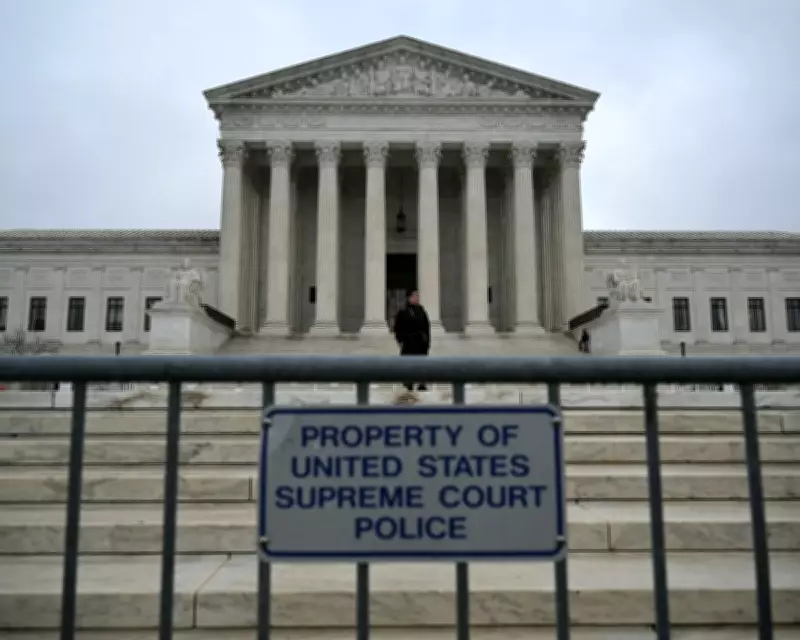
Supreme Court Declares Trump's Tariff Policy Unconstitutional
The US Supreme Court has delivered a landmark ruling, striking down former President Donald Trump's flagship policy of imposing tariffs on foreign imports. In a 6-3 decision, the court found that Trump exceeded his authority by unilaterally enacting tariffs without seeking congressional approval, a move he had defended as part of his effort to revitalise American manufacturing.
Trump, who reportedly called the verdict a "disgrace", announced the tariffs on what he termed "liberation day" last April. They applied to dozens of countries, including war-torn Syria, impoverished Lesotho, and major economies like the UK, China, Canada, Mexico, Japan, and EU nations, with rates varying across sectors.
Legal Basis and Implications of the Ruling
The court's conservative-majority panel ruled that the International Emergency Economic Powers Act (IEEPA) of 1977, which Trump invoked to implement the tariffs, does not authorise the president to impose tariffs. This decision affirms earlier judgments by lower courts that deemed the tariffs illegal under IEEPA, a law designed to address national emergencies.

Experts suggest that Trump is unlikely to abandon his trade war despite this setback. With slowing economic growth as a backdrop, he may pivot to other tariff regimes or trade barriers to maintain his international trade policy. Erin McLaughlin, a senior economist at The Conference Board, noted that while the ruling is a blow to Trump, it is not a knockout, as he has alternative legal avenues, such as Section 232 investigations for targeted tariffs on sectors like steel, and Section 122 of the 1974 Trade Act for temporary import surcharges.
Financial and Business Ramifications
Tariff revenues for last year are estimated between $240 billion and $300 billion, with US manufacturers and consumers bearing most of the cost. If the US government is forced to repay these funds to importers, the financial impact could be vast, though experts like McLaughlin indicate that refunds would not occur soon. Supreme Court Justice Brett Kavanaugh described the potential refund process as likely to be a "mess".
Businesses that have invested heavily in adapting to the new import regulations are awaiting clarity on long-term plans. Richard Rumbelow, director of international business at Make UK, emphasised the need for clear guidance on implementation and resolution of remaining Section 232 tariffs on UK steel and aluminium.
International Reactions and Trade Deal Uncertainties
The UK's Department for Business and Trade stated that the ruling does not affect the preferential deal negotiated on steel, autos, and pharmaceuticals, expecting the UK's privileged trading position with the US to continue. Meanwhile, the European Commission is analysing the ruling carefully, with spokesperson Olof Gill advocating for stability and predictability in trade relations.
The German Confederation of Industries (BDI) hailed the decision as a strong signal for the rules-based trade order. However, the EU-US trade deal, struck last year in Scotland, faces uncertainty as the European Parliament has yet to ratify it and may pause proceedings again, similar to previous pauses over diplomatic disputes.
As Trump prepares for his upcoming State of the Union address, the global trade landscape remains in flux, with stakeholders closely monitoring his next moves in light of this judicial rebuke.