

Federal Renewable Energy Support for Farmers Gutted Under Trump Administration
Farming in America remains a challenging enterprise, where securing affordable energy can often determine the thin line between profitability and financial loss. However, obtaining federal assistance to transition to renewable energy sources has become significantly more arduous since Donald Trump's return to the White House, according to a collaborative investigation by The Associated Press and Grist.
Trump has consistently expressed hostility toward renewable energy, instead championing fossil fuels as pivotal to American energy dominance. The AP-Grist project meticulously analyzed how recent federal policy shifts on energy are impacting agricultural producers nationwide. Their findings reveal that two programs crucial for renewable energy expansion—a rural-focused initiative known as REAP and a clean energy tax credit—have been dramatically scaled back.
REAP Program Grinds to a Halt
Through the Rural Energy for America Program (REAP), the U.S. Department of Agriculture traditionally issues grants and loans to farmers, ranchers, and rural businesses seeking to adopt renewable energy solutions, such as installing solar panels to reduce utility expenses. Since its inception nearly two decades ago, REAP has supported tens of thousands of renewable energy and efficiency projects, disbursing grants totaling over $1.8 billion.

The program received a substantial boost from funding allocated under the Inflation Reduction Act in 2022 and enjoyed bipartisan support until recently. However, the AP-Grist analysis of USDA data uncovered that REAP has not committed a single dollar to renewable energy development since September. Although the agency pledged to reopen REAP's grant application cycle last October, it has failed to do so.
While the loan guarantee program—targeted at larger farm and rural business ventures—remains technically open, the analysis indicates that no new agreements have been awarded this fiscal year. Furthermore, on March 31, the USDA announced a suspension of all REAP grant awards to update regulations in compliance with a Trump executive order issued in July.
A USDA spokesperson described the suspension as temporary but declined to specify its duration.
Clean Energy Tax Credit Tightened, Projects Abandoned
The Energy Policy Act of 2005, enacted under President George W. Bush, introduced a 30% investment tax credit for large-scale clean energy projects, providing a significant impetus to the solar industry. This tax credit was extended for eight years during the Obama administration and again under Trump in 2020.
When President Joe Biden signed the landmark climate bill in 2022, the tax credit was extended once more through 2032 or until specific emissions targets were achieved. However, under Trump's tax legislation passed by Congress last year, the eligibility timeline for credits was accelerated. Commercial solar projects must now be under construction by July 2026 and operational by the end of 2027 to qualify for the credit.
The AP-Grist analysis identified at least 126 solar projects proposed since 2024—all situated on or adjacent to farmland—that are pending regulatory approval. Collectively, these projects would generate approximately 20 gigawatts of renewable electricity, sufficient to power around 4.5 million homes. Numerous developers are now abandoning projects, citing an inability to meet the stringent new deadlines.
Impact on Farmers and Rural Communities
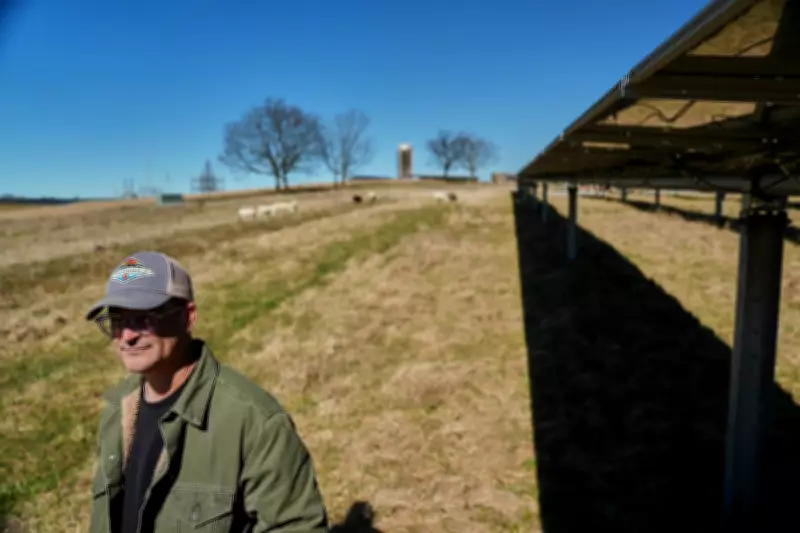
Daniel Bell, a sheep farmer from Kentucky, exemplifies the practical consequences of these policy changes. Bell supplements his income by grazing his flock on land owned by a commercial solar operation, where the sheep maintain vegetation beneath solar arrays. With his flock expanding, Bell requires a new barn and intended to power it with rooftop solar, only to discover that the Trump administration has effectively halted the grants that would have facilitated this on his property.
Bell emphasized that, for him, this issue revolves around the freedom to pursue initiatives that reduce his expenses. Robert Bonnie, who served as undersecretary for farm production and conservation at the USDA under the Biden administration, warned that the withdrawal from funding renewables will reverberate across rural America.

Bonnie highlighted that part of the USDA's mandate has been to invest in rural regions while integrating rural prosperity into the climate agenda. "In states like Iowa and Texas, renewables are crucial not only for additional power, lower electricity bills, and clean energy but also for farmers' financial well-being," Bonnie stated. "Any retrenchment in this area is profoundly problematic."
In the fiscal year commencing October 1, the investigation found that the USDA has not awarded any rural energy grants or loan guarantees, marking a stark departure from previous support mechanisms. This policy shift underscores a broader retreat from federal backing for renewable energy in agricultural sectors, potentially jeopardizing both economic and environmental progress in rural communities.





