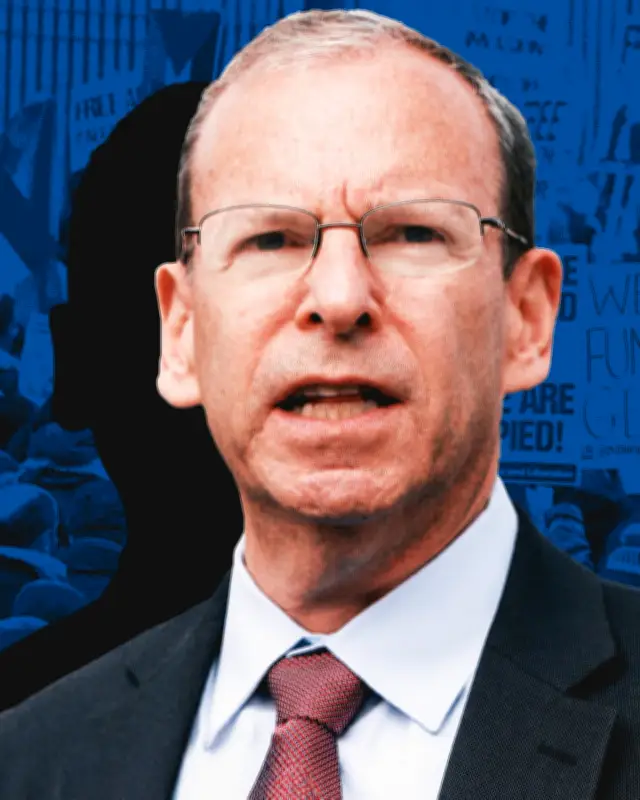
When Daniel Biss addressed his supporters after clinching the Democratic nomination in Illinois's ninth congressional district this past March, he paid homage to a lobby group. "This victory belongs to J Street," Biss declared. The reference was to the "pro-Israel, pro-peace, pro-democracy" advocacy organization, the longtime underdog rival to Capitol Hill powerhouse Aipac.
Growth and Transparency
Senior leaders say J Street's staff has grown by 50% in the last five years, and both its budget and the number of individual donors have doubled. J Street raised $1.3m in June, its biggest monthly haul ever, according to its vice-president of political and digital strategy, Tali deGroot, and it expects to spend at least $13m in this election cycle, up from $9m in 2022. That's a far cry from the hundreds of millions Aipac will pump into this year's races. DeGroot said J Street is "ridiculously committed to transparency" and only raises money for candidates who publicly affiliate with it. Since 7 October 2023, a growing list of elected officials, including senators Amy Klobuchar, Chris Coons and Jack Reed, has sought J Street's endorsement.
Electoral Setbacks
Nonetheless, a parade of J Street endorsees – Sharif Street, Tom Malinowski, Sue Altman, Antonio Reynoso, Dan Goldman and Diana DeGette – were defeated by progressive challengers with more pro-Palestinian positions. In the Michigan Senate primary, the group's favored candidate, Mallory McMorrow, dropped out in July after failing to gain traction. J Street's penchant for playing to the middle was again on display when nearly half of the House Democratic caucus voted to cut off aid to Israel. The group opposed the amendment but hailed it for "sending a strong message … that it is time for a fundamentally different American approach to the US-Israel relationship and the region."
Shifting Public Opinion
The Democratic electorate as a whole is rapidly moving left on Israel. Eight in 10 Democrats hold an unfavorable view of Israel, according to recent polling. Democratic pollster Adam Carlson said: "You rarely see a shift in public opinion this rapid. The closest thing I can think of is gay marriage, and that [took] almost a decade. This is happening over the course of two or three years." The two-state solution J Street has long championed seems increasingly remote, with nearly four in five Jewish Israelis now opposing Palestinian statehood.
Founder and Internal Strife
J Street was founded nearly two decades ago by Jeremy Ben-Ami, a former domestic policy adviser to Bill Clinton. In November 2023, a group of younger staff members presented an internal letter demanding J Street call for a ceasefire. Ben-Ami declined, prompting a handful of resignations. Marisa Edmondson, a former member of the communications team, recalled: "The rhetoric was constantly like, ‘Oh, you know, we’ve got to build up power, rise to the moment,’ But this was the moment, and we didn’t fucking do a single thing. We sat on our butts." In August 2025, Ben-Ami issued a statement on the term genocide: "I simply won’t defend the indefensible."
Criticism from Left and Right
Beth Miller, political director of Jewish Voice for Peace Action, said: "The idea was to create a counterforce to Aipac, and that was desperately needed at the time. It created an opening for members of Congress to be more critical of the Israeli government." But she added that the Democratic mainstream had moved sharply left, "and J Street has not really kept up." Yousef Munayyer of the Arab Center Washington DC said: "With big, bad Aipac now being as toxic as it is, they’re not really as susceptible to that attack as they used to be." Former J Street endorsee Jamaal Bowman said he concluded the two-state solution was no longer possible: "We’re lying to the American people and we’re lying to ourselves. And that became my frustration with Jeremy and J Street when I was in Congress, because they were always trying to thread this impossible needle."
Accomplishments and Future
At least 60% of congressional Democrats now carry J Street's endorsement, compared with just 22% in 2012. Ben-Ami noted: "There are people who’ve been in Aipac or other groups who are coming now to the realization that they were wrong." When asked about J Street's impact given the doubling of West Bank settlers and devastation in Gaza, Ben-Ami said: "J Street exists to change American policy. That’s it. I’m hopeful, really hopeful, that a change in American policy will have an impact on what’s happening in Israel. But everything we do has to be calibrated to impact our targets, American policymakers." He acknowledged that Israeli politics must shift for J Street to remain viable. Rahm Emanuel recently borrowed Ben-Ami's "23-state solution" framing in a speech at Tel Aviv University.