

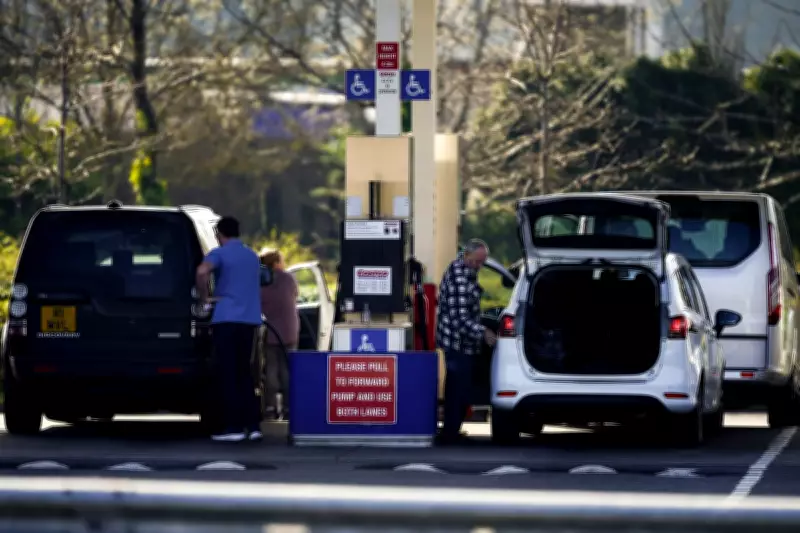
New analysis has revealed that the ongoing Iran oil crisis has inflicted a staggering financial burden on UK drivers, with motorists forced to pay an additional £307 million for fuel since tensions escalated in the Middle East. The RAC Foundation, a motoring research charity, conducted the detailed study, highlighting the direct economic impact of the conflict on everyday consumers and businesses across the nation.
Soaring Oil Prices and Pump Costs
Oil prices have skyrocketed to as much as 120 dollars per barrel in response to Iran's aggressive stranglehold on tankers navigating the critical Strait of Hormuz. This dramatic increase in global oil markets has translated directly into higher costs at UK forecourts, placing immense pressure on household budgets.
Detailed Price Increases
The RAC Foundation's analysis shows that the average price of a litre of petrol at UK filling stations has surged from 132.9p on February 27 to 146.4p as of this Monday. Diesel prices have experienced an even more pronounced hike, climbing from 142.4p to 169.8p over the same period. These figures underscore the rapid inflation in fuel costs directly attributable to the geopolitical instability.

Calculating the Financial Impact
By meticulously accounting for average daily pump prices and national fuel consumption rates, the charity calculated that UK drivers have spent an estimated £4.574 billion on petrol and diesel since February 28. Crucially, their analysis determined that this total would have been significantly lower at £4.267 billion if pump prices had remained broadly stable before the conflict.
The £307 million difference has been described by the RAC Foundation as a "direct cost" of the war, a financial penalty that continues to accumulate daily. Steve Gooding, director of the RAC Foundation, emphasized the widespread ramifications, stating that this puts a tangible financial price on the war not just for UK drivers but also for the nation's businesses.
Broader Economic Consequences
Gooding further explained that whether running a household or a company, fuel prices constitute a significant portion of any budget. He warned that even those who do not drive will inevitably feel the impact through higher transport costs, as firms pass on their additional expenses to customers. This cascade effect is exacerbating the ongoing cost-of-living crisis, leaving many with little immediate recourse.
"In the short term, people have little option to change the way they live and so they are stuck with footing the refuelling bill despite the increase in cost," Gooding noted, highlighting the inelastic demand for fuel in daily life.
Government and Policy Responses
In light of these soaring prices, there are growing calls for the Government to postpone a planned increase in fuel duty scheduled for September. Chancellor Rachel Reeves announced in her November 2025 budget that the 5p-per-litre cut in fuel duty, originally introduced by the Conservative government in March 2022, would only be extended until the end of August 2026.
Rates are then set to gradually return to March 2022 levels over the following five years, a timeline now under scrutiny due to the current crisis.
Official Reassurances and International Advice
On Tuesday, Energy Minister Michael Shanks insisted that motorists should not alter their driving habits or fuel purchasing behavior because of the conflict. When questioned by Times Radio if British drivers should change their habits, he replied, "They should do everything as absolutely normal because there is no shortage of fuel anywhere in the country at the moment."
Shanks added, "We monitor this every single day, I look at the numbers personally. There's no issue at all with that." However, this stance contrasts with advice from the International Energy Agency, which has recommended motorists worldwide reduce their speed on highways, share rides, and work from home when possible to curtail petrol and diesel consumption.

Future Projections and Infrastructure Concerns
The RAC Foundation issued a stark warning that the financial toll on UK drivers will continue to rise "even if the conflict was resolved tomorrow." This projection accounts for the inherent time lag between changes in the barrel price of oil and corresponding adjustments at the pump, compounded by the extensive time required to repair war damage to oil production, refining, and distribution infrastructure.
As the situation evolves, the analysis serves as a sobering reminder of how international conflicts can swiftly translate into domestic economic strain, with UK motorists bearing a direct and costly burden from geopolitical events far beyond their shores.





