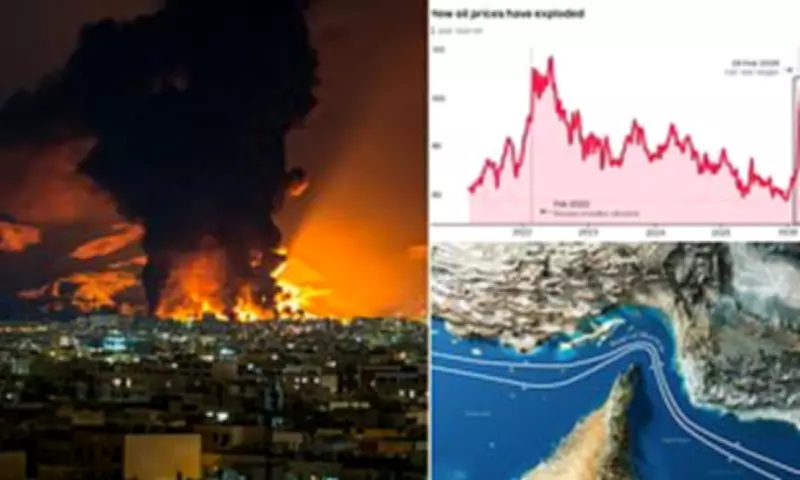
Unprecedented Energy Supply Crisis Grips Global Markets Following Hormuz Blockade
The head of the International Energy Agency has issued a stark warning that the current oil and gas crisis, triggered by Iran's blockade of the Strait of Hormuz, represents the most severe disruption to global energy supplies ever recorded. Fatih Birol, the IEA's executive director, told Le Figaro newspaper that this situation surpasses the combined severity of the energy crises in 1973, 1979, and 2022.
Critical Waterway Effectively Shut Down
The Strait of Hormuz, a crucial maritime passageway between the Persian Gulf and the Gulf of Oman, normally facilitates approximately twenty percent of the world's oil and gas transportation. Iran has effectively closed this vital channel as retaliation against joint US-Israeli military attacks launched on February 28th. Since this de facto closure, energy prices have surged uncontrollably, plunging the global economy into significant chaos and uncertainty.
"The world has never experienced a disruption to energy supply of such magnitude," Birol emphasized during his interview. He highlighted that while European nations, Japan, Australia, and others will undoubtedly suffer economic consequences, developing countries face the greatest risk. These nations are particularly vulnerable to soaring oil and gas prices, escalating food costs, and a dangerous acceleration of inflation rates.

Strategic Reserves Deployment and Nuclear Safety Concerns
In response to the escalating crisis, IEA member countries agreed last month to release portions of their strategic petroleum reserves. Birol confirmed that some of these reserves have already been deployed, with the release process continuing as the situation develops.
Simultaneously, nuclear safety concerns have intensified following multiple strikes near Iran's Bushehr atomic power plant. Rafael Grossi, director of the International Atomic Energy Agency, warned on Monday that attacks in proximity to the operational facility "pose a very real danger to nuclear safety and must stop."
The Bushehr plant, located in southern Iran and equipped with a 1,000-megawatt reactor constructed with Russian assistance, has been targeted four times since the US-Israeli conflict with Iran began. The latest strike, reported by Iranian state media on Saturday, impacted approximately seventy-five meters from the plant perimeter. While satellite imagery analysis confirmed the strike did not damage the reactor itself, Grossi cautioned that such incidents "could cause a severe radiological accident with harmful consequences for people and the environment in Iran and beyond."
Escalating Threats and Diplomatic Deadlock
The crisis has reached a critical juncture with Tehran facing an ultimatum to reopen the Strait of Hormuz by 8pm ET tonight. Former US President Donald Trump has threatened to bombard Iran's energy infrastructure if the blockade persists, declaring in a press conference that he would bomb the country so extensively it would be sent back to the "Stone Ages." Trump elaborated that "every bridge in Iran will be decimated" and "every power plant will be out of business, burning, exploding and never to be used again."
These threats have drawn sharp criticism, with Senate Democratic leader Chuck Schumer describing Trump's rhetoric as "ranting like an unhinged madman" and "threatening possible war crimes." Legal experts have raised concerns about proportionality under international humanitarian law, noting that systematic destruction of civilian infrastructure could violate established wartime protocols.
Diplomatic efforts have thus far yielded minimal progress. Tehran has rejected a proposed deal mediated by Pakistan that would have implemented a forty-five-day pause in military strikes in exchange for reopening the strategic strait. Iranian foreign ministry spokesman Esmaeil Baghaei stated the US had "destroyed the path to diplomacy" and described peace negotiations as "incompatible with ultimatums and threats to commit war crimes."

Economic Fallout and Market Volatility
The economic repercussions continue to intensify as confidence in a swift resolution diminishes. Global markets, which had initially anticipated skilled diplomacy would soon conclude the conflict, now face renewed uncertainty. The FTSE 100 experienced declines while oil prices surged significantly.
Brent crude, the international benchmark, rose to approximately $111 per barrel, while West Texas Intermediate reached $115 per barrel—its highest level in a month. This volatility reflects growing concerns about prolonged supply disruptions and their cascading effects on inflation, food security, and economic stability worldwide.
The evolving situation presents complex challenges for global leaders, energy markets, and international security frameworks as the world confronts what the IEA describes as an unprecedented energy supply crisis with far-reaching consequences for developed and developing nations alike.