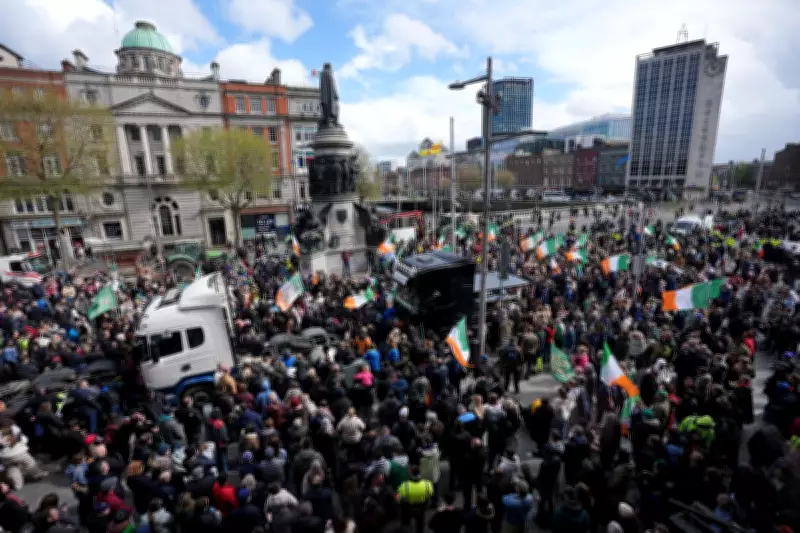
Irish Government Calls Emergency Cabinet Meeting Amid Sixth Day of Fuel Protests
An emergency Cabinet meeting has been convened by the Irish Government as it prepares to finalise measures intended to bring an end to widespread protests over escalating fuel costs. The demonstrations, now entering their sixth consecutive day, have severely disrupted fuel distribution across the country, leading to heightened police responses and multiple arrests.
Nationwide Disruption and Police Escalation
The protests, primarily organised by hauliers, farmers, and agricultural workers, began on Tuesday with coordinated actions including slow-moving convoys on major motorways and blockades of critical infrastructure. Key targets have included Ireland's only oil refinery at Whitegate in County Cork and essential fuel depots in locations such as Galway harbour and Foynes, County Limerick.
An Garda Siochana, the Irish police service, cleared the Whitegate refinery blockade around lunchtime on Saturday, deploying pepper spray during physical clashes with protesters in an operation that lasted approximately one hour. This action restored access for fuel trucks, but similar confrontations occurred at Galway harbour, where hundreds of protesters gathered in heavy rain, using tractors to block access to a fuel depot.

Garda Commissioner Justin Kelly has vowed to intensify enforcement against protesters who are "endangering the state" by obstructing critical national infrastructure. He emphasised that these blockades are not a legitimate form of protest, citing their impact on emergency services, businesses, and the general public due to resulting fuel shortages.
Government Response and Proposed Measures
While protesters' demands for direct meetings with Government officials were not met, relevant ministers held discussions with established national representative bodies on Friday and Saturday. These talks concluded with the outline of a "substantial" package, which is understood to include a temporary fuel transport support scheme and temporary fuel support measures.
The transport support scheme would involve direct payments to businesses in sectors most affected by high fuel costs. Ger Hyland, president of the Irish Road Haulage Association, described the discussions as having "the bones of an agreement" and expressed hope that the package would be finalised by Sunday morning.
The Cabinet is scheduled to meet on Sunday afternoon to formally approve these measures. However, it remains uncertain whether this will be sufficient to persuade protesters to disband their actions before the return of schools on Monday adds further pressure to road networks.
Widespread Consequences and Regional Impact
The blockades have led to significant disruptions, including full closures of sections of the M50 ring road around Dublin and other major motorways. Kevin McPartlan, chief executive of Fuels for Ireland, reported that approximately 600 of the 1,500 filling stations in the Republic of Ireland had run dry by Saturday morning, warning that this number would "grow quite dramatically" if the blockades persisted.
In Rosslare Europort, operations have been affected by a blockade in the nearby town of Kilrane, County Wexford. A spokesperson for Irish Rail indicated that the port is expected to reach capacity by Sunday evening or Monday morning, potentially forcing ships to anchor or divert to alternative ports.
Meanwhile, authorities in Northern Ireland are monitoring social media posts calling for similar protests there. A PSNI spokeswoman stated that a policing response has been prepared to ensure public safety and minimise potential disruption to the wider community if needed.
In a further escalation of the situation, a small number of Defence Forces personnel with heavy-lift recovery trucks have been placed on standby to assist gardai in moving large vehicles if necessary. This underscores the severity of the crisis as the Government seeks to balance enforcement with economic relief measures to resolve the ongoing standoff.