Australia's Fuel Crisis Exposed as Strait of Hormuz Conflict Threatens Supply Chains
Australia, despite its vast natural resources, is now grappling with a severe fuel crisis that risks leaving cars stranded and planes grounded. The escalating conflict in the Strait of Hormuz, a critical global shipping choke point in the US-Israeli-led war with Iran, has laid bare the nation's dangerous dependence on imported oil and refined fuels.
Prime Minister's Diplomatic Dash for Fuel
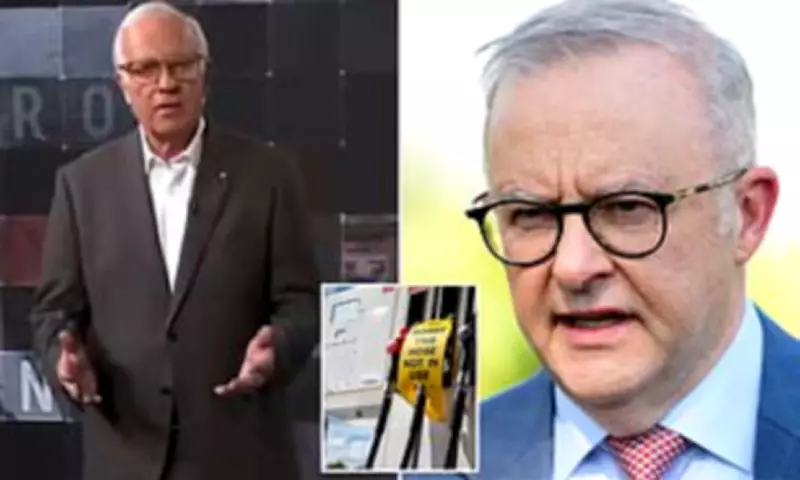
ABC finance reporter Alan Kohler has sharply criticised Prime Minister Anthony Albanese for spending the past two weeks touring Asia 'cap in hand' to secure emergency fuel supplies. Kohler alleges that Albanese is cutting deals to swap Australia's abundant gas for urgently needed petrol, diesel, and jet fuel, highlighting a desperate scramble to keep the country moving.
This extraordinary diplomatic effort underscores what critics describe as a decades-long failure in energy policy, leaving Australia perilously vulnerable to global shocks such as war. According to Kohler, the crisis stems from two fundamental and unavoidable truths that have been ignored for years.

The Twin Failures: Exploration and Refining
Kohler points first to Australia's abandonment of oil exploration. 'How the hell did resource-rich Australia get into this pickle where the PM has to go around cap in hand to keep our cars and trucks on the road and our planes in the air?' he asked. 'Two reasons. First, over several decades, our explorers gradually stopped looking for oil and looked for gas instead, which is why Anthony Albanese has gas to trade for fuel.'
The statistics are stark. In the 1970s, Australia produced 70 percent of its own oil. Today, that figure has reversed, with 90 percent of oil now imported, even as the nation has become the world's second-largest gas exporter. Kohler warns that untapped gas reserves could remain buried forever without renewed exploration efforts, cutting off potential new supplies.
The second critical failure is the collapse of Australia's domestic refining capacity. 'We used to have 10 oil refineries, now there are two,' Kohler stated. 'One-by-one, eight of them closed, and despite an energy white paper in 2004 that warned we'd be caught short one day, the government did not have the stomach or the money to keep them going.'
Consequently, Australia now imports most of its refined fuel, with the two remaining refineries in Geelong and Brisbane relying almost entirely on imported crude oil. Kohler describes these facilities as 'marginal' and at risk of closure at any time.
Strategic Reserves and Global Implications
Compounding the issue is Australia's failure to maintain adequate strategic fuel reserves. Under the International Energy Program signed in 1974, Australia committed to holding at least 90 days of the previous year's oil imports in reserve. 'But for more than a decade, we've been the only country to consistently fail to do that,' Kohler revealed.
When the Strait of Hormuz closed seven weeks ago, Australia had less than half of that mandated reserve. 'Which is why the Prime Minister is doing an Oliver Twist, asking for more please,' Kohler remarked.
The Strait of Hormuz is a vital artery for global trade, carrying more than 100 cargoes daily of essential gas, fertiliser, and chemicals, along with one-fifth of the world's oil supply through a narrow bottleneck along Iran's coastline. Any disruption here sends shockwaves through the global economy.
Prime Minister Albanese has thrown Australia's support behind an international mission to keep the strait open, warning that any move by Iran to impose charges or tolls on transiting vessels would upend global commerce. 'We want to see the Strait of Hormuz opened and we want to see no privatisation and no tolls,' Albanese declared. 'Freedom of navigation is essential for global trade. It is how the world operates, not just in fuel but in other areas as well.'

Current Stockpiles and Economic Warnings
Energy Minister Chris Bowen reported over the weekend that 61 fuel tankers are currently en route to Australia, up from 57 the previous week. Current stockpiles stand at approximately 46 days of unleaded petrol (a 10-day increase since February 28 when the Iran war began), 31 days of diesel, and 30 days of jet fuel.
However, AMP chief economist Shane Oliver issued a stark warning about the global oil supply crunch. 'The last ship load of oil to leave the Gulf before the War started is now getting refined into fuel,' he explained. 'Our rough estimate is that if the flow of oil through the Strait does not quickly resume we could survive till late next month but beyond that fuel rationing would likely be required.'
This looming deadline underscores the urgency of Australia's situation. The nation's fuel security, once taken for granted, is now a pressing geopolitical and economic issue, demanding immediate policy attention and long-term strategic planning to prevent future crises.