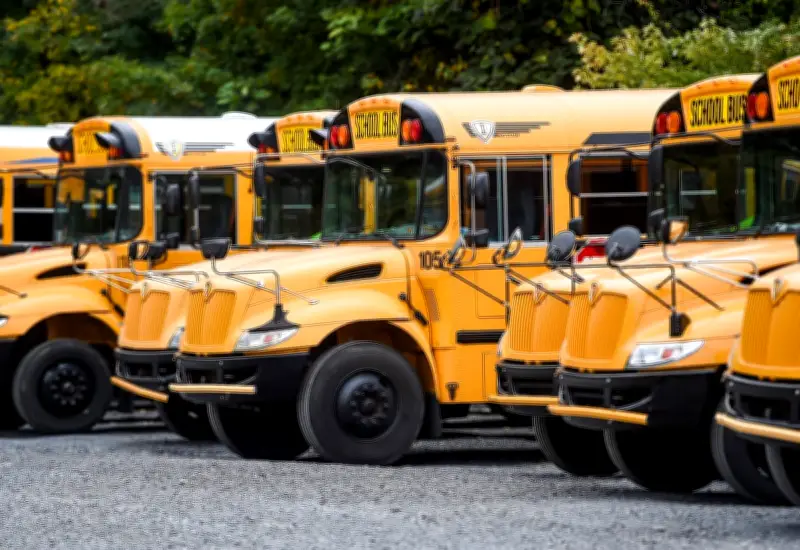
School districts across the United States are increasingly finding it difficult to provide student transportation, a challenge that has intensified in recent years due to a shortage of bus drivers, budget constraints, and the expansion of school choice.
Routes reduced and services scaled back
This year, officials in states including Arizona, Connecticut, Florida, Idaho, New Jersey, New York, Ohio, Oregon, and Virginia have either reduced or proposed cuts to student transportation services. The consequences extend beyond inconvenience for parents; researchers note that transportation problems can lead to worse academic outcomes and higher absenteeism.
“It’s an especially important thing for families who don’t have reliable forms of transportation or others who they can regularly turn to for help,” said Jeremy Singer, assistant professor of education at University of Michigan-Flint, who has studied school transportation and absenteeism. “If schools reduce their school bus offerings, that means more families driving, which means more money on gas, more traffic and more emissions.”
Driver shortages and budget gaps
According to a 2025 report from the Associated Press-NORC Center for Public Affairs Research, 80% of US districts have seen their transportation operations affected by bus driver shortages, and 73% have been affected by budget shortages. The study was conducted in partnership with HopSkipDrive, a school rideshare company.
Experts trace many of the problems to the Covid-19 pandemic, when remote learning reduced the need for bus drivers. Many drivers found other jobs and did not return when schools reopened. In August 2019, there were more than 223,000 US school bus drivers, according to the Economic Policy Institute; by August 2025, that number had fallen to 202,000, a 9.5% decrease.
“If you want to drive to make money, it’s a lot easier to drive for Uber or Lyft than it is to drive a school bus,” said Sarah Cordes, a Temple University associate professor who studies education and urban policy. “Driving a school bus requires all kinds of training,” and “it’s not an easy job if you are dealing with a vehicle full of children.”
Rising costs and enrollment declines
Public education systems have also been affected by inflation and increased gas prices. During the 2025-26 school year, more than half of school district leaders said their diesel fuel costs exceeded budgeted amounts, according to a survey from the School Superintendents Association. A quarter said they had to cover overruns by transferring funds from other programs, and 19% used reserve funding.
Enrollment has decreased due to declining birth rates and parents increasingly sending children to private or charter schools or homeschooling, Singer said. That decline means districts receive less tax revenue. Unlike other expenditures, districts have difficulty reducing bus routes because students remain dispersed geographically, Cordes noted. Cutting routes would require existing drivers to expand routes, lengthening transit times.
“Theoretically you could reduce routes but then depending on where kids live relative to each other and relative to school, that could mean that you have kids on the bus for an hour, an hour and a half, two hours,” Cordes said. “If kids are on the bus for more than an hour, that is not good for their attendance.”
New approaches and regulatory hurdles
Districts are experimenting with alternatives to traditional yellow buses, including student-focused rideshare companies like HopSkipDrive that use small vehicles. However, regulations pose a challenge. The federal School Bus Safety Amendments passed in 1974 require that new vehicles carrying 11 or more persons meet the same motor vehicle safety standards as school buses.
The Heritage Foundation, a conservative thinktank, has called for repeal of the law, arguing that states need “more tools in their transportation toolbox than yellow buses to meet the modern challenge.” The National Association of State Directors of Pupil Transportation Services disagreed, stating that the law improved safety and that “using vehicles other than school buses compromises student safety and heightens the potential for disastrous crashes.” Singer noted that such regulation creates additional costs for safety features and limits flexibility.
Ohio’s transportation crisis
Ohio is among the states grappling with a significant bus driver shortage. In 34 districts, fewer than 10% of vacant bus driver positions were filled, according to a report published in June from the Ohio pupil transportation workgroup. Transportation cost Ohio districts an average of $1,273 per student during fiscal year 2026, an almost 5% increase over the previous year.
Meanwhile, the state’s public school district enrollment decreased by almost 100,000 students between 2016 and 2025, and 124 districts projected negative cash balances by 2029, the worst rate since the Great Recession, the Columbus Dispatch reported. Ohio still requires public schools to transport students who attend charter and private schools.
During the most recent school year, Ohio districts labeled more than 22,000 students “impractical to transport,” allowing them to pay families instead of transporting them. The workgroup recommended phasing out that designation and establishing “a clear statewide policy that every transportation-eligible student receives safe and reliable transportation.” The report suggested coordinating with families to identify centralized pickup and drop-off points and reviewing the bus driver training model to compress the timeline.
Columbus City Schools transports 20,000 students to its schools and 8,000 to private and religious schools, according to Michael Brown, the district’s chief of communications and engagement. School officials are considering reducing service to high school students because of high costs, Brown stated, adding that eliminating the impracticality option would create a new unfunded mandate. Meanwhile, Ohio’s governor, Mike DeWine, a Republican, in 2025 approved legislation that caps school district funding when property values increase, a measure expected to reduce revenue for schools by at least $1.7 billion over three years, according to Ideastream Public Media.
“We continue to be concerned about the state’s lack of full, fair funding to meet the actual costs” of transportation, Brown stated in an email to the Guardian. Cordes said districts must “weigh the costs and benefits of expanding access,” noting that while more students may get to school, that “might take away from the district’s ability to spend money on other important things that have to happen in the classroom.”