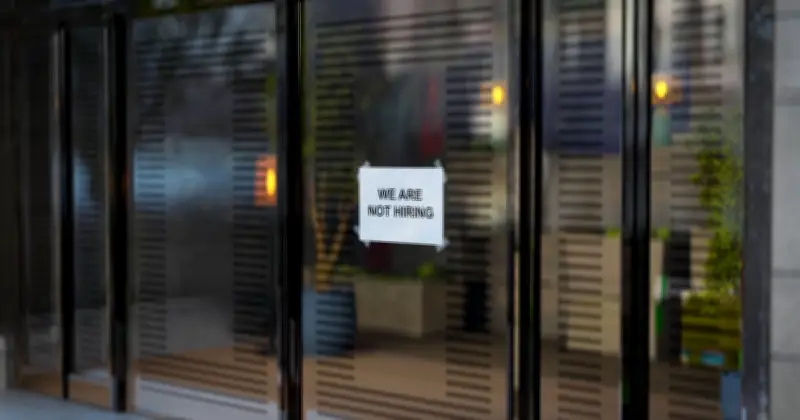
UK job vacancies fell in the latest quarter as small businesses put hiring on hold, with early estimates for May to July 2026 suggesting a decrease of 6,000 (0.8%) to 707,000, compared with February to April 2026. Excluding the pandemic, vacancies are now at their lowest level since late 2014.
Small business owners explain why they're not hiring
Small business owners from multiple sectors have shared why they're not hiring, with punitive taxation, stricter employment laws and economic uncertainty key factors. But they said AI was also a contributor, with one noting his firm has grown rapidly "with zero new hires".
In a report published this morning, the Office for National Statistics (ONS) said its Vacancy Survey suggests that some small firms may not be recruiting because of increases in labour costs and other operating expenses. It added that, outside of the coronavirus (COVID-19) pandemic period, the last time there were 707,000 or fewer vacancies was in September to November 2014, when there were 703,000 vacancies. Meanwhile, the unemployment rate held at 4.9%.
Experts and business leaders weigh in
Liz McKeown, director of economic statistics at the ONS, said: "Vacancies remain broadly flat, though a small fall in the latest period puts them at the lowest level in more than five years. The latest decrease was driven mainly by smaller businesses, which cite labour and operating costs as reasons for not hiring new staff or replacing leavers."
Thomas George, director of Mansell McTaggart, an estate agency firm covering Sussex, described dwindling job vacancies as "entirely predictable" for a number of reasons. He continued: "The Employment Rights Bill, rising employer National Insurance (NI) and stricter dismissal rules have made every new hire feel like a gamble businesses can't afford to lose. When the numbers get tight, the first to go is the marginal hire, the apprentice, the entry-level candidate, the person you were going to take a chance on.
"And with AI getting cheaper and more capable by the month, the question has shifted from 'who do I hire?' to 'what can I subscribe to?' We're taxing the very thing we say we want more of and paying the price in a generation locked out before they've even started."
Impact on entry-level jobs and future hiring
Kelly Smallcombe, fractional chief people officer at Meliorem HR Consultancy, agreed with George that no small business would be surprised by the vacancy figures. She added: "Businesses warned this would happen since the Employment Rights Bill and NI rises landed and uncertainty over what's still to come makes any headcount commitment feel riskier to unwind. People are now the most reversible line in the budget, that's a bad place for the labour market to concentrate its slack.
"It's rational: unfair dismissal changes mean less time to judge fit, employees cost more, and employers will wait to see what else lands before committing. That caution was foreseeable and avoidable. This also hits people already in work, who absorb the extra load from fewer hires, stretching the employed while shutting out the unemployed."
Zac Santer, director of South Digital, a website developer based on the south coast, said his firm had been growing rapidly over the past year "with zero new hires". He continued: "AI does have a big part to play for that, which I do feel bad about. But as a digital agency owner, if AI can do certain tasks faster and often to a higher standard, we'd be silly not to use it.
"Our remote staff are still in the driving seat, but they're now driving a Ferrari rather than a pedal car. I anticipate we'll need to hire again in the next couple of months but we'll be looking for senior people who are also AI proficient. In sectors like mine, entry-level jobs are being wiped out quickly. There's far less skilling up and training on the employer's dime."
Stephen Perkins, managing director of Norwich-based Yellow Brick Mortgages, said "small businesses haven’t stopped wanting to grow, but there are now more hurdles to overcome to achieve that growth". He added: "Higher employment costs, employer NI and wider operating expenses all raise the bar for taking on another employee. Businesses are also asking whether technology and AI can help them grow without adding the same costs. When confidence is fragile, every new hire becomes a much bigger decision."
Tony Redondo, founder of Newquay-based Cosmos Currency Exchange, pointed the finger firmly at Labour: "As Chancellor Denis Healey said back in the 1970s, 'we will squeeze them until the pips squeak'. Labour's first two budgets have piled £66bn of extra tax on business, largely landing on employers, and it shows: job vacancies have fallen to 707,000, a level unseen outside the pandemic since late 2014." Mr Redondo added that for many firms these days, "the maths simply doesn't work".
Ben Perks, managing director of Stourbridge-based Orchard Financial Advisers, said: "If the government loosened the noose around business owners' necks, this vacancies stat would shift quickly. Lower vacancies are the result of a stumbling economy and the rising cost of hiring."
Tony Sanchez, founder of Bridging Loan Directory, a publisher, said: "For a small firm, taking on someone new is a much bigger commitment than their salary alone suggests. National Insurance, pensions, employment costs and general overheads have all risen, while many businesses still lack confidence about future demand.
"AI may help some firms avoid adding administrative roles, but I think cost and confidence are the bigger factors. Many employers are probably choosing to work their existing teams harder until the outlook becomes clearer."
Graham Nicoll, financial planner at NCL Wealth Partners, believes a lot of firms may wait and see what is unveiled in the Budget later this year before taking on new jobs. He said: "A culture of fear and uncertainty tends to put the brakes on people and businesses taking action and making decisions. For most SMEs, I suspect caution will remain until after the Budget. Businesses need greater certainty over the direction of tax and economic policy before they have the confidence to invest and hire again."
Matt Coulson, founder of Rickmansworth-based Heron Financial, cut straight to the chase: "This is what happens when you make employing someone more expensive just as automating gets easier."