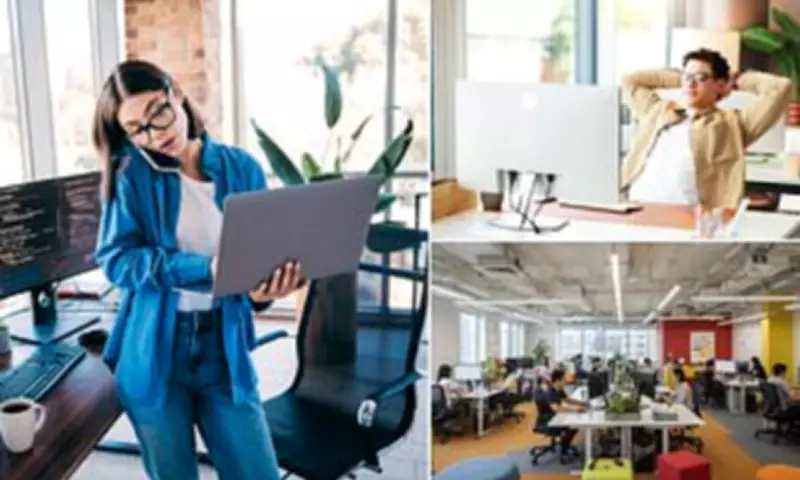
The Office Gender Gap: How Workplace Design Disadvantages Women
Modern offices present themselves as sleek, neutral spaces optimized for productivity. Yet beneath this standardized facade lies a surprising reality: many workplaces remain fundamentally designed around a narrow template - a 40-year-old man weighing approximately 154 pounds, sitting at a fixed-height desk in an environment cooled to his specific metabolic rate. This historical default has created systemic disadvantages for women that extend far beyond mere discomfort.
The Temperature Trap: Air Conditioning's Gender Bias
Office thermal standards present one of the most pervasive examples of this design bias. Stephanie Alston, a workforce equity and inclusion expert, references a 2015 PNAS study revealing that office thermal standards typically derive from metabolic rates of 40-year-old men. "In practice, this means many women work in environments calibrated for someone else's physiology," Alston explains.
Workplace strategist Liane Davey elaborates: "Over-air-conditioning offices results in performance deficits for women, particularly in cognitive tasks. Women continue expending energy just to stay warm." This thermal mismatch forces women to burn mental bandwidth regulating body temperature instead of focusing on work responsibilities.

Shampaigne Graves notes the historical origins: "Thermal formulas in modern buildings developed in the 1960s using resting metabolic rates of 154-pound men. The air conditioning literally makes women less productive while men stay comfortable. That's not just a gender issue - it's a business problem."
Furniture Failures: When Standardization Means Exclusion
Walk through corporate offices and you'll encounter uniform rows of desks and chairs. While standardization saves costs, it assumes physical sameness that doesn't exist. Eric Prendergast, co-founder of Pacific Tusk Builders, observes: "Many offices were built for and designed by predominantly men. Desks, chairs, and furniture are standard across the board, mostly suited to average male frames."
Alston adds: "Standard office chairs often fit average male bodies. Desk heights and standing desks frequently don't adjust to accommodate petite women." The consequences accumulate through daily micro-discomforts that dilute attention, reduce productivity, and increase errors.
Davey summarizes the impact: "Chairs that are too small, desks that are too high, and mice that don't fit women's hands cause distractions that reduce productivity. It's a subtle but relentless drag on performance."
The Emotional Toll: Invisible Labor in Open-Plan Spaces
Physical design represents only part of the challenge. Open-plan layouts, once celebrated as collaboration utopias, amplify expectations that women will remain helpful, accommodating, and emotionally steady even when overloaded. Davey explains: "Optimal performance requires minimizing thoughtload - the invisible tax from distractions, emotional triggers, and energy drains. Office environments often prove problematic for women across all three areas."
Research indicates that "surface acting" - suppressing frustration and performing positivity - significantly contributes to burnout. "Women are expected to help. Women are expected to put on a show," Davey notes, describing how emotional labor compounds physical discomfort.
Return-to-Office Mandates: Amplifying Existing Inequalities
If physical workplaces reflect male defaults, return-to-office mandates risk reinforcing these disparities. A Modern Health national survey found 74% believe RTO makes working mothers' workforce participation harder, while 69% say RTO disadvantages mothers more than fathers.
Dr. Jessica Watrous, Chief Clinical Officer at Modern Health, states: "RTO mandates expose cracks in workplace support for women. Most working mothers carry dual physical and mental loads of professional and caregiving responsibilities. Companies ignoring this reality risk accelerating burnout and driving experienced women from the workforce."

Clothing as Compensation: Navigating Male-Coded Spaces
Even clothing reflects adjustments women make to navigate male-coded environments. Yulya Konoval, founder of womenswear brand BÚDZIKO, explains: "Women often adjust outfits to appear more 'serious' or authoritative for equal respect. Clothing becomes a tool to navigate environments not originally designed with women in mind."
When thermostats won't change and furniture won't fit, wardrobes become coping mechanisms. Graves bluntly observes: "Women spend their own money compensating for institutional design failures. That's not empowerment - that's a tax."
Alternative Perspectives: Is This Conscious Design or Poor Implementation?
Not everyone agrees offices are consciously designed "for men." Tom Oddo of Northeast College of Health Sciences argues modern workplace standards aim to accommodate diverse body sizes. The real issue, he suggests, involves companies cutting corners with fixed-height desks, limited adjustability, and cost-saving standardization.
"The issue is less about offices being designed for men, and more about whether they're designed - and implemented - well enough to support the full range of people using them," Oddo contends.
Moving Forward: Designing for Human Variability
Companies successfully accommodating women rethink design entirely. Prendergast reports his firm increasingly works with female design leads, incorporating features like health rooms, more equitable amenities, and softer, collaborative layouts. The goal isn't designing "for women" but designing for human variability.
When talented employees become distracted by discomfort, drained by invisible labor, or forced to choose between caregiving and career progression, it affects everyone. As Graves concludes: "When your best talent spends mental energy regulating body temperature instead of closing deals, that's not a women's issue. That's a revenue leak."
The future of work - if truly aiming for human-centric, high-performing environments - cannot afford continuing to design for a default that never reflected the entire workforce.