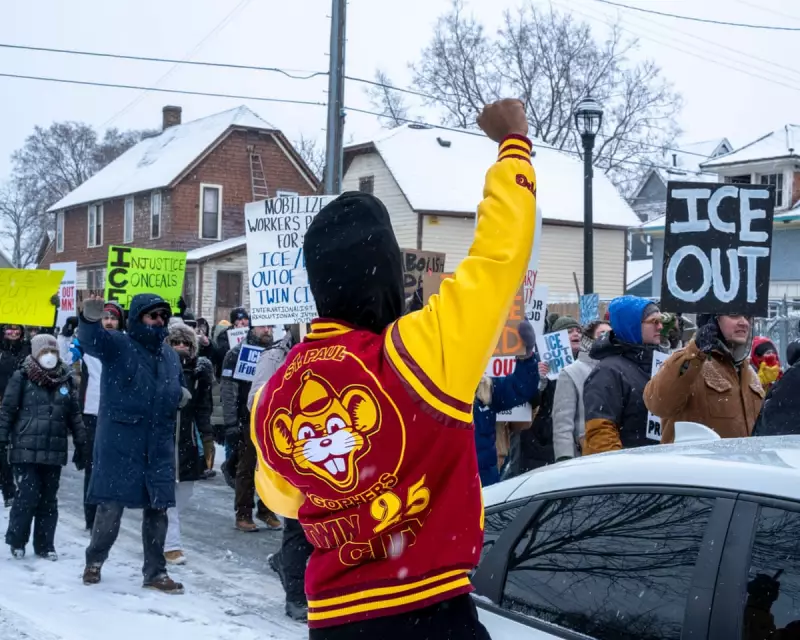
Labour unions, faith leaders, and community organisers in Minnesota have issued a powerful call for a statewide economic blackout this Friday, 23 January. The action is a direct protest against what they describe as an unprecedented surge of federal immigration agents in the state and to mourn Renee Good, a 37-year-old woman fatally shot by an ICE officer in Minneapolis earlier this month.
A Day of Refusal: No Work, No School, No Shopping
Organisers are urging all residents of Minnesota to refuse to participate in the economy this Friday. The call is for people to not go to work, not attend school, and not shop. The protest is a response to the Trump administration's deployment of roughly 3,000 federal agents to Minnesota, which it labels its largest immigration enforcement operation to date. This has led to the arrest of more than 2,400 people in recent weeks.
"There is an unprecedented and outrageous attack being waged against the people of Minnesota. I have never seen anything like it in my life," said Kieran Knutson, president of Communications Workers of America (CWA) Local 7250 in Minneapolis. He condemned the situation as "an outrageous acceleration and escalation of violence toward working-class people."

Labour Leverage and Corporate Silence
The protest has garnered significant backing from major labour organisations. The CWA, which represents employees at firms like AT&T and DirecTV, is joined by Unite Here Local 17 and the teachers' federations of both Minneapolis and Saint Paul. Together, they aim to use collective economic power to send a message.
Chelsie Glaubitz Gabiou, president of the Minneapolis Regional Labor Federation, AFL-CIO, highlighted the human cost: "Union members are being detained commuting to and from work, tearing apart families. Parents are being forced to stay home, students held out of school, fearing for their lives, all while the employer class remains silent."
Knutson expressed hope that the CEOs of Minnesota-based corporate giants—including Target, Best Buy, United Healthcare, and General Mills—would "take notice." None of these companies provided immediate comment on the planned action.
Official Responses and Disputed Narratives
The planned blackout has drawn a sharp rebuke from federal authorities. A Department of Homeland Security spokesperson criticised the move, stating it sought to shut down the economy to "fight for illegal alien murderers, rapists, gang members, pedophiles, drug dealers, and terrorists."
The spokesperson reiterated the administration's claim that Good had "weaponized" her car before the shooting—an account strongly disputed by local leaders and eyewitnesses. Video evidence appears to show Good's vehicle turning away from the officer when he opened fire.
Meanwhile, Minneapolis Mayor Jacob Frey has voiced concerns about the sheer scale of the federal presence, noting that city police are "outmanned and outgunned" and wary of creating "warfare in the street."
The protest will culminate in a march and rally in downtown Minneapolis at 2pm local time on Friday. As organisers from the multi-faith group Isaiah declared, "What we have experienced and are experiencing in the state of Minnesota is not normal." With the White House offering no comment, the economic blackout stands as a stark test of community resolve against a sweeping federal crackdown.