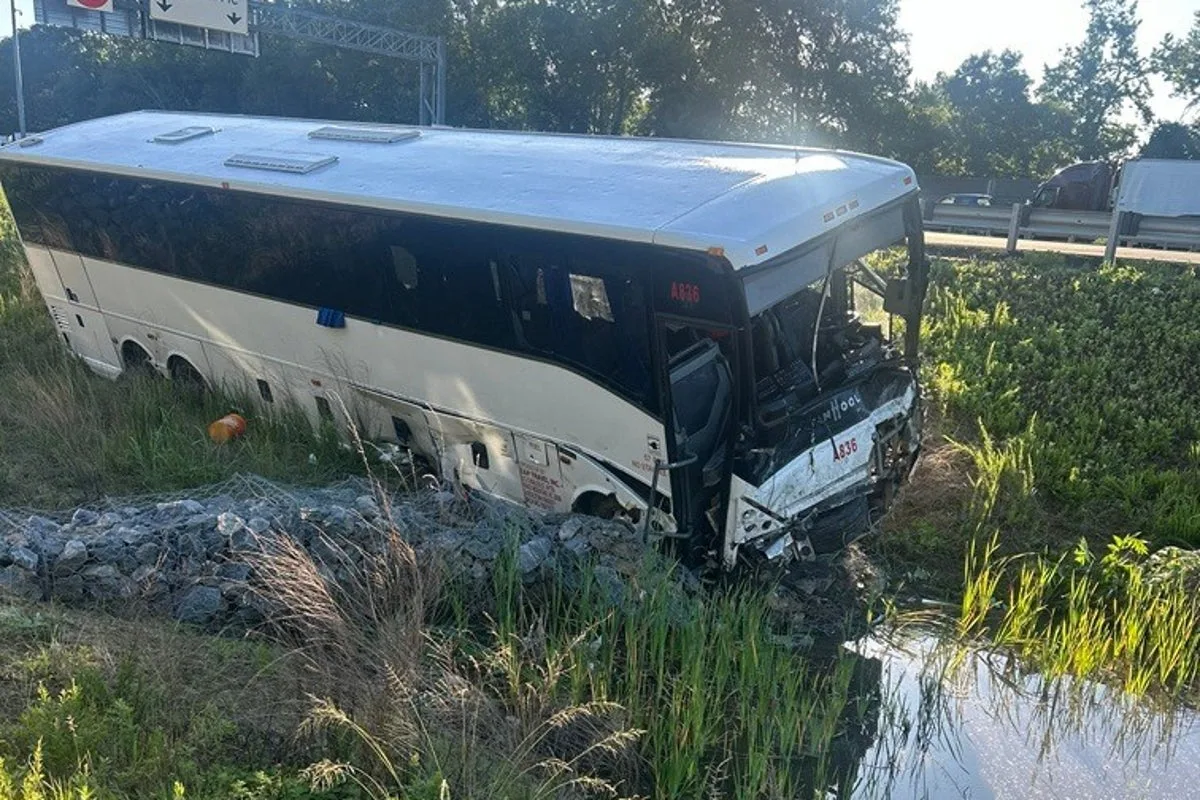
A fatal bus crash in Virginia that killed five people and injured dozens has reignited concerns over commercial bus safety, with experts pointing to a long list of unfulfilled safety recommendations from the National Transportation Safety Board (NTSB). The crash, which occurred early Friday morning, involved a bus operated by E&P Travel Inc. The driver, Jing Sheng Dong, 48, of Staten Island, New York, faces five counts of involuntary manslaughter and one count of reckless driving.
Court records show Dong had a prior conviction for speeding 73 mph in a 55 mph zone in Virginia in 2024, and received a second ticket in March 2025 in Annapolis, Maryland, for driving 72 mph in a 50 mph zone. Despite these violations, he remained employed. Industry experts say such a record would typically lead to dismissal. Fred Ferguson, head of the American Bus Association, noted: “The fact that there was one conviction and another citation and this driver is still on the road goes against industry norms and best practices in a pretty significant way.”
The crash also raises questions about driver fatigue, as it happened around 2:30 a.m., roughly five hours into a trip from New York to North Carolina. Federal rules prohibit bus drivers from driving more than 10 hours or working more than 15 hours without eight hours off. Electronic logs have improved compliance, but tampering remains a concern. Former state trooper Jeremy Disbrow of the Commercial Vehicle Safety Alliance said the timing makes him wonder whether fatigue was a factor.

Another E&P Travel driver, Pei Jie Lu, was involved in a similar crash in North Carolina in 2024, where the bus failed to slow for a traffic control vehicle, injuring nine people. Lu later pleaded guilty to failure to reduce speed. That crash occurred three months after Lu was ticketed in Maryland for negligent driving and unsafe lane changes.
Observers criticise the lack of enforcement of NTSB recommendations, such as requiring collision-avoidance technology and emergency braking systems on commercial buses, which are standard on many new cars. Jim Hall, former NTSB chairman, said: “Everybody walks a walk in talking safety… And then at the end of the day, it’s the same old excuses. And if it costs money, there’s going to be a strong resistance.” Transportation Secretary Sean Duffy has said federal investigators are looking into Dong’s background, the company, and the training school.