
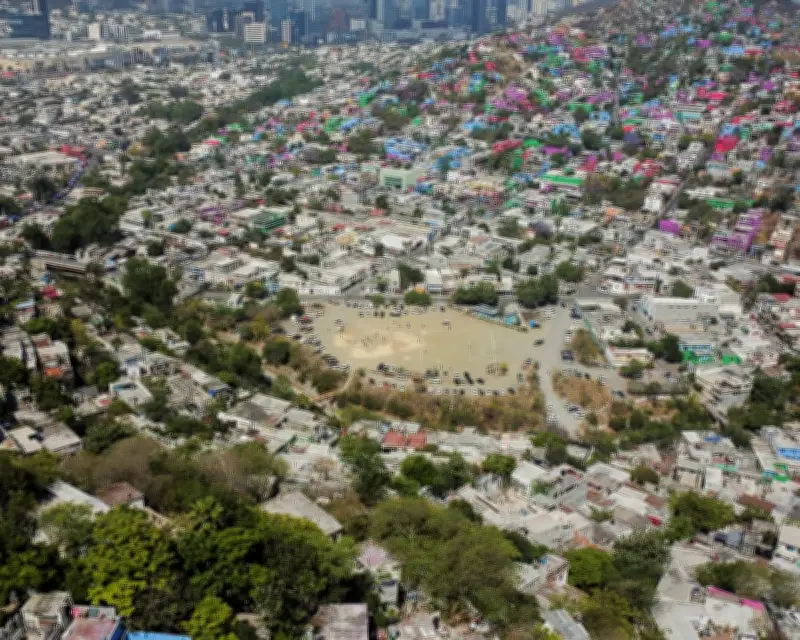
Across Mexico, a co-host of the 2026 World Cup, football pitches are laid out wherever communities can find the space. On the edges of towns, on highway underpasses, and even in a volcano crater, spaces are cleared that allow people young and old to share in the dream of the beautiful game.
Monterrey's Cerro de la Campana
In an impoverished neighbourhood in Monterrey, northern Mexico, 14-year-old Humberto Guadalupe, nicknamed “Messi” by friends and family, spends his weekends on the community’s only football field, surrounded by abandoned cars and dirt roads. Humberto with his grandfather Guadalupe Mendonza Guerrero and his grandmother Maria del Carmen Gutierrez Rodriguez at their house at Cerro de la Campana, Monterrey. Just like the legendary Argentinian player who inspired his nickname, Humberto dreams of becoming a professional player one day, encouraged by his grandmother. “One way or another, it’s going to happen,” he says. “Even when we lose a match, we keep our heads up.”
Pandilleros team members seen warming up through a broken car window before the Cerro de la Campana llanero championship semifinal tie against Bandoleros at Los Pinos football pitch in Monterrey. People watch a match between Bandoleros and Pandilleros. Children from communities near Cerro de la Campana play a match.
Teoca Volcano Crater
To the south, in a rural district on the outskirts of Mexico City, families arrive by car, motorcycle, bicycle and on foot to watch matches at the “Field of the Gods”, a football pitch inside the crater of the extinct Teoca volcano. Mist moves between pine trees and fruit orchards that frame the pitch in the former crater, nearly 700 metres (2,300 ft) above the sprawling Mexican capital. Built by the community more than 60 years ago, it is used by amateur local teams on Sundays.
Players during in an amateur league match between San Mateo and Real Madrid at the Cancha de los Dioses (Field of the Gods), a soccer field inside the crater of the dormant Teoca volcano. San Isidro coach Jorge Baltazar (in blue) talks to his players during a match against Bombay at the Cancha de los Dioses. Aitana Michelle Hernandez Blas and her mother sit as they watch Aitana’s father play.
Xochimilco Canals
In nearby Xochimilco, football players ride in traditional trajinera wooden boats along canals and cross chinampas, the ancient agricultural plots or floating gardens that helped sustain the Aztec capital centuries ago. They are heading to play on some of Mexico City’s last remaining natural grass pitches. Located inside a Unesco world heritage site, the pitches are an important social hub, but their creation can be damaging to the area’s ecology and the habitat of the endangered axolotl salamander, scientists say.
People ride a trajinera towards football fields to take part in amateur league matches. Referees gather before taking part in amateur league matches in the protected Xochimilco area. Emmanuel Dela Rosa, two, looks up at his father during an amateur league game. Emiliano Macedo, 21, wearing a kit inspired by the former Mexican goalkeeper Jorge Campos Navarrete, rests during a break in a match between Mexico and Argentina in the protected Xochimilco area.
Other Unique Pitches
In the Tlatelolco housing complex, a painted football pitch hosts the Sharkes community-led team, promoting sport within the LGBTQA+ community in Mexico City. Hot air balloons drift over a football field near the ancient pyramids of Teotihuacan on the outskirts of Mexico City. The Alberto ‘Chivo’ Cordova University Stadium in Toluca doubles as a giant canvas: the “Aratmosfera” mural, by the renowned Mexican artist Leopoldo Flores Valdés, which is painted directly on to its arches and surrounding rock, blending art with architecture.
In one of the most densely populated areas on the outskirts of Mexico City, at Avioneta Park in Ecatepec, a small aircraft sits beside a barrio soccer pitch. A soccer field at the Sports Unit Luis Donaldo Colosio on the outskirts of Mexico City has the near-perfect circle of the Xico volcano crater, known locally as the “navel of the world”, forming a backdrop. A synthetic football field at a housing complex in Monterrey shows how compact “mini-pitches” are increasingly common in dense Mexican cities.
A pitch at the University Olympic Stadium in Mexico City, declared a Unesco world heritage site, was once the main venue for the 1968 Olympic Games. The Neza 86 Stadium on the outskirts of Mexico City was built for the 1986 World Cup and rises from the crowded outskirts. The Los Pinos football pitch in the Cerro de la Campana, Monterrey, is another example of community spaces. Finally, a pitch on the rooftop of a Costco branch in Mexico City’s Santa Fe business district is part of a layered urban landscape incorporating recreation and sustainability.




