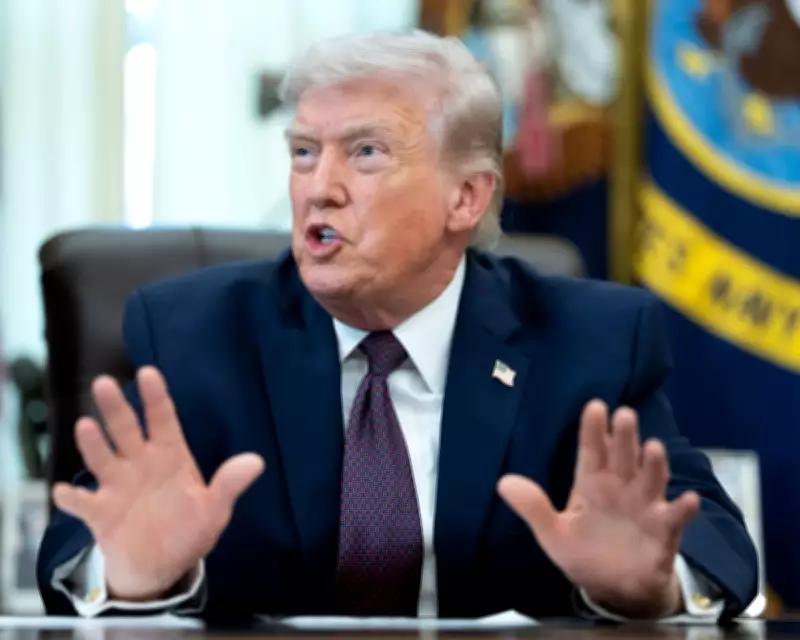
Global financial markets experienced a dramatic shift as former US President Donald Trump declared that the war in Iran would conclude in "two to three weeks," triggering a significant drop in oil prices and a widespread stock market rally. The comments, made on Tuesday, prompted immediate reactions across Asia and Europe, with investors interpreting the statement as a signal of reduced geopolitical risk in the volatile Gulf region.
Oil Prices Tumble Amid Geopolitical Optimism
Brent crude, the international benchmark for oil, plummeted to $98.35 per barrel on Wednesday, representing a staggering decline of more than 15% compared to the previous day. This marked the lowest price point in over a week, though some recovery was observed later in the trading session, with prices settling at $102. The sharp decrease reflects market expectations that a swift resolution to the Iran conflict would alleviate concerns about potential disruptions to oil supplies from the Gulf, a critical region for global energy markets.
Asian Markets Lead Global Rally
Stock markets across Asia surged in response to Trump's optimistic timeline. Japan's Nikkei index jumped by 5%, while South Korea's Kospi experienced an even more substantial gain of 8%. Hong Kong's Hang Seng rose by 2%, and China's CSI 300 index increased by 1.7%. These rallies were particularly pronounced in economies heavily dependent on oil and gas imports from the Gulf, where any threat of supply shortages had previously weighed on investor sentiment.

European Markets Follow Suit
The positive momentum extended to European markets, with the UK's FTSE 100 blue-chip index closing 1.8% higher on Wednesday, recording its most significant single-day gain in nearly a year. The broader Europe Stoxx 600 index, which tracks major companies across the continent, rose by 2.4%. This coordinated upward movement underscored the global nature of the market response to the perceived de-escalation in Iran.
Trump's Comments and Market Interpretation
Speaking about the ongoing conflict, Trump stated, "Now we're finishing the job. I think in two weeks or maybe a few days longer, we'll do the job. We want to knock out everything they've got." These remarks ignited a relief rally in US markets on Tuesday, with the S&P 500 initially surging 2.9% at the opening bell before closing 0.72% higher. The former president is scheduled to address the nation later on Wednesday evening, with markets closely monitoring for further clarification on the administration's strategy.
Expert Analysis and Cautionary Notes
Emma Wall, chief investment strategist at broker Hargreaves Lansdown, noted that financial markets were "choosing to believe the optimism from the White House." She elaborated, "Trump's comments suggest that the US will call victory soon and remove their presence from the region, despite no deal being reached with Iran. While this is expected to provide an immediate boost to stocks, energy disruption would continue for some months, and likely impact both inflation and economic growth." This perspective highlights the potential disconnect between short-term market euphoria and longer-term economic realities.
Broader Financial Implications
The market movements had ripple effects across other asset classes. In the UK, City traders began scaling back expectations for interest rate hikes this year, with money markets pricing in approximately 41 basis points of increases to the bank rate by the end of 2026. This shift suggests investors now anticipate fewer than two quarter-point rate rises, down from 66 basis points priced in just a day earlier. Meanwhile, gold prices continued their ascent, rising 2.5% on Wednesday to over $4,786 per ounce, reaching a nearly two-week high as investors sought safe-haven assets amid ongoing uncertainty.
The collective market response underscores the profound impact of geopolitical statements on global finance, with Trump's timeline for the Iran conflict serving as a catalyst for significant repricing across oil, equities, and interest rate expectations. As the situation develops, investors remain vigilant for further updates that could either reinforce or undermine the current optimistic sentiment.