Oil Prices Skyrocket and Global Markets Nosedive Following Trump's Iran Address
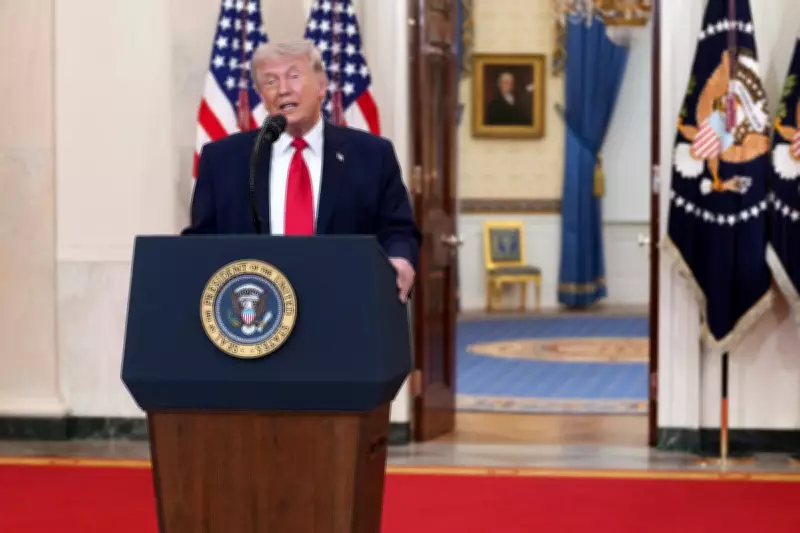
In a dramatic market reaction to escalating geopolitical tensions, US crude oil surged past $110 per barrel and Wall Street futures tumbled sharply on Thursday. The volatility followed President Donald Trump's first national address since the Iran war began, where he vowed to continue military attacks on the Middle Eastern nation for several more weeks, asserting that US "core strategic objectives are nearing completion" even as he described Iran as "really no longer a threat."
Financial Markets React with Widespread Declines
Oil prices experienced a staggering increase, with benchmark US crude rising by $10.11 to reach $110.24 per barrel, outpacing the international Brent crude which jumped over 8% to $109.38. This surge came despite Trump not addressing a looming deadline to reopen the Strait of Hormuz, a critical global oil transport waterway he had previously threatened to target if kept closed.
Equity markets mirrored the anxiety, with US futures indicating a bleak opening: S&P 500 futures fell 1.5%, Dow Jones Industrial Average futures lost 1.4%, and Nasdaq futures slid 2%. The declines extended globally, with European indices like Britain's FTSE 100 down 0.6%, France's CAC 40 falling 1.3%, and Germany's DAX losing 2.4% by midday.

Asian Markets and Commodities Also Feel the Pressure
Asian shares closed lower across the board, reflecting the broad economic unease. Tokyo's Nikkei 225 dropped 2.4% to 52,463.27, while South Korea's Kospi plunged 4.5% to 5,234.05, partly driven by government data showing a 2.2% year-on-year rise in consumer prices for March due to soaring fuel costs. Other regional markets, including Hong Kong's Hang Seng and Australia's S&P/ASX 200, also posted losses.
In a contrasting move, precious metals declined, with gold down 3.9% to $4,627 per ounce and silver losing 6.9% to $70.85. Meanwhile, corporate news added to the downturn, as General Motors slid over 2% after reporting a nearly 10% decline in first-quarter sales, dragging other automakers lower ahead of further earnings reports.
Geopolitical Context and Market Disappointment
The market turmoil was exacerbated by Trump's speech, which analysts criticized for lacking concrete details on ending hostilities. Takashi Hiroki, chief strategist at Monex in Tokyo, noted, "The market has shown disappointment because the speech President Trump made was far less than what the market expected. There were no concrete details about the end of the hostilities with Iran. What the market wants is a clear outline for the ceasefire."
Adding to the tension, explosions were heard in Dubai just before Trump's address as air defenses intercepted an Iranian missile barrage. Concurrently, an Iranian military spokesman, Lt. Col. Ebrahim Zolfaghari, claimed Tehran maintains hidden stockpiles of arms and production facilities, asserting that targeted sites are "insignificant" and strategic locations remain undiscovered.
Thursday marked the last trading day of the week due to the Good Friday holiday, with markets failing to post a weekly gain since the Iran conflict began in late February. The ongoing supply disruptions and geopolitical uncertainty continue to fuel volatility, leaving investors grappling with the economic fallout of prolonged military escalation in the region.