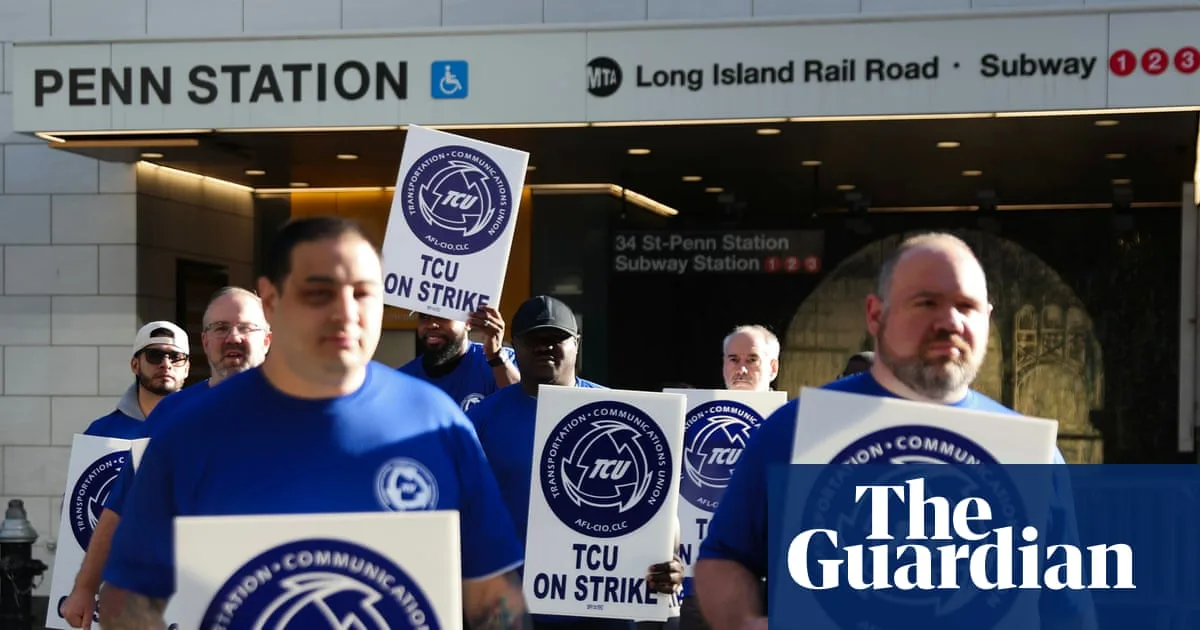
The Long Island Rail Road (LIRR), North America's largest commuter rail system, was shut down on Saturday after unionised workers walked off the job, halting services for hundreds of thousands of daily passengers in the New York metropolitan area.
Five unions representing roughly half of the LIRR's workforce began striking at 12.01am on Saturday, following months of stalled contract negotiations. The Trump administration had intervened in an attempt to broker a deal, but the unions were legally entitled to strike from that time. The walkout is the first since a two-day strike in 1994.
Kevin Sexton, national vice-president of the Brotherhood of Locomotive Engineers and Trainmen, said no new talks had been scheduled. "We're far apart at this point," he said. "We are truly sorry that we are in this situation." Janno Lieber, chairman of the Metropolitan Transportation Authority (MTA), said the agency's last offer "gave the union everything they said they wanted in terms of pay", adding that "we cannot and will not do a deal that shifts huge costs to our riders by forcing fare hikes".
The disruption threatens to affect sports fans planning to attend matches at venues with dedicated LIRR stops, including Yankee Stadium, Citi Field and Madison Square Garden. If the strike continues into the working week, the roughly 250,000 people who use the system each weekday will be forced to find alternative routes, likely leading to congestion on the region's notoriously busy roads.
New York Governor Kathy Hochul said the unions' demands could "raise fares as much at 8%, pit workers against one another and risk tax hikes for Long Islanders". She said: "I stand with the LIRR riders and will fight to preserve the long-term stability of the MTA." Gil Lang, general chair of the Brotherhood of Locomotive Engineers and Trainmen's LIRR committee, countered: "To every LIRR passenger whose trip is disrupted, know that the MTA left us no choice but to strike."
The dispute centres on salaries and health care premiums, with unions arguing that more substantial raises are needed to keep pace with inflation and living costs. The MTA has said its contingency plan offers free limited shuttle buses on weekdays, but this will not cover all normal ridership. Gerard Bringmann, chair of the LIRR Commuter Council, warned that pay increases would "come at the expense of our riders who will see next year's 4% fare increase doubled to 8%". Labour relations expert William Dwyer of Rutgers University noted that Governor Hochul, up for re-election, faces political pressure to resolve the strike quickly, as a significant fare hike "does not bode well" for her on election day.