

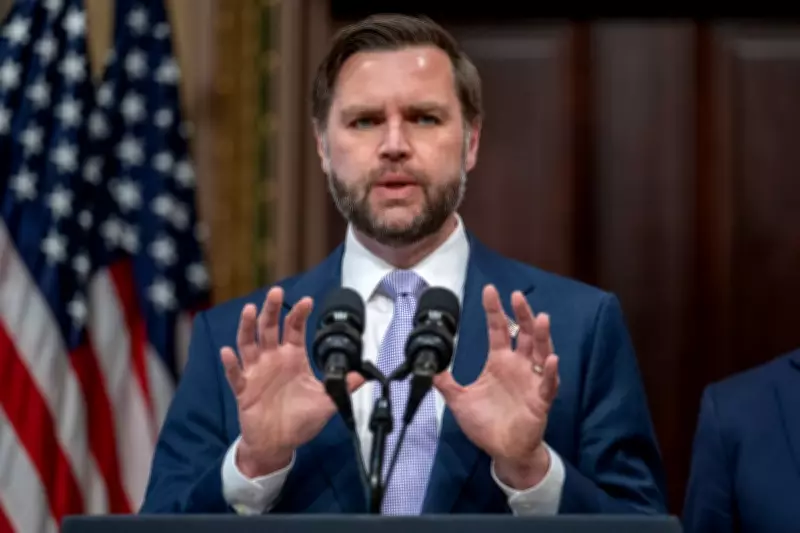
JD Vance has threatened to cut federal funding for government health insurance programs in states that refuse to comply with the Trump administration's anti-fraud efforts. The US vice-president announced on Wednesday that states failing to address suspected fraud could lose Medicaid and Medicare funding, raising concerns that unfounded allegations are being used to punish political rivals.
New restrictions on hospice and home health agencies
The Centers for Medicare and Medicaid Services (CMS) has paused new Medicare enrollment for hospices and home health agencies for six months while investigating potential fraud alongside Vance's taskforce. Vance stated that the administration would review anti-fraud funding for states deemed non-compliant, warning that further resources within state Medicaid programs could be cut.
"Our goal here is not to do that. We don't want to turn off any money," Vance claimed. "What we want to do is ensure that people are taking fraud seriously. We want to protect Medicaid and Medicare, but we cannot do that if states are allowing fraudsters to fleece these programs."

Targeting Democratic states
This follows a crackdown on Minnesota and three other Democratic states, alongside a freeze on new medical suppliers for Medicare. Donald Trump signed an executive order in March to create a taskforce on eliminating fraud. The Vance investigation on Medicaid will include audits of Medicaid Fraud Control Units (MFCUs), which are federally funded watchdog organizations. The audits aim to reveal whether these units are pursuing known abuse of Medicaid.
Attorneys general in all 50 states reportedly received a letter from Thomas Bell, inspector general at the US Department of Health and Human Services (HHS), stating that failure to address fraud could jeopardise state Medicaid funds. More than $300 million in funding was halted to Minnesota in recent months due to alleged non-compliance, though CMS later stayed that hold.
Legal concerns raised
Andy Schneider, research professor at Georgetown University's Center for Children and Families, noted that there is no statutory or regulatory basis for withholding all of a state's federal Medicaid matching funds due to non-performance by an MFCU. He emphasised that CMS does have authority but has never done so and is unlikely to do so. "It's important to watch what CMS does, not what Dr Oz or Vice-President Vance says," Schneider added.
Democratic Representative Lloyd Doggett pointed out that about 850 agents and brokers suspected of fraud were reinstated under the Trump administration. HHS Secretary Robert F Kennedy Jr dismissed that claim as "not a credible story" and focused on alleged fraud by home health aides, including family members receiving payments for caregiving. Kennedy claimed the US is "paying for fraud now as much as for medicine," sparking concern in the disability community.
Impact on caregivers and access
David Perry, a journalist and parent of a disabled adult, argued that Republican anti-fraud programs are not about building capacity to help those in need but about stripping away capacity to punish political rivals. CMS highlighted states with "elevated fraud risk," including Arizona, California, Georgia, Ohio, Nevada, and Texas.
Alice Burns, associate director of the Medicaid and the uninsured program at KFF, noted that while it is not new to scrutinise state-level fraud investigations, this approach differs in its greater reliance on financial penalties for states. Such moves could force states to make difficult decisions on funding Medicaid, potentially affecting providers and enrollees not involved in fraud. Last year, Congress cut nearly $1 trillion in Medicaid spending, the largest decrease in history, removing coverage for 7.5 million low-income people.
Burns cautioned that the announcements are preliminary, and it is uncertain whether federal Medicaid funding will be withheld. However, the deferrals in Minnesota are historically unprecedented, and if the scope increases, there could be implications for access to Medicaid services in affected states.






