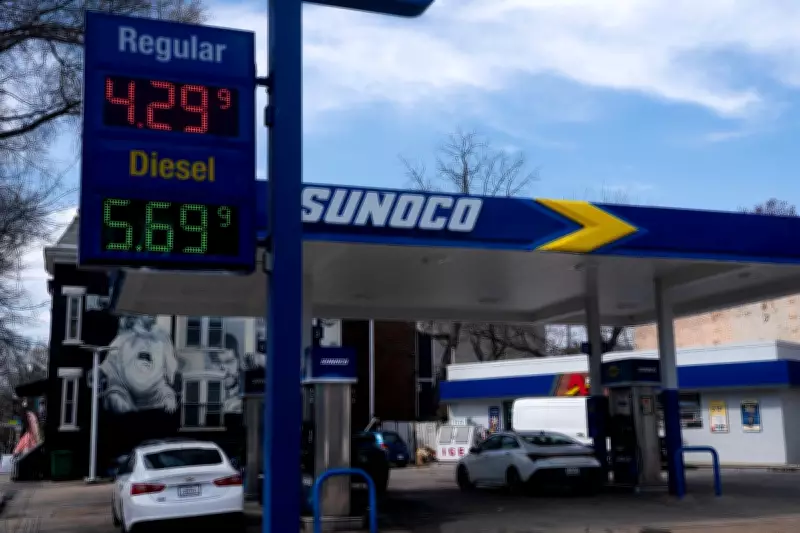
Gas Price Spike Erases Trump's Tax Refund Benefits for American Households
America's economic momentum, initially fueled by substantial tax refund increases from President Donald Trump's tax cut legislation, now faces a severe setback as soaring gas prices threaten to absorb these financial gains. The national average for gasoline reached $3.94 on Sunday, representing an increase of more than a dollar from just a month earlier, directly impacting household disposable income across the country.
Economic Forecasts Dim as Refunds Disappear into Fuel Costs
Economists now predict slower growth throughout spring and the remainder of the year, as funds that would typically support restaurant meals, new clothing purchases, and entertainment are instead diverted to cover escalating fuel expenses. "The energy shock is going to hit those who have the least cushion," explained Alex Jacquez, chief of policy at the left-leaning Groundwork Collaborative and former economist in the Biden White House. "And it doesn't look like those tax refunds are going to be here to save them."
Lower and middle-income households are particularly vulnerable to this economic pressure, as they receive smaller tax refunds while allocating a greater proportion of their earnings to gasoline purchases. This disparity exacerbates existing economic inequalities, with the bottom 10% of earners spending nearly 4% of their incomes on gasoline compared to just 1.5% for the top 10%, according to Pantheon Macroeconomics estimates.

The Rocket and Feathers Phenomenon in Fuel Pricing
Neale Mahoney, director of the Stanford Institute for Economic Policy Research, projects that gas prices could peak at $4.36 per gallon in May based on Goldman Sachs oil price forecasts, followed by gradual declines throughout the year. This pattern reflects what economists term the "rocket and feathers" phenomenon, where prices rise rapidly but decline much more slowly.
In this scenario, the average American household would pay approximately $740 more for gasoline this year, nearly matching the $748 increase in tax refunds estimated by the Tax Foundation. Through March 6, IRS data shows refunds averaging $3,676, representing a $352 increase from $3,324 in 2025, though more complex returns could still boost these figures.
Broader Economic Impacts and Consumer Vulnerability
Oxford Economics analysts estimate that if gas prices average $3.70 per gallon throughout the year, consumers would face approximately $70 billion in additional costs, surpassing the $60 billion in increased tax refunds. This comes at a precarious time for many consumers, with hiring nearly stagnant and Americans' saving rates steadily declining over recent years.
"When you start looking across the perspective from a consumer side, you're seeing people who have maxed out their credit cards, are using 'buy now, pay later' to purchase their groceries," noted Julie Margetta Morgan, president of The Century Foundation think tank. "They're making it work for now, but that can fall apart quite quickly."
Consumer Resilience Tested by Sustained Price Pressures
Despite these challenges, some indicators suggest continued consumer resilience. Data from the Bank of America Institute shows spending on discretionary items like restaurant meals, electronics, and travel continues to grow, though without the acceleration many economists had anticipated. However, spending on gasoline using the bank's credit and debit cards surged 14.4% higher in the week ending March 14 compared to a year ago, reversing a previous 5% decline before the conflict began.
"The longer these gasoline prices persist, the more that will gradually sap consumer discretionary spending," warned David Tinsley, senior economist at the Bank of America Institute.
Revised Growth Projections and Economic Outlook
Oxford Economics economists Bernard Yaros and Michael Pearce have revised their U.S. economic growth forecast downward to just 1.9% for the year, reduced from an earlier estimate of 2.5%. "We had anticipated a lift in spending from a bumper tax refund season," they explained, "but the rise in gasoline prices, if sustained, would more than offset that boost."

While most analysts still expect the U.S. economy to expand this year, the pace will likely be slower due to the gas price shock. Higher fuel costs may worsen inflation in the short term, while weaker consumer spending could gradually slow overall economic growth, testing the resilience that has characterized the American economy through multiple post-pandemic challenges.