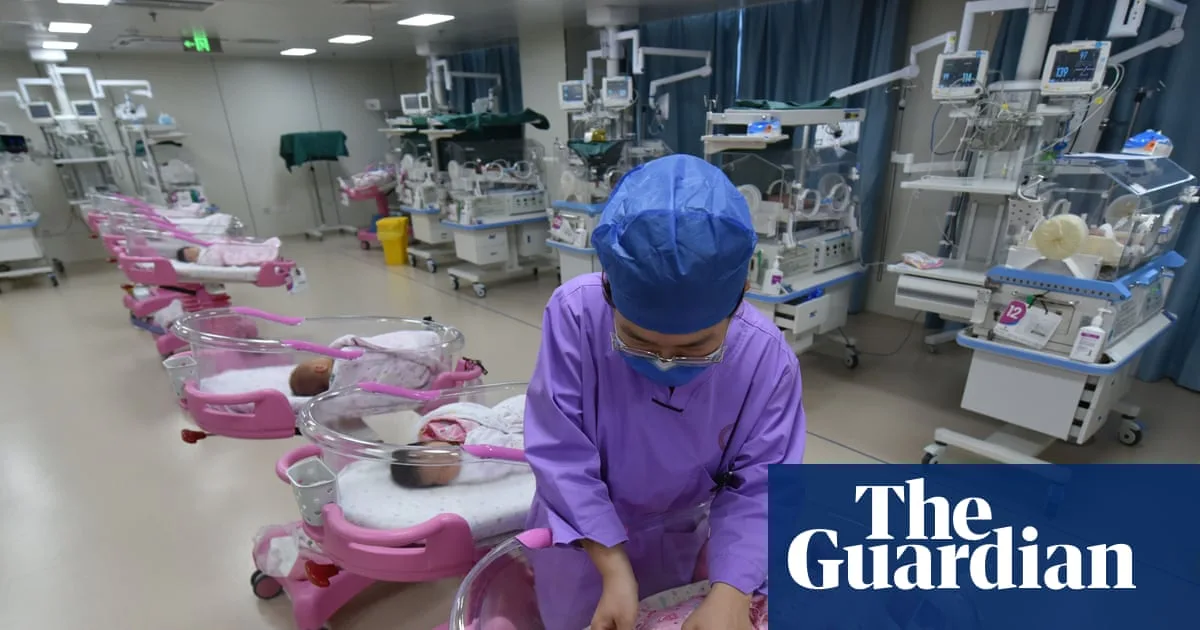
China's population has shrunk for a fourth year in a row, with the number of births plunging to a new historic low, according to the latest official statistics. The accelerating decline deepens anxieties over the nation's rapidly ageing society, its shrinking workforce, and the profound long-term economic consequences.
A Steepening Demographic Decline
Data from China's National Bureau of Statistics (NBS) reveals the population fell by 3.39 million in 2025 to 1.405 billion. This represents a faster rate of decline than the previous year. The driving force behind this drop is a stark fall in births, which plummeted by 17% to 7.92 million in 2025, down from 9.54 million in 2024. Concurrently, deaths rose to 11.31 million from 10.93 million.
The country's birthrate now stands at just 5.63 births per 1,000 people. Demographer Yi Fuxian from the University of Wisconsin-Madison put this into a startling historical context, noting that births in 2025 were "roughly the same level as in 1738, when China's population was only about 150 million". Meanwhile, the death rate of 8.04 per 1,000 was the highest recorded since 1968.
The Looming Challenge of an Ageing Society
The sustained population drop, which began in 2022, is rapidly ageing the nation's demographic profile. This presents a direct complication for Beijing's economic plans to boost domestic consumption and manage debt. People over 60 now account for about 23% of the total population.
Projections indicate that by 2035, the number of citizens older than 60 will reach a staggering 400 million – a figure roughly equivalent to the combined populations of the United States and Italy. This mass exit from the workforce is set to occur as pension budgets are already under severe strain. In response, China has already begun raising retirement ages, with men now expected to work until 63 and women until 58.
Root Causes and Policy Responses
Several interconnected factors are fuelling the demographic downturn. A key leading indicator, marriages, plunged by a fifth in 2024, the steepest drop on record. However, a recent policy change allowing couples to marry anywhere in the country, not just their place of residence, led to a 22.5% year-on-year increase in marriages in the third quarter of 2025, potentially signalling a temporary halt to a near-decade-long annual decline.
Authorities are actively trying to promote "positive views on marriage and childbearing" to counter the long shadow of the one-child policy (1980-2015). Urbanisation, where raising children is more expensive, has compounded the challenge, with China's urbanisation rate reaching 68% in 2025.
Policymakers have made population planning a cornerstone of economic strategy. Reuters estimates that Beijing faces potential costs of about 180 billion yuan (£19.3bn) this year to incentivise births. Measures include a national child subsidy and a commitment that from 2026, women will have "no out-of-pocket expenses" during pregnancy, with all medical costs – including IVF – fully covered by national medical insurance.
Despite these efforts, China's fertility rate remains one of the lowest globally at about one birth per woman, far below the 2.1 replacement rate. This places it alongside other East Asian nations like South Korea and Taiwan. Looking further ahead, the UN forecasts China's pool of women of reproductive age (15-49) will shrink by more than two-thirds to fewer than 100 million by the century's end, signalling that the demographic challenges are set to define China's future for decades to come.