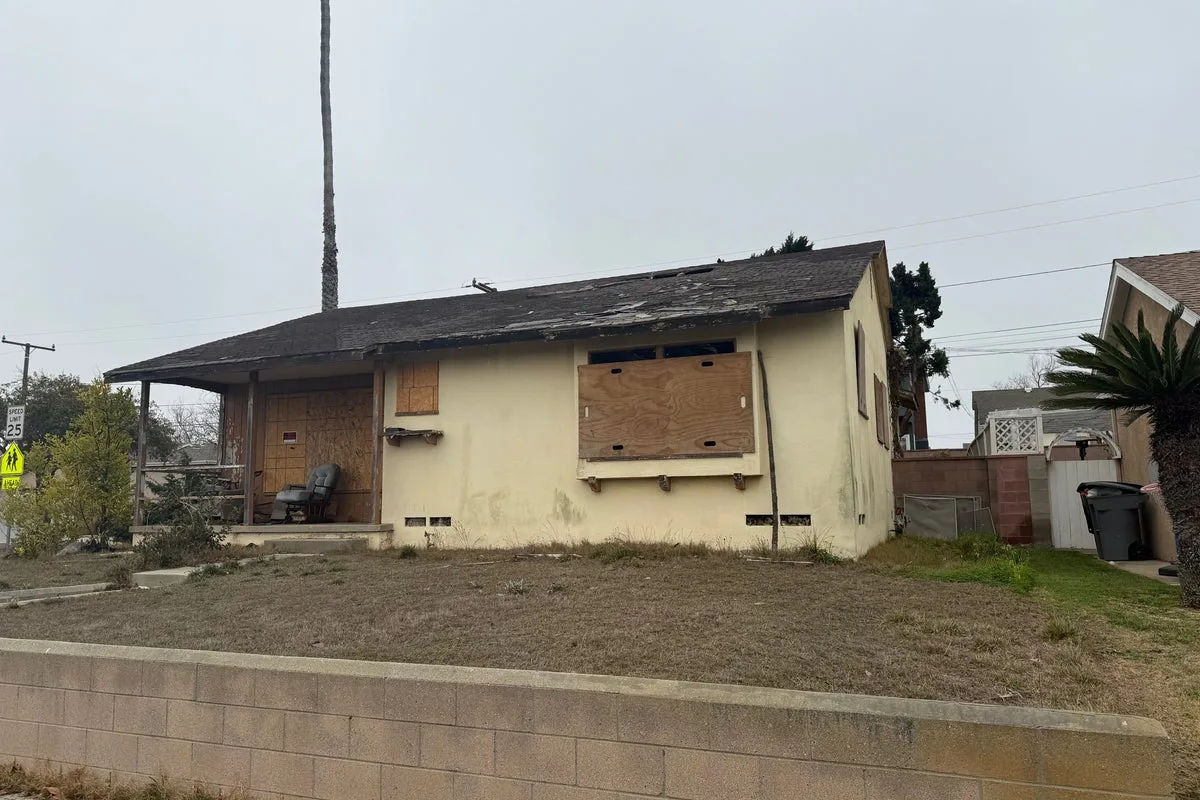
A fire-damaged home on a busy corner in Torrance, Los Angeles, has sold for $1 million, underscoring the severity of California's housing crisis. The boarded-up, three-bedroom, two-bathroom property, which remains unlivable with a gaping hole in its roof, fetched the sum last week, according to property listings.
The ranch-style house, measuring 1,140 square feet, went for 2 percent above its asking price, according to Homes.com. Rhett Winchell, chief financial officer of NDA Real Estate, who handled an earlier auction of the property, described the area as “a nice part of Torrance” and said there had been “tremendous interest” in the house.
The dwelling has been vacant since a fire broke out inside on 1 February 2024. The blaze is thought to have started when a heating grate ignited something in a “dangerously cluttered” interior, forcing an older man, the sole occupant, to escape through a window. He survived the incident but later died, leading to a probate auction last year at which the high bid was $980,000, with a selling price that pushed the total to $1.075 million.
Winchell said that the house “sold for the land value” and that the price was not unusual for the area, where comparable homes in “move-in condition” regularly fetch $1.5 million. The transaction highlights what the California Legislative Analyst's Office calls a “serious housing shortage”, with the median price of a mid-tier home reaching $775,000 in March, more than double the national average of $366,000.
The shortage has been blamed on decades of restrictive planning. Eric McGhee, policy director at the Public Policy Institute of California, said local governments had imposed constraints on new development “in the name of environmentalism or preserving a livable community”, which had benefited individual areas but not the state as a whole. He suggested making construction easier, faster and cheaper, including through modular, factory-based methods.
In the meantime, measures such as allowing accessory dwelling units have been introduced, with such projects now accounting for about 20 percent of residential construction. However, McGhee cautioned that it was unclear whether they were “really helping the housing supply”, as some may be used as offices, “man caves” or short-term rentals. Estimates suggest California needs an additional 2.2 million homes to meet demand.