
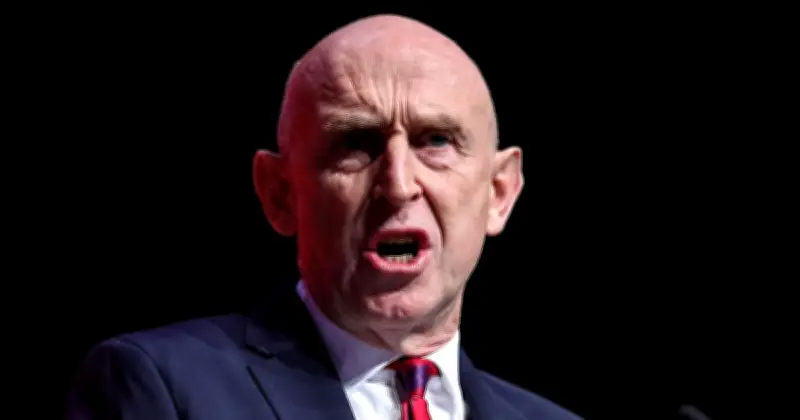
Experts have warned that John Healey could make mistakes in his upcoming Budget that would make him as bad as his predecessor, Rachel Reeves. The former Chancellor faced criticism for introducing a series of tax measures, including raising employers' national insurance contributions and extending the freeze on income tax and national insurance thresholds until April 2031.
Now, Mr Healey is set to deliver his first Budget, and speculation is growing about what it might contain. Economists and campaigners have highlighted several potential missteps, ranging from tax hikes to energy subsidies.
Potential Budget missteps
Professor Len Shackleton, an economics professor at the University of Buckingham and a fellow at the Institute of Economic Affairs, told the Express that Mr Healey could err by failing to provide a clear defence spending plan, hiking capital gains tax, extending the income tax threshold freeze, subsidising energy prices, introducing a property or wealth tax, or boasting about fiscal headroom based on "optimistic" growth forecasts.
"He'll be as bad or worse if he does not present a clear plan and timetable for funding a boost for defence expenditure," Prof. Shackleton said. "Indeed, he'll be worse than her as he had made such a point of resigning as defence secretary. To add to incompetence he'd be displaying blatant hypocrisy. I fear he'll be tempted by pushing up capital gains tax, perhaps to the standard rate of income tax."
He added that such a move would have "all sorts of undesirable effects which would ultimately be passed on to people who never had a capital gain in their life." He also predicted Mr Healey would continue the "stealth tax" by not raising income tax bands and the personal allowance in line with inflation.
Energy subsidies and property taxes
Prof. Shackleton warned that Mr Healey might subsidise energy prices, describing it as "a costly temporary fix which did for Liz Truss." He noted that subsidising energy prices is "insane when a big chunk of energy prices is made up of net zero levies," and that cutting prices would lead to increased consumption of energy, something net zero advocates oppose.
He also mentioned that Andy Burnham has "frequently hinted that he wants some form of property or wealth tax," and if Mr Healey follows this path, he would "definitely be doing worse than Rachel Reeves." Prof. Shackleton concluded: "I expect he will crow that the measures he has taken will, when fed overly optimistic growth forecasts, create increased 'fiscal headroom', something Ms Reeves was inclined to boast about herself."
Campaigners and industry voices
Dennis Reed, director of Silver Voices, an independent campaign group for over 60s, also warned against freezing thresholds, restricting energy support, and failing to adequately fund social care. "The Budget will prove whether John Healey is 'continuity Reeves' or not," he said. "Reeves would have kept the tax thresholds frozen, provided energy support for those on benefits only and provided no extra support for social care. We want to see the lower tax threshold raised by £1,000 at least, the winter fuel payment doubled and a down payment this year on Burnham's commitment to free social care. We shall see!"
Jinesh Vohra, CEO of mortgage app Sprive, urged Mr Healey not to make things harder for homeowners. "Millions of homeowners are coming off cheap fixed rates onto much higher payments, so the last thing they need is a Budget that squeezes them further," he said. He suggested a scheme allowing employers to pay into employees' mortgages tax-free, similar to pension contributions. "For most homeowners, their mortgage is their biggest monthly expense, so this could make a real difference, helping people pay off their mortgages sooner and become mortgage-free faster. On a typical £200,000 mortgage, an extra £100 a month takes more than three years off the term and saves around £24,000 in interest."




