

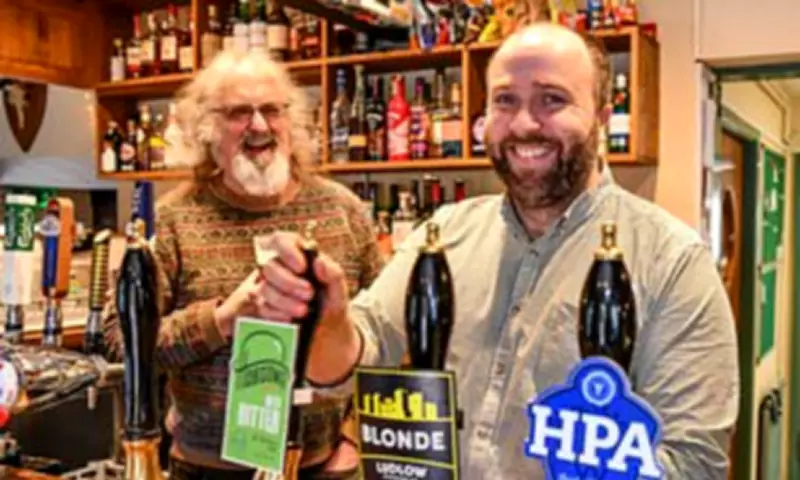
Villagers who purchased £300,000 worth of shares in their local pub to rescue it from demolition and prevent a housing development are now seeing a return on their investment. Residents of Orleton in Herefordshire pooled their resources to acquire The Boot Inn in January 2019, when it faced the threat of being torn down.
Approximately 300 locals invested their savings, which were used to renovate the historic establishment in this leafy village. Shareholders now report that their stake in the pub yields better returns than leaving money in a current account, after investors were offered an attractive 3 per cent interest on their shares.
Regular patron David Harrison, 63, claims his investment outperforms his bank, earning £600 in interest annually—equivalent to 109 pints, which would cost him around £430 at the pub. The retired aerospace engineer, living just four minutes away, stated: "We have over £10,000 invested in shares here, and it's definitely more profitable than a standard bank account. You'd be lucky to get a third of that, if any, while we're getting 3 per cent and the pub stays open—that's a win for us." He added, "The dividend is a lovely bonus, which we reinvest each year into our portfolio. We get £300 twice a year, which is great."

The Community Boot Inn, a community benefit society established to save the pub, set a minimum share value of £250—or five shares—to allow a wide range of locals to participate. A £1,000 investment would yield £30 annually at the 3 per cent rate, whereas the same amount in a Santander current account at 1.98 per cent would earn only £19.80 in a year.
Mr Harrison emphasised the pub's importance: "Ultimately the pub is very important to me and the village. It's where you meet people, sit and chat. We used it when it was previously owned and they wanted to knock it down to build houses." He was among the initial group involved and helped renovate the interior after they "finally succeeded in securing the place." He recalled, "It was the first and only time I've been in a pub with no beer." He added, "To me it was very important for the village to maintain having a useable pub, and I felt compelled to put a reasonable amount of money into it and help out to get the pub back to a useable standard. The benefits of being a shareholder are that you're involved personally while also getting a reasonable dividend. We're very happy—it's a success story supported by the local community."
Fellow investor Guy Holmes-Henderson, 58, a semi-retired landscape gardener, moved to the area around the time of the pub's reopening in August 2019. He said: "One of the main reasons we moved here was the fact that a community pub, like The Boot, had just opened up. It's well supported by the locals, drinkers and eaters, and it's a great place to come in." He became a shareholder about a year ago, adding: "I was supporting the pub by my custom before, but now I'm supporting the pub while helping it to keep going. I do get paid some interest, which is nice. It's far better than a standard account, which nets you nothing when you add it up. You're getting bricks and mortar. I'm the pub gardener so I take pride in getting the garden done knowing that I'm a shareholder."
Local Terry Tandler, 74, a retired handyman, added: "It's much better than keeping your money in the bank—and we're helping the tax man as well, he's struggling. We get to buy extra beer as well. We get interest, but we get to keep the pub open at the same time, have a pint of beer and enjoy singing and music. I come at least once a week, maybe more." Under the scheme, shares are non-transferable and do not change in value, but can be withdrawn.

Community Boot Inn chairman John Alderman, 68, said: "It's an attractive proposition. We bought the place in January 2019, we then had six months of redevelopment, then we had six months of trading before Covid hit. The pub had been shuttered in June 2017 where the guy who owned it wanted to develop it as a building plot. He shut it and put it into liquidation—we were worried that he would use it to clear the debts and then buy it back. The minimum offering was five shares at £50 each. I was damned if I was going to pay more in bank fees than interest—that's why we set it at £250. We started paying interest after two years, we initially thought three years. We were paying 2 per cent after two years. We upped it to 3 per cent in 2025 then everything went mad. As a society, we recommend that the members then vote on it at the AGM. When we started paying interest the current accounts were 0.1 per cent. We were at 2 per cent. It's still better than a current account now."
Landlord Chris Thorpe now runs the pub, having started working there aged 18 in what was his first job. He recalled: "I worked my way up to become manager for the original owner who sadly had different opinions of what it should be turned into. The community saved it and I came back and my wife and I thought it was the perfect opportunity to run our own business—but with the support of it being community owned."





