Wisconsin Pancake House Implements Controversial Cannabis Odour Ban
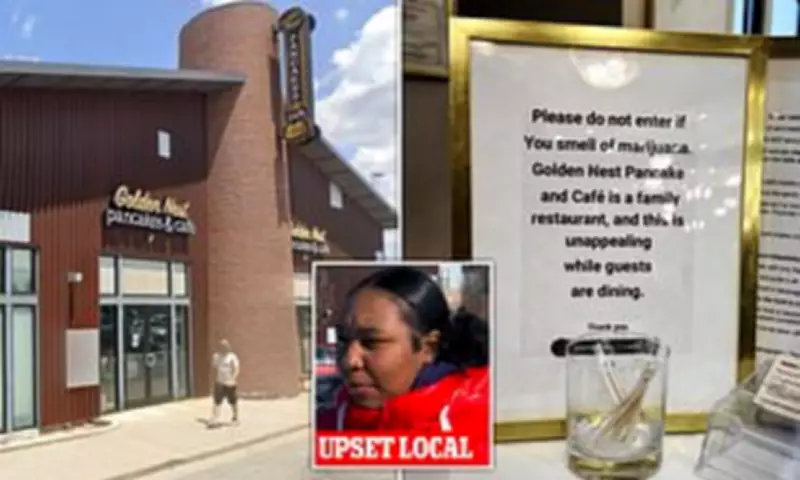
A well-established Midwest diner has ignited a fierce community debate after implementing a strict policy prohibiting customers who emit the scent of marijuana from entering its premises. The Golden Nest Pancake & Cafe in Wauwatosa, Wisconsin, recently displayed a prominent sign stating: 'Please do not enter if you smell of marijuana. Gold Nest Pancake & Cafe is a family restaurant, and this is unappealing while guests are dining. Thank you.'
Management Cites Customer Complaints as Primary Motivation
Wayne Doney, the restaurant's general manager, explained to the Daily Mail that the decision was driven by numerous complaints from other patrons who found the odour offensive, particularly families dining with young children. Doney emphasised that the rule was introduced several months ago following repeated incidents where customers reported smells reminiscent of 'marijuana or a skunk'.
'The smell is offensive to our customers,' Doney stated, insisting the policy is applied uniformly regardless of a patron's background. 'Anyone will be asked to leave. Anyone in general,' he clarified, dismissing suggestions of targeted enforcement.

Allegations of Racial Targeting Emerge Amid Black History Month
Despite management's explanations, several local customers have voiced concerns that the ban disproportionately affects specific demographic groups. Yolanda, a patron who preferred not to appear on camera, told CBS 58 she believes the policy implicitly targets 'a group of young African American individuals'.
'You cannot exclude someone for smelling like marijuana just like you cannot exclude someone for having body odor. I don’t see the difference,' Yolanda argued. She expressed particular dismay that the sign appeared during Black History Month, stating: 'It’s disappointing because you’re gonna start putting that everywhere, basically saying that we are not allowed here. And it’s Black History Month and I’m proud to say that. Take the sign down.'
Regular Patrons Question Policy's Specificity and Intent
Iyani Raines, another frequent customer who considers the diner one of her favourite establishments, told reporters the restriction felt 'very intentional' in its focus on cannabis odour specifically.
'If you have a preference, that’s one thing, but I just don’t feel like everyone’s bothered because we’re not even sitting in close proximity where we can smell one another. It’s a restaurant. It’s gonna smell like eggs,' Raines remarked. She suggested that a broader policy addressing smoke odours in general might have been less contentious, questioning: 'Why can’t I come in and have breakfast? My money is as good as anyone else’s.'
Online Debate Reflects Divided Public Opinion
The controversy has spilled onto social media platforms, where users have expressed sharply contrasting views:
- 'Well if they feel targeted, don't come. Don't smoke,' one Facebook commenter wrote.
- 'Their business, their rules,' another user supported the establishment's prerogative.
- Several questioned why cigarette smokers weren't subject to similar restrictions, with one noting: 'This should apply to cigarette smokers because that smell is ewwwww.'
- Another added: 'Put a sign up for all the cigarette smokers too if that’s the case, this is so stupid.'
Business Impact and Legal Context in Wisconsin
Despite the controversy, Doney reported that the publicity has unexpectedly 'doubled our sales', and the restaurant has no plans to remove the sign. The policy exists within a complex legal landscape where recreational marijuana remains prohibited in Wisconsin, though low-THC and CBD oils are permitted for certain medical conditions.

Democratic legislators have recently introduced bills to fully legalise cannabis in the state, though these face significant opposition from Republican lawmakers who control both legislative chambers. Governor Tony Evers has repeatedly advocated for legalisation, with support from fellow Democrats including Representative Darrin Madison.
'Arresting someone for smoking weed does not make our neighborhoods safer,' Madison recently told Wisconsin Public Radio. 'It limits access to jobs, housing, education and stability for life and … those arrests fall overwhelmingly on Black and brown communities.'
National Cannabis Legalisation Landscape
Currently, twenty-four American states have legalised recreational marijuana use, including prominent jurisdictions like New Jersey, New York, California, and Nevada. Conversely, cannabis remains fully illegal in Idaho, Wyoming, Kansas, and South Carolina, while forty states have approved medical marijuana programmes.
The incident at Golden Nest Pancake & Cafe highlights ongoing national tensions between business policies, personal freedoms, and concerns about equitable enforcement as cannabis laws continue evolving across the United States.